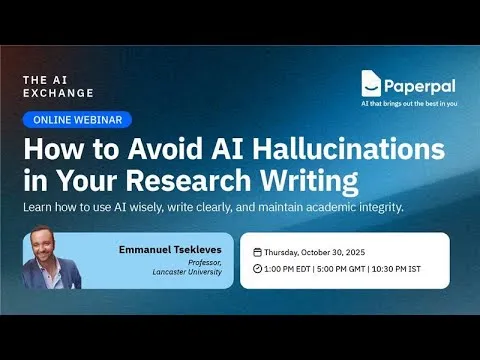
How to Avoid AI Hallucinations in Your Research Writing | AI Exchange Webinar - Paperpal
Based on Paperpal Official's video on YouTube. If you like this content, support the original creators by watching, liking and subscribing to their content.
AI hallucinations in research writing include fabricated citations, misleading facts (wrong numbers/findings), and distorted paraphrases that can shift meaning or certainty.
Briefing
AI hallucinations in research writing aren’t just about fake citations—they also show up as wrong numbers, subtly altered meanings, and misquoted evidence that can damage credibility fast. The core message from the webinar is that researchers should treat AI as an assistant that accelerates drafting and discovery, while verifying every claim that could affect rigor, integrity, or originality.
The session breaks hallucinations into three recurring academic failure modes. First are fabricated citations: AI may invent author–title–journal combinations, including journals that don’t exist or dates that don’t match the underlying work. Second are misleading facts, where statistics or key findings sound plausible but are incorrect—such as a claim about the number of protein-coding genes in the human genome that is far off from the commonly cited range. Third are distorted paraphrases, where small wording changes shift certainty or scope (for example, turning “may contribute” into “causes” and expanding a regional effect into a global one). Those “small” edits can change the scientific meaning and invite retraction-level scrutiny.
Why this matters is framed in career-risk terms. Hallucinated content can trigger editor queries, university investigation, and funding or degree consequences. Retractions are increasingly common, and the cost of fixing problems after submission can outweigh the time saved by using AI in the first place. The webinar also emphasizes that early-career researchers and interdisciplinary scholars are especially vulnerable because they may not know every detail well enough to spot errors in unfamiliar areas.
To reduce risk, the presenter offers a practical verification framework built around a “trust but verify” mindset and an acronym-based checklist. The guidance starts with treating AI output as a draft for human judgment, not authority. It then recommends using AI to generate candidate keywords and search directions, but requiring researchers to apply their own critical thinking and verify results themselves. For statistics and study outcomes, the advice is to cross-check numbers, dates, and key findings against primary sources rather than relying on AI summaries. When summarizing papers or extracting claims, researchers should read the original work—especially when AI reports effect sizes or percentages that may depend on population, geography, or study conditions.
A major theme is “inquiry-based learning” with papers: instead of only asking AI to summarize, researchers can interrogate documents—asking what the main claims are, what research gaps exist, or clarifying confusing terminology. The webinar also encourages building a personal knowledge base by saving and organizing verified sources, so later writing can synthesize without rereading everything.
Finally, the session addresses ethics and transparency. Copying and pasting AI-generated paragraphs directly is discouraged; AI should support brainstorming, outlining, and language refinement while the researcher maintains authorship and voice. For disclosure, it highlights features such as AI “footprints” that help identify which parts were generated or paraphrased, and templates that support proper AI-use statements aligned to different publication contexts.
On the platform side, Paperpal is positioned as an end-to-end workflow tool: drawing from a scholarly repository (not the open web), surfacing relevant papers and paywalled sources, integrating into Microsoft Word, and providing security/privacy assurances that user data isn’t used for model training. The webinar’s bottom line: speed is useful, but only verification, critical reading, and transparent authorship protect research quality.
Cornell Notes
The webinar argues that AI hallucinations in academic writing go beyond fake references: they also include incorrect statistics and subtly altered paraphrases that can change scientific meaning. Researchers should treat AI as an assistant, using it to speed up brainstorming, keyword discovery, and paper triage, but verifying every citation, number, and claim against primary sources. A practical approach emphasizes “trust but verify,” inquiry-based questioning of papers, and building a personal database of read-and-checked literature. Ethical use also matters: avoid copy-pasting AI text as-is, maintain original analysis and voice, and disclose AI assistance using tools that track AI-generated or paraphrased passages.
What are the three main ways AI hallucinations show up in research writing, and why does each one matter?
How should researchers verify AI-provided citations without getting stuck in endless manual searching?
Why are misleading statistics especially dangerous for early-career or interdisciplinary researchers?
What’s the difference between using AI to summarize papers and using it to interrogate them?
How can researchers use AI for writing while protecting originality and avoiding “AI-sounding” text?
What does ethical transparency look like when AI is used in academic writing?
Review Questions
- What are the three categories of AI hallucinations described, and what verification step would you take for each one?
- How does inquiry-based questioning of a paper help reduce the risk of relying on incorrect AI summaries?
- What disclosure and authorship practices does the webinar recommend to keep AI use ethical and credible?
Key Points
- 1
AI hallucinations in research writing include fabricated citations, misleading facts (wrong numbers/findings), and distorted paraphrases that can shift meaning or certainty.
- 2
Researchers should treat AI output as a draft for human judgment and verify every citation, statistic, date, and key claim against primary sources.
- 3
Use AI for efficiency tasks like generating keyword candidates and triaging which papers to read, but apply critical thinking to select what truly fits the research question.
- 4
When AI summarizes studies, writers must read the original paper to confirm effect sizes and conditions (population, geography, and scope) before citing.
- 5
Maintain intellectual authorship by using AI for brainstorming, outlining, and language support—not by copy-pasting AI-generated paragraphs as final text.
- 6
Track and disclose AI assistance using tools that identify AI-generated or paraphrased passages and provide context-appropriate disclosure templates.
- 7
For literature review and proposal work, combine AI-assisted discovery (papers, gaps, structure) with manual reading and manual drafting of the final argument.