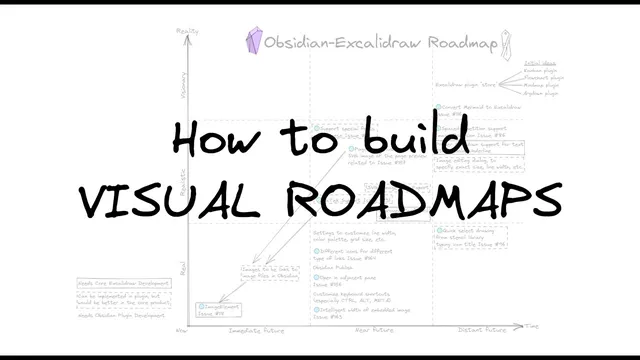
How to Build Visual Roadmaps - A Case Study developing the Obsidian-Excalidraw Roadmap
Based on Zsolt's Visual Personal Knowledge Management's video on YouTube. If you like this content, support the original creators by watching, liking and subscribing to their content.
Use a two-axis template (time horizontally; feasibility/difficulty vertically) to separate today’s deliverables from longer-term, less certain work.
Briefing
A structured visual roadmap turns a messy backlog of requests into a clear, communicable plan—using Excalidraw mind maps to organize the Obsidian-Excalidraw roadmap. The core move is a 2-axis template: the horizontal axis represents time, while the vertical axis represents “reality” (what’s feasible now) versus difficulty (what’s less clear or harder to deliver). Early brainstorming starts as a free-flowing cloud of ideas, then gets reorganized into a 3-by-3 matrix where items naturally trend diagonally—from today’s practical work in the bottom-left toward more visionary or dependency-heavy efforts in the top-right. That diagonal outcome becomes a reality check: ambitious items tend to land later once timing and constraints are made explicit.
The roadmap process begins with reviewing the plugin’s issue log, then layering in additional opportunities gathered from GitHub, Discord, YouTube, and Twitter suggestions. As the list nears completion, ideas are grouped and linked based on the type of development required—specifically whether work targets the core Excalidraw product or the Obsidian plugin—along with difficulty and timing. Dependencies are visualized with arrows, so the plan doesn’t just list tasks; it shows what must happen first and what can follow. The result is a shift from scattered ideas to a coherent plan that reflects both feasibility and sequencing.
Three practical benefits drive the approach. First, it improves idea generation: reviewing the issue log while placing items on the map helps surface additional opportunities, and the roadmap becomes something the creator expects to revisit and extend over time. Second, it sharpens clarity: grouping and linking forces each item into a development category and exposes how effort and timing relate, while arrows make dependencies visible. Third, it strengthens communication: visual roadmaps are easier for teams to interpret, especially when dependencies, timing, tasks, and ownership need to be aligned quickly.
The 3-by-3 matrix is also positioned as a reusable thinking tool beyond this specific plugin case. By swapping axes, it can support risk management (probability vs. impact), business strategy (market share vs. market growth), technical product selection (product vision completeness vs. vendor execution ability), or even mapping “whiskies by flavor” using chosen dimensions.
In terms of near-term priorities, the immediate focus is deploying a new image element into the Obsidian plugin with as full an integration as possible with other Obsidian features. From there, the roadmap points to potential work like LaTeX support and Markdown document previews. Longer-standing requests—such as pencil support, Chinese handwritten fonts, and proper Markdown formatting—are placed later because they depend on core Excalidraw product development. Over the long run, the plan aims at a plugin-like ecosystem where people can share Excalidraw automation solutions in an easy-to-install setup. The takeaway is a direct call to integrate visual thinking into everyday workflows: it’s presented as an efficient way to turn ideas into actionable plans, especially when paired with Obsidian and Excalidraw.
Cornell Notes
The roadmap uses Excalidraw mind maps with a structured template to convert a backlog of requests into a time- and difficulty-aware plan. The horizontal axis tracks time, while the vertical axis separates today’s feasible work from harder or less certain items. Ideas are grouped and linked by development type (core Excalidraw vs. Obsidian plugin), difficulty, and timing, with arrows showing dependencies. The creator argues this improves idea generation, increases clarity through grouping and dependency mapping, and makes plans easier to communicate to teams. A 3-by-3 matrix organizes items into a diagonal pattern—practical near-term work in the bottom-left and dependency-heavy or visionary work in the top-right—then guides near-term execution priorities.
How does the roadmap template translate uncertainty and feasibility into a visual structure?
What method turns a list of requests into an actionable plan rather than a pile of ideas?
Why does grouping and linking matter for clarity in this roadmap approach?
How does the roadmap improve communication for teams?
What are the near-term and long-term priorities described, and how do dependencies shape their placement?
How can the 3-by-3 matrix be reused for other decision-making problems?
Review Questions
- What do the horizontal and vertical axes represent in the roadmap template, and how does that affect where ideas land?
- How do arrows and grouping by development type change the roadmap from a list into a dependency-aware plan?
- Which requests are delayed due to core Excalidraw dependencies, and what near-term step is positioned as the foundation for later work?
Key Points
- 1
Use a two-axis template (time horizontally; feasibility/difficulty vertically) to separate today’s deliverables from longer-term, less certain work.
- 2
Start from a real backlog (e.g., an issue log) and continuously incorporate external requests from community channels.
- 3
Group ideas by development type—core Excalidraw product work versus Obsidian plugin work—to clarify ownership and constraints.
- 4
Link dependencies explicitly with arrows so sequencing becomes visible instead of implied.
- 5
Reorganize brainstorming into a 3-by-3 matrix to create a reality-check pattern that typically trends diagonally from near-term to future work.
- 6
Treat the 3-by-3 matrix as a reusable decision tool by swapping axis definitions for risk, strategy, or selection problems.
- 7
Prioritize foundational integration work (like an image element) when later features depend on it.