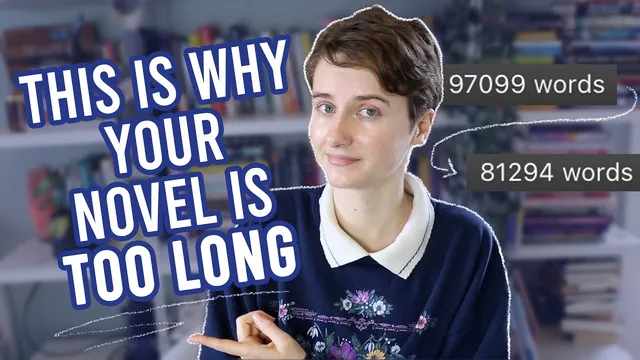
How to Condense Your Novel (I cut 16k words with this...)
Based on ShaelinWrites's video on YouTube. If you like this content, support the original creators by watching, liking and subscribing to their content.
Treat late-stage condensation as tightening choices, not just removing obvious mistakes; draft 11–12 still contains subtle padding.
Briefing
Cutting 16,000 words from a novel that had already gone through roughly a dozen drafts is less about finding one “big” problem and more about systematically tightening the routes between events, trimming unnecessary subplots, and compressing prose at the paragraph and line level. The key insight is that late-stage condensation works best when the manuscript is treated as a set of choices: which steps are required to move from one major moment to the next, which mini-arcs earn their space, and which sentences merely repeat information or delay the scene’s purpose.
The process starts with a late-development mindset. By draft 11 and 12, many obvious cuts had already been made, so the remaining word bloat tends to be subtler—extra context, tangential ideas, and “padding” that only feels necessary when the writer is still emotionally attached to earlier versions. The author frames condensation as three nested levels: (1) developmental plot trimming, (2) scene-level trimming, and (3) line-level trimming. Even though only a few larger plot changes were made, most of the word reduction came from scene and line edits.
At the plot level, the first move is simplifying the path between major events. Instead of adding complexity, revision focuses on removing convolutions in the chain of smaller steps that connect key moments. In practice, that can mean condensing two chapters into one when the connective tissue between events no longer needs that much space.
Next comes removing mini-arcs that don’t contribute. The author describes a quarry sequence where the protagonist and her sister go to sell cider. That scene was tied to a broader, two-chapter stretch of brewing-and-selling context. The fix wasn’t just trimming the scene—it was cutting the entire mini-arc, eliminating the setup and the repeated steps that existed mainly to support a side thread.
A third plot-level tactic targets scenes that exist to develop tangential ideas rather than deepen the story’s core themes, character arcs, or emotional stakes. Once the book was essentially finished, the author could spot moments that felt like detours: interesting in isolation, but not necessary for what the novel ultimately needed to say.
Scene-level cuts focus on paragraphs and beats that behave like non-sequiturs—sections that introduce an idea but don’t advance the scene’s purpose. The author also emphasizes removing action beats that don’t add to the “choreography” of the moment. A year away from the manuscript, previously memorized details stopped feeling essential; lines like characters opening doors or taking steps became expendable if they didn’t improve clarity or visualization.
Dialogue compression is another major lever. Drawing on playwriting advice, the author uses a ratio mindset: if a draft contains three lines of dialogue, often only one is needed to carry the exchange. That means cutting unnecessary back-and-forth, removing redundant dialogue tags paired with action beats, and tightening exchanges so the scene’s minimal goal is achieved.
Finally, the author condenses description by selecting the strongest image from multiple sentences and deleting the rest, then relies on thorough line editing to rearrange or remove words without losing meaning. The cumulative effect is what makes the numbers work: small cuts repeated across many chapters add up to a large reduction, even for a book already heavily revised.
Cornell Notes
The author reduced a novel from 97,000 to 81,000 words (a 16,000-word cut) after the manuscript was already in late-stage revision (draft 11 and 12). The strategy is built on three levels of condensation: simplify the plot’s path between major events, remove mini-arcs and tangential scenes, and then tighten scenes and lines. Scene-level work targets non-sequitur paragraphs, action beats that don’t improve visualization, and dialogue padding. Line-level edits compress dialogue, remove redundant dialogue tags plus action beats, and consolidate description by keeping the strongest image. The result shows that even after many rounds of editing, word count can still drop substantially through repeated, small, purposeful trims.
How does simplifying the “path between major events” reduce word count without weakening the story?
What’s a “mini-arc,” and why does removing one create disproportionate savings?
How do non-sequitur paragraphs and tangential scenes differ, and how are they cut?
Why do action beats become easier to cut after time away from the manuscript?
What dialogue rule-of-thumb helps compress exchanges?
How does the author handle description when trying to reduce length?
Review Questions
- Where in a draft do you tend to add extra steps between major events, and how could you test whether those steps are truly necessary?
- Pick one scene you wrote: what is its single purpose, and which paragraphs, action beats, or dialogue lines don’t directly serve that purpose?
- How would you apply the “three lines to one” dialogue rule to a conversation in your manuscript without losing character voice?
Key Points
- 1
Treat late-stage condensation as tightening choices, not just removing obvious mistakes; draft 11–12 still contains subtle padding.
- 2
Simplify the chain of events between major moments by cutting convoluted connective tissue, even if it means merging chapters.
- 3
Remove mini-arcs that exist mainly for setup or context that no longer supports the novel’s core themes or character arcs.
- 4
Cut non-sequitur paragraphs and tangential scenes by asking what complexity is required for the scene’s purpose.
- 5
Trim action beats that don’t improve visualization or choreography, especially when rereading after time away.
- 6
Compress dialogue by removing redundant back-and-forth and using a “often one line carries what three lines do” mindset.
- 7
Consolidate description by keeping the strongest image and deleting additional sentences that repeat the same effect.