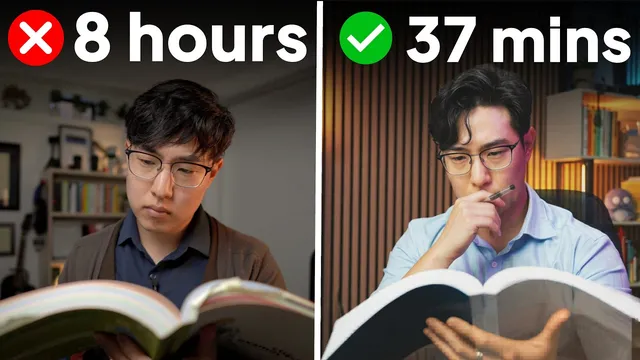
How to Learn Anything Faster Using Modern Research
Based on Justin Sung's video on YouTube. If you like this content, support the original creators by watching, liking and subscribing to their content.
Treat practice time as a secondary variable for most professionals; redesign practice strategies and contexts instead of simply adding hours.
Briefing
A set of widely believed “learning rules” is costing people time—because research repeatedly finds that more practice, more memorization, and easier instruction don’t reliably produce better skill or durable knowledge. The core message is that efficient learning depends less on doing what feels traditional and more on using practice and study methods that trigger the brain’s deeper processing, build conditional knowledge, and generate timely feedback.
The first target is the idea that getting good at something means practicing more. The Berlin violinist study popularized the notion that elite performers accumulate around 10,000 hours by age 20, but later synthesis of 88 studies found deliberate practice explains only a small slice of performance differences overall—about 20% in some competitive domains like music, chess, and sports, and roughly 1% for professional tasks such as computer programming. The implication: for most working adults, the limiting factor is rarely “not enough hours.” Instead, how practice is structured matters more than raw volume, especially after an initial improvement phase.
That leads to the second outdated rule: focus on just one thing. Narrow specialization can make sense when time is scarce, but modern findings on learning curves point to a different pattern: diminishing returns show up when the same strategy is repeated, not when a fixed number of hours is reached. Plateauing often reflects strategy stagnation—practicing the same way in the same context—rather than a lack of effort. The fix is to vary practice so learners build conditional knowledge: knowing when to apply which skill in which situation. A practical tool offered is a “learning log” that tracks (1) what is being practiced, (2) why it’s being practiced that way, and (3) what is being learned from it; unclear goals suggest random practice, while no learning suggests diminishing returns.
The next set of rules targets learning information. “Seek to understand, not to memorize” is treated as a misleading slogan. The video argues that both understanding and memory are byproducts of deep processing—meaning-making that forms connected schemas. Shallow processing produces fragile recall and regurgitation. Counterintuitively, merely trying to understand while reading or listening may still be shallow, while some forms of memorization-like repetition can be shallow too. A 1969 experiment is used to support a middle path: participants who rated words as pleasant or unpleasant—without being told to remember—recalled the list as well as or better than those instructed to understand and remember. The takeaway: effective learning comes from comparisons and evaluations that build networks, not from the intent to “understand” alone.
Rule four—write it down to remember—is also challenged. Copying notes repeatedly is framed as shallow processing, and the “pen is mightier than the keyboard” effect is attributed not to handwriting itself but to the slower pace forcing paraphrasing and summarization, which increases thinking. The advice becomes: write to think, not to capture everything.
Rule five says difficult material should be fixed. The argument flips that: difficulty is often where durable learning happens, supported by ideas like cognitive load and the zone of proximal development. Even when teachers make content easier, students may underperform later if they never learn how to build deep processing under real challenge. Strategies recommended include creating analogies and teaching the material in simplified form to force pattern-finding.
Finally, rule six—get more experience to build better intuition—lands with nuance. Experience increases confidence, but intuition becomes accurate only in “high validity” environments with stable cues and when feedback is timely. Domains like chess, accounting, and firefighting fit; stock picking is offered as a low-validity example where confidence rises without improved predictive accuracy. The practical self-check: ask whether the environment is high validity and whether feedback arrives quickly enough to learn from mistakes, and then shorten the feedback cycle whenever possible.
Cornell Notes
The transcript argues that many popular learning rules waste time because they don’t reliably produce deep processing, durable memory, or accurate intuition. More practice helps only modestly for most professionals; after early gains, the structure of practice and strategy changes matter more than total hours. For learning information, “understand, don’t memorize” is treated as incomplete: durable memory comes from deep processing—comparisons, evaluations, and schema-building—regardless of whether the method feels like memorization or understanding. Writing and note-taking work best when they slow you down enough to force thinking, not when they become transcription. Difficulty is framed as part of learning, and intuition improves fastest only in high-validity environments with timely feedback.
Why does “more practice” often fail to deliver proportional gains for everyday professionals?
What’s the difference between practicing longer and practicing in a way that prevents plateauing?
How can a “learning log” improve practice quality?
Why does the transcript claim that “seek to understand” can still produce shallow learning?
What’s the real mechanism behind handwriting beating typing in note-taking research?
When does experience translate into accurate intuition, and when does it mostly create confidence?
Review Questions
- Which findings suggest that practice quantity matters far less than practice design for many professional skills?
- What specific cognitive mechanism is described as producing durable memory, and how do the examples of word pleasantness ratings and note-taking fit it?
- How do “high validity environment” and “timely feedback” determine whether experience improves intuition accuracy?
Key Points
- 1
Treat practice time as a secondary variable for most professionals; redesign practice strategies and contexts instead of simply adding hours.
- 2
Use varied practice to build conditional knowledge—expertise depends on knowing when to apply different skills, not just executing one routine well.
- 3
Track practice with a learning log (what, why, what learned) to detect randomness, weak rationale, and diminishing returns early.
- 4
Aim for deep processing through comparisons and evaluations; “intent to understand” alone may not trigger it.
- 5
Write to think: reduce transcription and force summarization/paraphrasing when taking notes.
- 6
Don’t automatically blame materials when learning feels hard; difficulty often signals the mental effort needed for durable learning.
- 7
Improve intuition fastest by working in high-validity environments with timely feedback, and shorten feedback cycles when they’re delayed.