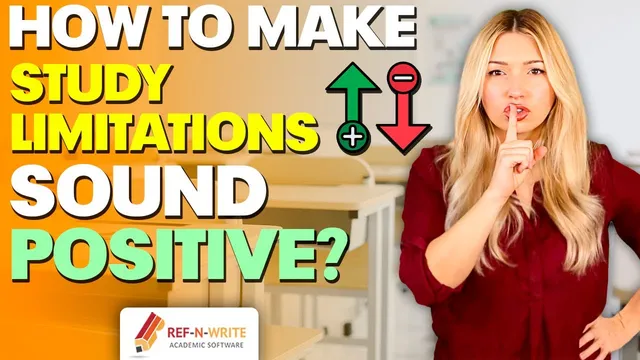
How to Make Study Limitations Sound Less Negative?
Based on Ref-n-Write Academic Software's video on YouTube. If you like this content, support the original creators by watching, liking and subscribing to their content.
Use milder limitation language (e.g., “limitations,” “pitfalls,” “drawbacks”) instead of emotionally loaded negatives like “unfortunately.”
Briefing
A small limitation doesn’t have to read like a verdict on the study’s credibility. The core move is to describe weaknesses in a constructive, neutral tone—using careful wording and adding context—so readers understand the constraint without dismissing the findings.
The transcript focuses on how authors can soften the impact of common limitations, especially in the discussion section where honesty about shortcomings is expected. It recommends avoiding strongly negative framing words such as “unfortunately” or “disappointing,” which can make the research feel undermined before any explanation is offered. Instead, authors should choose milder terms like “limitations,” “pitfalls,” or “drawbacks,” which acknowledge the issue while keeping the tone professional.
A key comparison shows how the same limitation—small sample size—lands differently depending on phrasing and follow-through. In one example, the authors open with a negative cue (“Unfortunately”) and stop there, leaving readers with an uncontextualized weakness. In the alternative example, the authors still note the sample size is small, but they explain why: the cases were limited to one hospital. They also close with a forward-looking note, arguing that even with a small study, the work produced useful results and that future research should replicate the findings in larger studies. That combination—cause plus constructive outlook—changes the reader’s takeaway from “the study is flawed” to “the study is constrained, but informative.”
The transcript then offers another tactic: acknowledge the negative while using sentence structure and attribution to reduce blame. One approach starts with “although,” which signals that a limitation is coming but frames it as a conditional tradeoff rather than a failure. The authors pair this with an explanation grounded in external constraints, such as financial limitations, and add that studies of this type often face the same issue. By distancing the limitation from the authors’ choices and placing it in a broader pattern within the field, the passage reads more neutral and less self-critical.
Overall, the guidance is practical: limitations should be stated clearly, but the language should avoid emotional negatives, the reasoning should provide context (why the limitation occurred), and the ending should point to value and next steps (replication, larger studies, future work). Done well, limitations become part of a credible scientific narrative rather than a signal that the research cannot stand.
Cornell Notes
The transcript argues that study limitations can be presented without damaging credibility by using constructive academic language and adding context. Strong negative starters like “unfortunately” can make readers discount the work, while milder terms such as “limitations” or “drawbacks” keep the tone professional. Explaining why a limitation exists—e.g., a small sample size due to cases limited to one hospital—helps readers interpret the constraint. Ending with a positive, forward-looking statement (useful results and replication in larger studies) further preserves impact. Using structures like “although” and attributing constraints to external factors (financial constraints, common issues in the field) reduces the sense that the limitation reflects poorly on the researchers.
Why are words like “unfortunately” discouraged when discussing limitations?
How does adding an explanation change the effect of stating a limitation like a small sample size?
What role does a forward-looking closing statement play in limitation writing?
How does the “although” strategy work in practice?
Why does attributing limitations to external constraints matter?
Review Questions
- Write a revised version of a limitation sentence that begins with “Unfortunately.” What word or structure would you replace it with, and why?
- Choose one limitation from a hypothetical study (e.g., small sample size). Draft a two-part limitation statement that includes (1) a reason and (2) a constructive future direction.
- How would you change a limitation paragraph if the limitation is caused by external constraints (time, funding, access) rather than research design choices?
Key Points
- 1
Use milder limitation language (e.g., “limitations,” “pitfalls,” “drawbacks”) instead of emotionally loaded negatives like “unfortunately.”
- 2
Avoid stating limitations without context; explain why the limitation occurred (e.g., cases limited to one hospital).
- 3
End limitation discussions with constructive, forward-looking implications such as replication in larger studies.
- 4
Use sentence structures like “although” to signal balance rather than letting the limitation dominate the tone.
- 5
Attribute constraints to external factors when appropriate (e.g., financial constraints) and note that similar studies often face the same issues.
- 6
Aim for a neutral, credible discussion tone that preserves the perceived value of the findings.