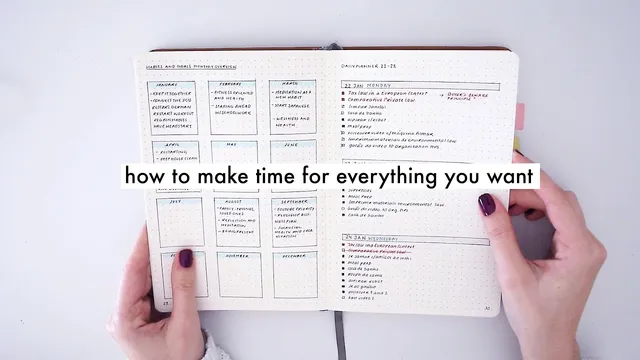
HOW TO MAKE TIME FOR EVERYTHING YOU WANT // Part I
Based on Mariana Vieira's video on YouTube. If you like this content, support the original creators by watching, liking and subscribing to their content.
Treat missed progress as a cue to restart the next day, not as a reason to wait until next year.
Briefing
Making time for everything starts with treating each day like a fresh start and building routines that can actually survive real life. The core idea is simple: every day should function like “January 1.” If momentum breaks—missed workouts, stalled goals, or a habit that didn’t stick—there’s no need to wait for next year. Resolutions should be symbolic, not punitive. Failing in March after a promise made in January doesn’t mean the goal is dead; it means the plan needs a restart tomorrow, then again next week if necessary. The process of getting there matters as much as the destination, so the focus shifts from perfection to steady rhythm.
From there, the transcript argues that habit tracking is the practical engine behind intentional living. Habit tracking isn’t framed as a forever system, but as a tool for accountability and progress awareness while routines form. Tracking can be done in a journal, a habit-tracking app, or even on paper—mark the task each day it’s completed, then review the “big picture” to see which habits are repeating easily and which ones consistently fail. That feedback becomes a diagnostic tool: if a habit isn’t working, the strategy should change rather than the person should blame themselves.
A major strategy is pacing—adding one step at a time and adjusting intensity. Trying to overhaul life with many new activities at once is described as a fast route to overwhelm and failure. Instead, new habits should be introduced gradually, such as adding one task every couple of weeks. Some goals may also need a different cadence. If daily practice burns out long-term—like studying two languages every single day—the plan can be redesigned to alternate focus (e.g., language one on Monday, language two on Tuesday, then language one again on Wednesday). The transcript also suggests shifting certain habits from daily to weekly when that better matches reality and sustainability.
Another key point is recycling habits once they’re embedded. If someone tracks something for months—like drinking eight glasses of water daily—and it becomes automatic, removing it from the tracker is treated as a sign of success. Tracking is meant to fade as the habit solidifies, not to become an additional chore.
Finally, time management is tied to how goals are planned. Instead of forcing everything into a 365-day grind, the transcript recommends monthly resolutions and a small number of yearly priorities. Monthly “themes” can reduce mental load: one month for health and fitness (workouts, healthy eating), another for YouTube work (content batching, website review and redesign), and another for spring cleaning and decluttering. The underlying claim is that time is flexible—daily routines help, but weekly and monthly routines can be just as effective when they align with what needs attention now.
The segment ends with a sponsor message for HiNative, a language-learning platform that lets users ask native speakers questions across 110+ languages, upload audio for pronunciation feedback, and receive voice answers, with a free tier available and premium upgrades for extra features.
Cornell Notes
The transcript’s central message is that intentional living comes from treating every day like a fresh start and building sustainable routines. Resolutions are framed as symbolic, so missed progress isn’t a reason to wait until next year—restart tomorrow. Habit tracking is presented as a practical tool for accountability and for spotting which behaviors are working versus failing, using anything from a journal to an app. When a habit becomes automatic, it should be removed from tracking, signaling success. Goal planning should also be flexible: monthly themed resolutions and routines can be less overwhelming than trying to maintain everything daily for a full year.
Why does the transcript treat “every day like January 1” as a time-management strategy, not just a motivational slogan?
How does habit tracking help someone prioritize effectively?
What should someone do when a habit isn’t sticking?
When is it time to stop tracking a habit?
Why does the transcript prefer monthly resolutions and themed months over year-long commitments?
How does the transcript balance daily routine with longer cycles like weekly or monthly routines?
Review Questions
- What does “restart tomorrow” change about how someone should handle missed resolutions?
- How would you use habit tracking to decide whether a habit should be daily, weekly, or removed?
- Give one example of a themed month and explain how it would reduce overwhelm compared with a year-long plan.
Key Points
- 1
Treat missed progress as a cue to restart the next day, not as a reason to wait until next year.
- 2
Use habit tracking (journal, app, or paper) to build accountability and to identify which habits are working versus failing.
- 3
Add new habits gradually—introduce one step at a time and increase intensity slowly to avoid overwhelm.
- 4
Adjust cadence when needed: switch from daily to weekly or alternate days for goals that cause long-term burnout.
- 5
Remove habits from tracking once they become automatic, using “tracking” as a temporary training tool.
- 6
Plan goals with monthly themes and a small number of yearly resolutions to reduce the pressure of 365-day consistency.
- 7
Build routines at multiple time scales—daily for habits, and weekly/monthly for broader priorities.