How to Plan to ACTUALLY Achieve Your Goals
Based on Ciara Feely's video on YouTube. If you like this content, support the original creators by watching, liking and subscribing to their content.
Define “done” by translating vague goals into concrete deliverables and outcomes, ideally with input from a supervisor or stakeholder.
Briefing
Goal achievement often fails at the planning stage: setting targets without mapping the specific work required to reach “done” leaves progress vague and easy to stall. A four-step approach turns a 12-week goal into an actionable plan by first defining what completion actually means, then scheduling the work, building weekly routines into the calendar, and finally measuring progress with clear scoring metrics.
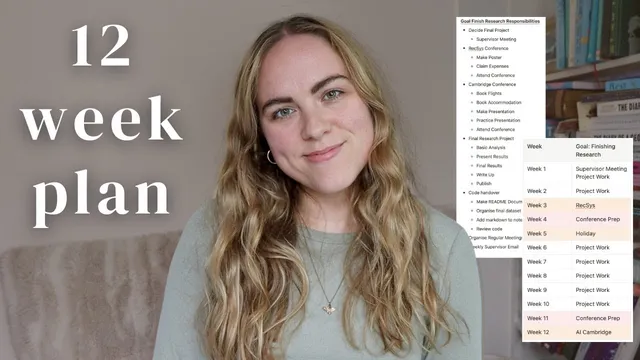
The process starts with brainstorming a comprehensive list of tasks, projects, and habits needed to fulfill the goal—then translating vague outcomes into concrete deliverables. For example, “finishing research responsibilities strongly” becomes a definition of what “done” looks like for that role. That definition is shaped through a meeting with a supervisor, where the final project scope is clarified. From there, the plan breaks the work into major streams: conference participation (including travel logistics, poster creation and practice, and expense claims), a later conference presentation (slides preparation, rehearsal, travel booking, and reimbursement), and a final project that likely involves data analysis leading to a journal paper describing the dataset and remaining analysis.
The plan also accounts for handover work, not just production. That includes a culminating research presentation in January (with uncertainty about how much preparation fits within the 12-week window), plus documentation so someone else can take over: organizing code and data and writing a handover document that prevents the need for repeated follow-up questions.
Next comes calendar construction for the full 12 weeks, placing tasks where they naturally fit and respecting fixed constraints like conference dates, holidays, and contract timing. Setup tasks land early—such as the supervisor meeting—because delays there can ripple across everything else. The schedule also includes buffer time: preparation weeks before conferences and a structured work block for the final project. The expected project rhythm is iterative: initial data analysis to generate early results, supervisor feedback, a second round of analysis, and then a multi-week write-up and publication phase. The timeline is treated as feasible within 6–8 weeks, provided the rest of the research obligations are handled in parallel.
Weekly scheduling turns the plan into habits and time blocks. Smaller habits can be “stacked” onto existing routines (like adding exercise by shifting wake-up and bedtime). Larger goals require dedicated blocks—research work, for instance, is allocated to two or more multi-hour sessions each week (Tuesdays and Fridays), with additional shorter blocks for cleanup and synthesis. The plan also includes recurring check-ins: an end-of-week update email to the supervisor every Friday and periodic meetings every 1–2 weeks, timed to the supervisor’s availability.
Finally, progress is made measurable through scoring metrics. Each week is evaluated on task completion (e.g., completing 3 of 4 planned tasks yields a 75% score) and on time investment (tracked hours versus planned hours). The system also scores adherence to key habits like sending the weekly update email and tracks ongoing outputs such as cleaning up coding notebooks via a progress bar. The end goal is treated as an outcome of completion—potentially including readiness for handover and whether a final paper is produced—so the 12-week period ends with both accountability and closure.
Cornell Notes
The core idea is that goals become achievable only when “done” is defined, the work is scheduled, weekly habits are built into real time, and progress is measured. The approach starts by listing every task, project, and habit required to complete a goal, then clarifying vague outcomes through a supervisor meeting. It then maps those tasks onto a 12-week calendar, accounting for fixed events like conferences and holidays, plus buffer time for preparation and feedback cycles. Weekly execution is supported by dedicated time blocks for deep work and recurring routines such as Friday progress emails and periodic supervisor meetings. Finally, weekly scoring combines task completion, hours worked versus planned, and adherence to key habits, with ongoing tracking like notebook cleanup progress.
How does the plan turn a vague goal into something measurable?
What does building a 12-week calendar actually require beyond listing tasks?
How are weekly routines and time blocks used to make execution realistic?
What scoring metrics keep progress from becoming subjective?
How does the plan handle handover and end-of-cycle closure?
Review Questions
- What specific deliverables would you list to define “done” for one of your own vague goals?
- How would you structure a 12-week calendar if your goal includes two fixed events (like conferences) and an iterative feedback cycle?
- Which weekly scoring metrics would you choose to measure both output (tasks) and effort (time), and how would you adjust if you fall behind?
Key Points
- 1
Define “done” by translating vague goals into concrete deliverables and outcomes, ideally with input from a supervisor or stakeholder.
- 2
Break the goal into every required task, project, and habit, including logistics like travel and reimbursement when relevant.
- 3
Build a 12-week calendar by placing fixed-date commitments first, then adding buffer time for preparation and feedback cycles.
- 4
Use your weekly schedule to assign realistic time blocks for deep work and smaller habits, rather than relying on motivation.
- 5
Create recurring routines that support accountability, such as weekly progress emails and regular check-ins.
- 6
Track progress with weekly scoring that combines task completion, hours worked versus planned, and adherence to key habits.
- 7
Treat handover and documentation as part of the goal’s completion criteria, not something to do after the main work is finished.