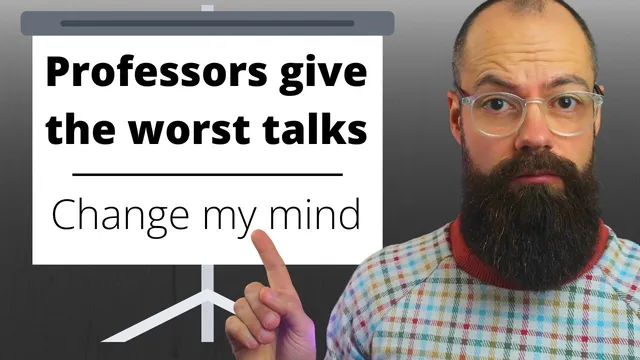
How to *RUIN* a Presentation Like a Tenured Professor.
Based on Andy Stapleton's video on YouTube. If you like this content, support the original creators by watching, liking and subscribing to their content.
Upload slides in advance instead of forcing on-site troubleshooting that delays the start.
Briefing
A “tenured professor” presentation, as portrayed in this transcript, is built to maximize dominance rather than clarity: it’s a deliberate recipe for wasting time, overwhelming the audience, and showcasing prestige instead of communicating ideas. The core move starts before the talk even begins—ignore repeated emails asking for the slides in advance, then arrive with a laptop and force the room to watch a connection attempt. The goal is to turn basic logistics into a performance of control, even if it means fumbling for several minutes while everyone waits.
Once the talk starts, the dominance continues through mic and slide choices. The presenter refuses the microphone regardless of auditorium size, insisting they don’t need it because they have a “boomy voice,” then asks if people can hear them from the back. After the audience confirms, the presenter drops back to a normal speaking volume so the back rows can’t hear—an intentional demonstration that the presenter’s expertise makes them “above” standard presentation norms.
The first slide is treated as a psychological weapon. Instead of setting a clear narrative, it lands the audience with an intimidating stack—“one of 135 slides”—to trigger dread and signal that the presenter’s career output is too vast for anyone else to match. The talk is framed as a single, long-evolved “life’s work” deck used everywhere, regardless of context, with the same slides reused and “bumbled through” for the full 45 minutes.
Prestige replaces substance. The presenter highlights papers from high-impact-factor journals, orders them by perceived prestigiousness, and leans on polished “cover art” skills learned during a sabbatical to make the work look impressive. Each slide is described as compressing an entire PhD into a quick blur of attribution—often naming researchers only if it’s convenient, then saving recognition for a brief thanks at the end.
Timing is also weaponized. Despite having years to learn pacing, the presenter spends most of the early talk—first four or five slides—overly pedantically, using them to brag about elite connections and status (Nobel laureates, vice-chancellors, and flattering anecdotes). Meanwhile, legibility is actively sabotaged: slides are copied and pasted directly from papers with tiny text so the audience can’t read it, and the presenter doesn’t plan to explain it anyway.
Later, the talk collapses into speed and selective attention. Near the end, the presenter “flicks through” results, dismissing important findings as not worth time, then rushes forward to finish. Finally, the presenter uses a group slide as a moral shield—flashing collaborator names, adding outdated lab headshots, and inserting a cheerful group photo—to create the appearance of humanity and gratitude while the rest of the presentation has already signaled contempt for audience comprehension.
In short, the transcript’s “how to ruin a presentation” checklist is a satire of academic status theater: it turns preparation into disruption, communication into intimidation, and research into a prestige display—leaving the audience confused, excluded, and impressed for the wrong reasons.
Cornell Notes
The transcript lays out a satirical “tenured professor” presentation strategy designed to undermine clarity and assert status. It starts with sabotaging logistics—ignoring slide-upload requests and forcing the room to watch laptop setup—then continues by refusing the microphone and speaking in a way that leaves parts of the audience unable to hear. The talk relies on intimidation (a huge slide count), prestige signaling (high-impact papers, cover art, ordered accolades), and unreadable slides copied from papers. Pacing is manipulated by overloading the first few slides with bragging, then rushing through key results later. A final group slide offers a veneer of gratitude to soften the damage.
How does the presenter turn basic logistics into a status performance?
What microphone behavior is used to create the illusion of superiority?
Why does the transcript emphasize the first slide and the slide count?
How are prestige and credibility displayed during the talk?
What pacing tactics sabotage understanding?
How does the presenter use a group slide to manage perceptions?
Review Questions
- What are three specific behaviors that make the audience unable to follow the talk (not just bored or unimpressed)?
- How does the transcript contrast early-slide overemphasis with later-slide rushing, and what does that do to narrative coherence?
- Which elements in the prestige strategy (journal impact, cover art, slide ordering, attribution) are meant to substitute for explanation?
Key Points
- 1
Upload slides in advance instead of forcing on-site troubleshooting that delays the start.
- 2
Use the microphone appropriately; refusing it can exclude parts of the audience from basic comprehension.
- 3
Avoid intimidation tactics like excessive slide counts without a clear narrative arc.
- 4
Don’t replace explanation with prestige signaling—high-impact journals and cover art can’t substitute for clarity.
- 5
Maintain readable slide design; copying tiny, dense text from papers undermines learning.
- 6
Pace the talk so key results receive adequate time rather than being dismissed and rushed.
- 7
Acknowledge collaborators sincerely, but don’t use a group slide as a substitute for respectful, understandable communication.