How to Start Your Productivity Project in 2022
Based on Mariana Vieira's video on YouTube. If you like this content, support the original creators by watching, liking and subscribing to their content.
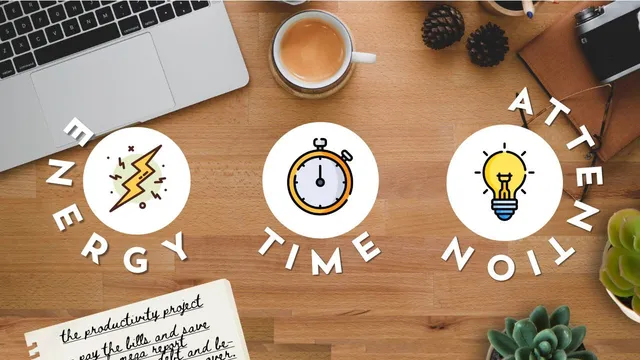
Productivity depends on managing time, attention, and energy—not just working longer hours.
Briefing
Productivity isn’t about squeezing more hours into the day—it’s about managing three scarce resources: time, attention, and energy. With everyone limited to the same 24 hours, the practical lever is how those hours are allocated and how well focus and stamina are sustained. Chris Bailey’s framework reduces productivity to a combination of time (using it wisely), attention (doing high-quality work without distractions), and energy (having enough “fuel” to finish what matters). When any one of those breaks down—too little focus, poor energy management, or time spent on low-value activities—results suffer, even if schedules look full.
Bailey also ties productivity to personal goals and values. How someone spends time signals what they value, and maximizing time, attention, and energy to work toward individual goals is positioned as a route toward purpose. That framing matters because it shifts productivity from a generic self-optimization game to a values-driven system: the goal isn’t to be busy, but to move meaningfully toward what someone cares about.
A major theme is replacing vague “output” metrics with quality-based evaluation. Instead of counting how long someone worked or how many pages were read, the more useful question is whether the work completed matched the intention—“Did I get done what I intended to?” Quality also depends on whether tasks were performed in a focused state and whether reading was understood rather than skimmed. Not all tasks carry equal weight either. Bailey’s highlights draw a line between deep work and shallow work—contrasting administrative busywork (like spending hours rearranging an inbox) with higher-impact efforts tied to passion projects or core responsibilities.
The transcript adds a scheduling tactic built around biological prime time. People experience energy and focus differently across the day—morning types versus night owls—and the “prime time” window is treated as the period when the highest-impact tasks should land. The suggested method is simple: track energy fluctuations for a week, note spikes after routines like coffee, workouts, or meals, and identify slumps. Once prime time is found, it should be protected and reserved for the most valuable work rather than low-stakes chores.
Procrastination is handled as a brain-state conflict between the limbic system (seeking comfort and low effort) and the prefrontal cortex (planning and logic). To regain control, the transcript recommends a “procrastination list” that warms up with smaller, administrative tasks; writing down the cost of procrastination to make the downside concrete; and using a five-minute start rule to break inertia. If momentum builds, work continues; if not, the person still moves forward.
Finally, the transcript argues for working less to work better. A four-week experiment alternating 90-hour weeks with 20-hour weeks found only marginal gains from longer hours, largely because attention and energy degraded. Shorter weeks created urgency, forcing smarter approaches and improving focus. Time limits also motivate deeper concentration, increase urgency, and can flip procrastination into a challenge. Maintenance tasks—laundry, groceries, cleaning, grooming—are treated as essential support for sustained creative work, with the best schedule varying by habit: some batch them into a weekly maintenance day, while others handle small upkeep daily.
Overall, the productivity project described here is a system for aligning time, attention, and energy with high-value outcomes—measuring quality, protecting prime focus windows, defeating procrastination with practical ramps, and using constraints to avoid the trap of being merely busy.
Cornell Notes
Productivity is framed as a balance of time, attention, and energy. Managing all three determines whether work is high-quality and sustainable, not just whether hours are filled. The transcript emphasizes measuring outcomes by intention (“Did I get done what I intended to?”) and distinguishing deep, high-impact tasks from shallow busywork. It also recommends scheduling around biological prime time by tracking energy patterns and protecting that window for the most valuable work. Procrastination is treated as a limbic-versus-prefrontal conflict, with tactics like a procrastination warm-up list, writing the cost of delay, and starting for five minutes. Finally, limiting work hours can improve focus and urgency, while maintenance tasks are necessary support for longer-term output.
Why does the transcript define productivity as time, attention, and energy—and what breaks when one is mismanaged?
How does the transcript suggest evaluating “productive” work without relying on vague metrics?
What’s the deep-work versus shallow-work distinction, and why does it matter for task selection?
How can someone find and protect biological prime time?
What tactics are offered to overcome procrastination, and what brain conflict do they target?
Why does the transcript argue that working less can increase productivity?
Review Questions
- What does “Did I get done what I intended to?” measure that time-spent metrics miss?
- How would you design a one-week energy-tracking experiment to identify your prime time, and what would you schedule there?
- Which procrastination tactic would you use first (warm-up list, cost-of-delay, or five-minute start), and why?
Key Points
- 1
Productivity depends on managing time, attention, and energy—not just working longer hours.
- 2
Quality beats quantity: evaluate whether intended outcomes were completed, not how long tasks took or how many pages were consumed.
- 3
Deep work and shallow work should be treated differently when planning a day; administrative busywork can crowd out high-impact effort.
- 4
Biological prime time can be identified by tracking energy patterns for a week and then protected for the most valuable tasks.
- 5
Procrastination is framed as a limbic-versus-prefrontal conflict, and practical interventions include warm-up tasks, writing the cost of delay, and starting for five minutes.
- 6
Working fewer hours can improve focus and urgency; longer weeks may reduce attention and energy enough to limit gains.
- 7
Maintenance tasks are essential support for sustained output and can be scheduled either as a weekly batch or as small daily upkeep depending on personal habits.