How to Structure the Literature Review in a Research Paper/Thesis?
Based on Research With Fawad's video on YouTube. If you like this content, support the original creators by watching, liking and subscribing to their content.
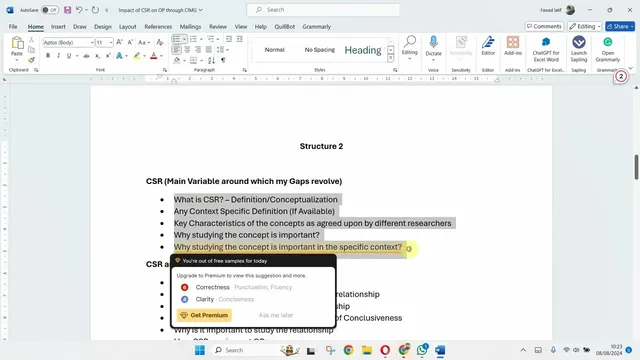
Start the literature review by defining and contextualizing key constructs, including any domain-specific framing (e.g., CSR in the services sector).
Briefing
A literature review can be organized in several workable ways, but the choice should follow how the study’s variables are treated—either as separate “building blocks” or as one integrated argument—especially when mediation is involved. Using a sample model of CSR (independent variable) affecting organizational performance (dependent variable) through corporate image (mediator), the core task becomes clear: define and contextualize each construct, then justify the relationships with prior research, directionality, and theory, and finally explain the mediation through a causal chain from CSR → corporate image → organizational performance.
The most thesis-friendly option is a detailed, variable-by-variable structure. It starts with a dedicated section for CSR: provide a definition and any context-specific framing (for example, CSR in the services sector), summarize key characteristics agreed upon by researchers, and explain why the concept matters both generally and in the specific context. The same kind of construct-focused discussion is then repeated for corporate image and organizational performance. After the constructs are established, the literature review shifts to relationships, typically using separate headings for each link: CSR → corporate image, CSR → organizational performance, and corporate image → organizational performance. Each relationship section should address what prior studies say, whether the relationship tends to be positive, negative, or inconclusive, whether contradictions exist, and why the relationship is worth studying. Theory is also required to support the “why,” since it feeds directly into hypothesis development.
Mediation gets its own logic: the review should build linking arguments that form a stepwise causal chain. In practical terms, the literature review should show how CSR leads to corporate image, and how corporate image then leads to organizational performance—so the mediator is not just named, but justified as the mechanism connecting independent and dependent variables.
Three alternative structures compress or merge these elements. In Structure 2, only CSR receives a full construct section; corporate image and organizational performance are not discussed separately. Instead, the review moves quickly into hypothesis building, defining organizational performance first (since it is not yet defined) and then constructing the relationships and mediation role around CSR as the central focus.
Structure 3 keeps CSR as the main construct section but merges the relationship work into the mediation heading. Rather than separate sections for CSR → image, image → performance, and the mediator mechanism, the review uses a single section that combines these arguments and then develops the linking causal chain.
Structure 4 is the most concise: it provides brief construct definitions only where needed (CSR first, then organizational performance, then corporate image) and then places all relationship logic—including the mediation explanation—under one heading. The transcript emphasizes that journal requirements and word count should determine which structure to use, with the detailed, variable-by-variable approach typically favored for theses.
Cornell Notes
The literature review can be structured in multiple ways depending on how much space is devoted to defining constructs versus building relationships. A common thesis approach uses separate sections for each variable (CSR, corporate image, organizational performance), then separate sections for each relationship (CSR→image, CSR→organizational performance, and image→organizational performance). Mediation is justified by linking arguments that create a causal chain from CSR to corporate image and then from corporate image to organizational performance. Alternative formats reduce repetition by defining only CSR (or only the mediator-related constructs) and then moving directly into hypothesis development and mediation logic. Word count and journal guidelines determine which structure fits best.
What elements should appear when discussing each variable (construct) in a literature review?
How should relationship sections be written when connecting two variables (e.g., CSR→corporate image)?
What is the recommended way to justify a mediation role in the literature review?
How does Structure 2 differ from the detailed thesis structure?
What changes in Structure 3 and Structure 4 compared with Structure 1?
Review Questions
- In a mediation study, what specific causal chain should the literature review build to justify the mediator?
- Which relationship details (direction, contradictions, theory, and importance) must be included when writing a section connecting two constructs?
- How would you decide between the detailed thesis structure and a more compressed structure based on word count and journal requirements?
Key Points
- 1
Start the literature review by defining and contextualizing key constructs, including any domain-specific framing (e.g., CSR in the services sector).
- 2
For each construct, summarize agreed-upon characteristics and explain why studying it matters both generally and in the study’s specific context.
- 3
When writing relationship sections, cover what prior research finds, the direction of effects (positive/negative/inconclusive), and whether results conflict or remain unclear.
- 4
Use theory to justify the mechanism behind each hypothesized relationship, since it directly supports hypothesis development.
- 5
Explain mediation through linking arguments that form a stepwise causal chain from independent variable to mediator to dependent variable.
- 6
Choose a structure based on journal requirements and word count: detailed variable-by-variable sections are often preferred for theses, while merged headings can reduce repetition.