How To Study for the Math Proficiency Test (MPT)
Based on Duddhawork's video on YouTube. If you like this content, support the original creators by watching, liking and subscribing to their content.
Start with the practice test to establish baseline knowledge and pinpoint weak concepts before studying.
Briefing
Passing Ontario’s Math Proficiency Test (MPT) hinges less on cramming and more on a tight loop of practice, targeted review, and retesting. The most practical starting move is to take the official-style practice test first—without calculator for one portion and with calculator for another—so test-takers get an immediate baseline of what they actually remember (and what they don’t). That score then determines what to study next, rather than guessing based on vague memories from high school.
The MPT is structured into 15 math questions without a calculator and 45 with a calculator, plus 21 teaching-related questions based on two Ontario teaching documents: “Growing Success” and “Learning for All.” A key grading detail reduces panic: passing requires at least 70 in each section, not an overall 70. In practical terms, the math component has 50 questions total, so a 35/50 or higher is needed for that section; the teaching component has 21 questions, so 15/21 or higher is required. Examples on the test-prep resources illustrate how someone can score very high in one section yet still fail if the other section falls below the 70 threshold.
After the baseline practice run, the next step is to map the test’s concept list and then study specifically the weak areas revealed by the first attempt. Khan Academy is recommended for relearning math concepts in depth, and a playlist is suggested that targets every problem from the Ministry practice test problems—useful because even if those exact questions don’t reappear, the underlying skills and concepts do. Once the targeted review is complete, retaking the practice test functions as a checkpoint: if scores are comfortably high (for example, around 85–90 in both sections), studying can stop; if performance is shaky, more help may be needed.
When self-study isn’t enough, the plan shifts to additional support. Private tutoring is suggested, and colleagues or friends can form a study group—because explaining math to others reinforces understanding. The transcript also emphasizes that math learning is fundamentally problem-based: the best “study” is doing problems, ideally repeatedly and independently.
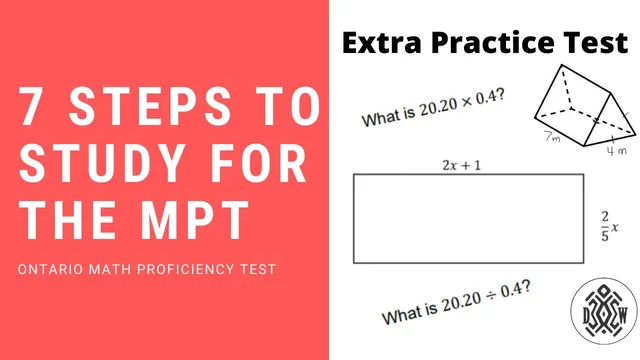
To build endurance and accuracy, a second practice test is recommended that mirrors the format but makes every question harder, effectively training for the real test’s difficulty. For the teaching portion, the advice is to read “Growing Success” and “Learning for All,” especially the evaluation section, since it frequently aligns with interview-style questions. For memorizing specific facts, flashcards are recommended, with tools like Quizlet and Anki mentioned as options for creating and sharing decks.
Overall, the strategy is explicitly iterative: practice reveals gaps, study closes them, and more practice confirms improvement. Retesting is available if needed, but the goal is to keep cycling until confidence is high enough to aim for well above the 70-per-section pass mark—ideally targeting around 90 so that even with a few surprises, scores are unlikely to drop to the minimums.
Cornell Notes
The MPT pass strategy centers on taking a practice test first to establish a baseline, then studying only the weak areas it exposes. Passing requires at least 70 in each section: 35/50 or more on the math component and 15/21 or more on the teaching component. After targeted review using resources like Khan Academy and concept lists, retake the practice test to confirm improvement. If scores remain unstable, add tutoring or peer group support, and keep learning through repeated problem-solving. For the teaching questions, reading “Growing Success” and “Learning for All” (especially evaluation) and using flashcards for memorization are presented as key methods.
What is the fastest way to decide what to study for the MPT?
How does the MPT’s passing rule work, and why does it change how people should prepare?
What should math studying look like after the baseline practice test?
When is extra help recommended, and what form does it take?
What’s the recommended approach for the teaching portion of the MPT?
Review Questions
- What minimum scores are required on each MPT section to pass, and how do those translate into question counts?
- Why does the strategy recommend taking a practice test before studying, and how should the results change the next study steps?
- What combination of resources and methods is suggested for the math and teaching components (including flashcards and practice tests)?
Key Points
- 1
Start with the practice test to establish baseline knowledge and pinpoint weak concepts before studying.
- 2
Plan around the MPT’s per-section passing rule: 70+ in each section (35/50 math; 15/21 teaching).
- 3
Use a concept list and targeted relearning (e.g., Khan Academy) to close gaps revealed by the first attempt.
- 4
Retake practice tests as checkpoints; stop only if scores are comfortably above the pass threshold.
- 5
Add tutoring or peer group support if practice scores don’t stabilize, but keep problem-solving central.
- 6
For teaching questions, read “Growing Success” and “Learning for All,” especially the evaluation section.
- 7
Use flashcards (Quizlet or Anki) to memorize teaching-related facts and share decks for group learning.