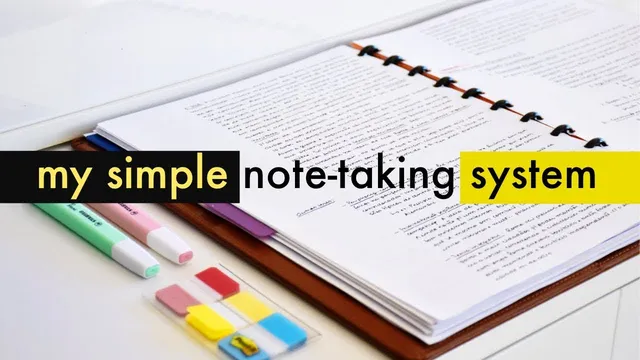
How to Take AMAZING Notes and SAVE your Grades » my simple note-taking system
Based on Mariana Vieira's video on YouTube. If you like this content, support the original creators by watching, liking and subscribing to their content.
Organize handwritten notes by assigning each class its own batch of pages.
Briefing
A streamlined note-taking system aims to make studying faster without sacrificing retention by organizing class notes into clear, self-contained batches. The core idea is to stop treating notes as a single, ever-growing pile and instead build a structure where each class has its own dedicated set of pages. That way, reviewing one subject doesn’t require sorting through unrelated material, and studying becomes more targeted when time is limited.
The system is designed around efficiency—especially for students who can’t afford the time it takes to write “pretty” notes. After using multiple approaches over the years, the creator frames this method as the most effective for capturing the information needed while still being realistic to maintain. The emphasis isn’t on aesthetics; it’s on speed, consistency, and the ability to retrieve information quickly during studying.
A key practical choice is flexibility in format. Notes can be done on paper, on an iPad using an iPad pencil, or even on a computer, but the method’s details are geared toward handwriting rather than typing. That matters because the workflow is built around physical organization—how pages are grouped, separated, and later reviewed.
The first organizational rule is “one class per batch of pages.” Each class gets its own batch, and all batches are then grouped together to form the complete set of notes for that class. This creates two levels of organization: (1) a batch for a specific class, and (2) a larger collection that represents the total notes for the class. The result is a study setup that supports both full-session review and selective review.
In short, the system prioritizes a study-friendly layout: notes are compartmentalized by class so students can quickly find what they need, whether they’re preparing for an exam across the board or focusing on a particular topic under time pressure. The approach is presented as a solution for students who want to retain information efficiently while keeping the note-taking process manageable in real life.
Cornell Notes
The note-taking system is built for speed and retention by organizing handwritten notes into class-specific page batches. Instead of mixing everything together, each class gets its own batch of pages, and those batches are then compiled into the full set of notes for that class. This structure makes it easier to study one class at a time or selectively review only certain notes without wading through unrelated pages. The method is meant to be practical for students who don’t have time to create detailed, “pretty” notes. It can be used on paper or on an iPad with an iPad pencil, with the workflow mainly designed for handwriting.
Why does organizing notes by “one class per batch of pages” matter for studying?
How does the system balance “total class notes” with the ability to study selectively?
What problem does the method target for students who don’t have time for elaborate notes?
Does the system require paper, or can it work digitally?
What is the practical benefit of keeping notes handwriting-focused?
Review Questions
- How does the “batch of pages per class” structure reduce the time it takes to study compared with keeping all notes in one place?
- What are the two organizational layers in the system, and how does each one help during exam preparation?
- Why does the method emphasize efficiency over creating “pretty” notes, and what trade-off does it avoid?
Key Points
- 1
Organize handwritten notes by assigning each class its own batch of pages.
- 2
Compile all class-specific batches into a single grouped collection for that class’s total notes.
- 3
Use the system to support both full-class review and selective review of only certain notes.
- 4
Prioritize efficiency and retention over spending time on elaborate, “pretty” handwriting.
- 5
The workflow works on paper or an iPad with an iPad pencil, with handwriting central to the approach.