How to Teleport Schrödinger's Cat
Based on minutephysics's video on YouTube. If you like this content, support the original creators by watching, liking and subscribing to their content.
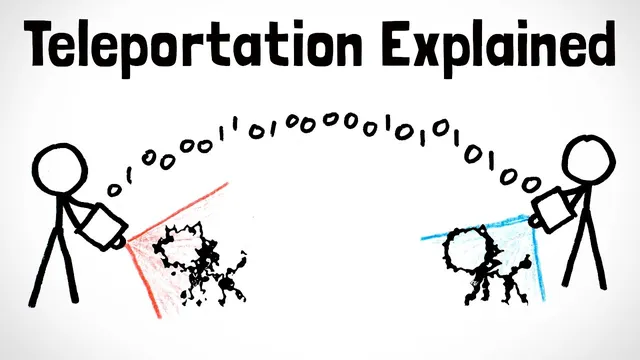
Quantum teleportation transfers quantum state information using entanglement, not by instant physical transport of the object.
Briefing
Quantum teleportation can transfer a system’s quantum state to a distant location without sending the object itself—but it does so by destroying the original state rather than copying it. That “no-cloning” constraint is central: quantum mechanics forbids making an exact duplicate of an arbitrary unknown state, so any physically allowed teleportation protocol inevitably alters or scrambles what remains behind.
The mechanism relies on quantum entanglement, not on instant transport through spacetime. Entangled particles share correlated states such that knowing the state of one immediately constrains the other, even across large distances. In the teleportation setup, one member of an entangled pair stays near Earth while the other is placed on the moon. The near-Earth particle acts like a template: after a carefully chosen measurement, the moon particle ends up in a state related to the original system’s state.
To make the logic vivid, the protocol is illustrated with Schrödinger’s cat. The cat is treated as a quantum superposition of alive and dead: A·(alive) + B·(dead), with unknown coefficients A and B. The entangled pair is represented by two “flea” particles—one on Earth and one on the moon—prepared in a superposition where one is alive and the other is dead. The cat’s state is then combined with the Earth flea, but crucially the cat is not directly “opened” (that would collapse the superposition and ruin the teleportation). Instead, the Earth side performs an indirect, partial measurement that only partially collapses the combined cat–Earth-flea system.
Those indirect measurements are framed as questions like whether the cat and flea are the same, whether exactly one is alive, or whether at least one is dead. Each question alone doesn’t reveal the full configuration; together they provide just enough information to steer the moon flea into one of several possible superpositions that mirror the cat’s original form. After the measurement outcome is known, a classical message is sent to the moon. Depending on which partial-measurement result occurred, the moon side applies a corresponding “swap” or sign-change rule to correct the coefficients.
The result is that the moon flea ends up in a state equivalent to the cat’s original A·(alive) + B·(dead). Teleportation, in other words, transfers the quantum information encoded in the state—not the cat’s physical body.
What happens on Earth is the price of that transfer. The original cat-like quantum configuration is not preserved. Instead, the particles that were initially in the cat state become maximally mixed—effectively “blender-jumbled” into a state that no longer resembles the original cat. The transcript even uses a word-encoding analogy: teleporting a quantum state representing the word “cat” would leave Earth with a superposition of all possible three-letter combinations, making it impossible to identify which copy is “the real one.”
In practice, teleportation has been demonstrated for small quantum systems such as photons and electrons, and even calcium atoms, over distances on the order of about 100 km. Scaling this to whole cats remains out of reach because generating and maintaining sufficiently large entangled pairs long enough for the protocol is extraordinarily difficult. Faster-than-light teleportation also doesn’t happen here; the classical communication step still matters, even if the quantum correlations are long-range.
Cornell Notes
Quantum teleportation transfers an unknown quantum state from one location to another using entanglement plus a partial measurement and a classical message. The protocol cannot copy the state: no-cloning means the original system’s quantum information is destroyed or scrambled, leaving Earth with a highly mixed state rather than the original cat-like configuration. In the cat-and-flea illustration, the cat starts in A·(alive) + B·(dead), and an entangled flea pair (Earth and moon) is prepared in a one-alive/one-dead superposition. A carefully chosen indirect measurement on the cat and Earth flea collapses the moon flea into a related superposition; the moon then applies a correction based on the measurement outcome so the moon flea matches the cat’s original state. This is why teleportation moves “state information,” not the physical object.
Why does quantum teleportation avoid the “copying” paradox that cloning would create?
What role does entanglement play in teleportation?
Why can’t the cat be directly observed during the teleportation protocol?
How do “indirect questions” like “are they the same?” help teleport the state?
What happens to the original cat-like state on Earth after teleportation?
What is the practical status of teleportation experiments?
Review Questions
- How does no-cloning shape what “teleportation” can and cannot preserve about the original system?
- Describe the sequence of steps needed to teleport an unknown state: entanglement, partial measurement, classical communication, and correction.
- In the cat-and-flea model, why do indirect measurements matter more than directly checking whether the cat is alive or dead?
Key Points
- 1
Quantum teleportation transfers quantum state information using entanglement, not by instant physical transport of the object.
- 2
No-cloning prevents exact copying of an arbitrary unknown quantum state, so teleportation necessarily scrambles or destroys the original state.
- 3
Entanglement provides the long-distance correlation needed so that a measurement on Earth determines the destination system’s resulting superposition.
- 4
Teleportation requires indirect, partial measurements that avoid fully collapsing the input superposition.
- 5
Different measurement outcomes correspond to different coefficient/sign relations on the destination side, which are corrected using a classical message.
- 6
After teleportation, the original system becomes maximally mixed and no longer resembles the original cat-like configuration.
- 7
Current experiments teleport small quantum states (photons, electrons, calcium atoms) over distances up to roughly 100 km; whole-cat teleportation remains impractical.