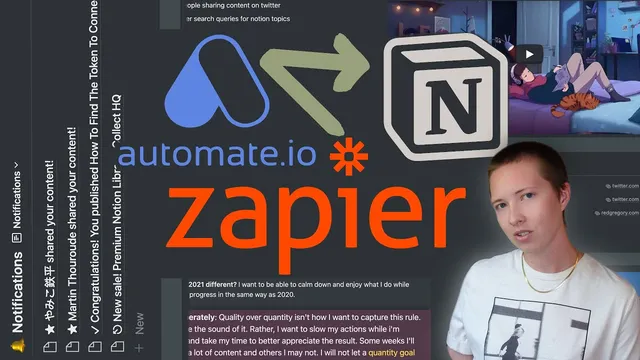
How To Use Notion's API: No-Code Starter Edition
Based on Red Gregory's video on YouTube. If you like this content, support the original creators by watching, liking and subscribing to their content.
Create a dedicated Notion Notifications database to act as the single landing zone for automated updates from multiple external services.
Briefing
Notion’s API is now being used as a central “notifications” hub that automatically collects updates from external services—without writing code—by wiring Zapier and Automate.io to a Notion database. The practical payoff is straightforward: sales, new blog posts, and Twitter mentions can land as structured rows inside Notion, complete with tags, links, and even auto-archiving logic, all while staying within the free-plan limits (up to five bots and monthly action caps).
The setup starts with a Notion workspace page that contains a dedicated Notifications database. That database is designed to store incoming events from multiple sources, using properties like tags (e.g., monetization, reminder, community), an emoji-style “sticker” reminder field, and fields for links and timestamps. A second database—User Research—acts as a place to capture content ideas by running Twitter search queries for posts that match a specific pattern (e.g., tweets mentioning “notion hq” and containing the word “database”).
From there, Zapier is used to create “Zaps” that translate external triggers into new database items. First comes Gumroad: when a Gumroad sale occurs, Zapier creates a new item in the Notifications database. Because Zapier can’t directly select a template icon for a property, the workflow uses a workaround—storing an emoji-like sticker in a text/formula field—so each notification can visually indicate its type. The Gumroad Zap is tested with sample sale events, then turned on.
Next, RSS feeds power content-post notifications. When the blog RSS feed publishes a new item, Zapier creates a Notion notification that includes the article title, a category-based tag (e.g., “program functions”), and a link back to the post. This keeps the content calendar dashboard aligned with what’s actually being published.
Twitter integrations add a more reactive layer. Using Zapier’s “search mentions” trigger, the workflow looks for shares/mentions that include the creator’s website URL while filtering out posts made by the creator themselves. Matching tweets then become Notion notifications, storing tweet text and a link, and using tags like “community” to categorize the source.
Automate.io is then used for a different style of automation: updating existing Notion page content rather than creating new database rows. A bot runs on a Twitter search query (again filtering out the creator), and when new matches appear, it updates a specific “list queries” page by adding a formatted paragraph snippet containing tweet context (tweet text, author, and a tweet link). Finally, Automate.io schedules a weekly reminder: every Friday at 7:00 a.m. Eastern time, it adds a “start brainstorming video idea” notification.
To prevent clutter, the system introduces an Archived Notifications view. A “force archive” checkbox and date-based logic determine which notifications should disappear from the active view, using filters and formulas to move items into the archived state. The result is a multi-source Notion dashboard that stays current automatically—sales, posts, tweets, and scheduled reminders—while remaining manageable through tagging and archiving rules.
Cornell Notes
The core idea is to use Notion’s API as a single destination for automated “notifications” coming from outside tools. A dedicated Notifications database stores structured entries with tags, links, and emoji-style stickers, while Zapier and Automate.io act as the automation layer. Zapier handles event-driven inserts—Gumroad sales, RSS feed posts, and Twitter mentions—by creating new database items in Notion. Automate.io adds complementary automation: updating a Notion page with tweet snippets and scheduling weekly reminders that create new notification items. An archived view, driven by a “force archive” checkbox and date logic, keeps the dashboard from becoming cluttered.
How does the workflow turn external events (like Gumroad sales) into rows inside Notion?
Why is a Notifications database structured with tags, links, and an archive mechanism?
How do RSS feeds become “new post” notifications in Notion?
What’s the approach for Twitter-based notifications without spamming from the creator’s own posts?
How does Automate.io differ from Zapier in how it updates Notion?
How are scheduled reminders implemented and then archived automatically?
Review Questions
- What Notion database properties are essential for categorizing and linking notifications across multiple sources?
- How do the Zapier and Automate.io workflows differ in whether they create new database items versus updating existing Notion page content?
- What filtering and archiving strategy prevents the Notifications database from becoming cluttered over time?
Key Points
- 1
Create a dedicated Notion Notifications database to act as the single landing zone for automated updates from multiple external services.
- 2
Use Zapier “Create database item” to insert new notifications for event-driven triggers like Gumroad sales, RSS “new item” posts, and Twitter mentions.
- 3
Store emoji-style “stickers” in a property to visually label notification types when Zapier can’t set template icons directly.
- 4
Use RSS triggers with the blog’s feed URL to automatically populate Notion with new article titles, categories/tags, and links.
- 5
Configure Twitter search terms with negative filters (e.g., excluding posts from the creator) to avoid self-notifications.
- 6
Use Automate.io for complementary automation such as updating a specific Notion page with formatted tweet snippets and scheduling weekly reminder notifications.
- 7
Add an Archived Notifications view driven by a “force archive” checkbox (and optional date logic) to keep the active dashboard clean.