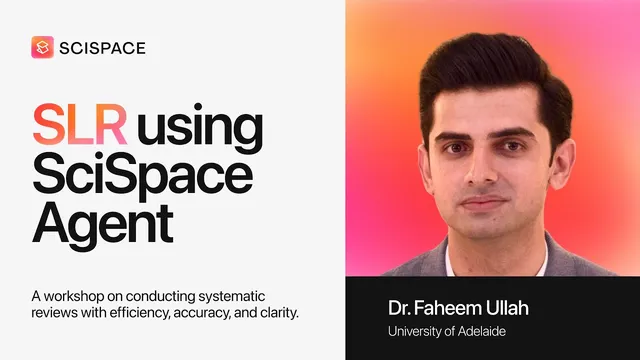
How to use SciSpace Agent for Literature Review | Dr Faheem Ullah | SciSpace Webinar
Based on SciSpace's video on YouTube. If you like this content, support the original creators by watching, liking and subscribing to their content.
An AI agent is a task executor that uses prompts plus planning and tool use to generate structured outputs, not just a free-form chat response.
Briefing
AI agents aimed at researchers can compress months of academic work—especially repetitive steps in literature reviews, writing, and formatting—into workflows that produce near-ready drafts, visuals, and structured outputs. The core pitch is that SciSpace’s research-focused agent uses prompts plus built-in planning and tool use to generate deliverables such as systematic literature reviews, manuscript drafts, research proposals, posters, peer-review-style feedback, and data visualizations. That matters because the bottlenecks in academic productivity often aren’t the “thinking” parts; they’re the time-consuming mechanics: searching, organizing, extracting, drafting, and reformatting.
An AI agent is framed as a task executor: users provide a goal, and the agent combines tools, memory, and planning to carry out the work and return an output. General-purpose assistants like ChatGPT, Siri, Google Assistant, and Alexa are positioned as broad tools, while domain-specific agents—such as those tailored for research—are presented as more concrete and accurate for specialized tasks. The webinar’s central question becomes whether a research-specific agent can outperform the traditional, manual end-to-end process. The answer offered is yes: where a systematic literature review once took roughly four months, a comparable quality review could take about a month using automation for repetitive phases.
The session then breaks down practical research use cases. For systematic literature reviews, the agent is described as helping with the full pipeline: defining research questions and search strategy, collecting and filtering papers, extracting and synthesizing information, and producing a structured review. For proposal drafting, it’s used to generate drafts aligned to specific grant or call requirements, while still emphasizing that researchers must supply judgment about whether the proposal fits their interests and expertise. For manuscript writing, users can provide findings or upload data and request a draft in formats such as PDF and LaTeX, turning research outputs into journal-ready structure.
Other workflows target common academic deliverables. Scientific poster generation is treated as a major time sink when done manually; the agent can convert a paper PDF into a conference-style poster (with sections like introduction, methodology, results, and conclusions) in minutes, followed by only minor edits. Peer review support is presented as a pre-submission quality check: the agent can flag issues such as overly long sentences, grammar/typos, formatting problems, and clarity of claims, then provide strengths, weaknesses, and an overall recommendation (e.g., minor revision). Data visualization is handled by uploading quantitative data and requesting dashboards or multiple chart types (bar charts, histograms, pie charts), with the goal of turning raw results into interpretable patterns and insights.
The final section shifts from productivity to guardrails. The guidance is consistent: AI should support rather than replace researchers, outputs must be reviewed to account for bias and limitations, and researchers must remain actively involved in editing and verification. Academic integrity is emphasized—checking journal policies on AI use, avoiding plagiarism, and protecting sensitive information by not uploading data to unsafe platforms. The message closes with a reminder that research methods are evolving quickly, so staying current on ethical and methodological standards is part of using these tools responsibly.
Cornell Notes
Researchers can use a research-focused AI agent (SciSpace) to automate many repetitive stages of academic work—especially systematic literature reviews, proposal drafting, manuscript creation, poster generation, peer-review-style feedback, and data visualization. The agent works by taking a prompt describing a task, then producing structured outputs that can be downloaded in formats like PDF, PPT, and LaTeX. The practical value is time savings: a literature review that once took months can shrink to about a month by accelerating search, organization, extraction, and drafting. Still, the workflow requires human oversight to correct errors, manage bias, and ensure academic integrity (including plagiarism avoidance and compliance with journal rules).
What makes an “AI agent” different from simply asking a chatbot for an answer?
How does SciSpace’s agent speed up a systematic literature review?
Why shouldn’t researchers fully delegate proposal writing to AI?
What kinds of outputs can the agent generate for writing and presentation?
How does AI “peer review support” work in this workflow?
What safeguards are emphasized when using AI agents for research?
Review Questions
- Which stages of a systematic literature review are most likely to be automated, and which stages still require researcher judgment?
- What are the three questions a research proposal must answer, and how should AI be used relative to those questions?
- List at least three categories of academic deliverables the agent can generate, and describe one human check you would perform for each.
Key Points
- 1
An AI agent is a task executor that uses prompts plus planning and tool use to generate structured outputs, not just a free-form chat response.
- 2
SciSpace positions research-specific agents as more concrete and accurate for scientific tasks than general-purpose assistants.
- 3
Systematic literature reviews can be accelerated by automating repetitive steps like searching, organizing, extracting, and drafting structured sections.
- 4
Manuscript and proposal workflows benefit from AI-generated drafts in downloadable formats (including PDF and LaTeX), but researchers must verify alignment with their expertise and intent.
- 5
Poster generation can be done by converting a paper PDF into a conference-style PPT structure in minutes, followed by manual edits.
- 6
Peer-review-style feedback can flag writing and clarity issues (e.g., long sentences, grammar, formatting) and provide an overall revision recommendation.
- 7
Academic integrity requires checking journal AI policies, avoiding plagiarism, and protecting sensitive data from unsafe uploads.