How to Write a Research Paper/Thesis
Based on Research With Fawad's video on YouTube. If you like this content, support the original creators by watching, liking and subscribing to their content.
Original research that advances knowledge is the priority; replication and heavily studied topics need a clear, defensible novelty to succeed in strong journals.
Briefing
A publishable research paper hinges on originality and a manuscript that lets reviewers quickly see the contribution—especially the theory and literature value. Replication and “tested elsewhere” models are often hard to place in top journals unless the write-up delivers a clear, strong contribution. Likewise, work that targets topics with heavy prior saturation—like building another scale for widely measured constructs (e.g., service quality) or re-testing familiar links (e.g., corporate social responsibility and organizational performance)—tends to struggle unless it adds something genuinely new. That “something” can be a novel variable, a fresh mechanism, or a different data source (for example, collecting from top executives rather than general employees) to create a defensible reason the study matters now.
A strong manuscript is described as content-rich, novel, useful, and exciting, with a logical structure that makes significance easy to verify. Clear presentation matters: English should be readable, concepts should be concrete, and claims should be supported by relevant literature. Reviewers and editors should be able to locate the ingredients of the study—contributions in the introduction and implications in the discussion—without hunting. The practical advice is to follow a journal-friendly structure so the paper’s purpose, design, and contribution are visible in the right sections.
Finding the right journal is treated as a risk-management problem. Submitting to a poor fit wastes months: associate editor review can take 3–4 months, and rejection forces a restart. To reduce that risk, the guidance emphasizes “homework” on journal metrics and recognition, including impact factor and other journal indicators, plus strict compliance with author guidelines. A practical tactic is to check the references in papers already being cited and identify which journals appear most often; those journals can become realistic targets. Journal finder tools (via Google) can also suggest outlets based on a title or abstract.
Writing quality is framed as both language and research fluency. Native-level English helps, but the reviewer must also understand the research domain so they don’t replace field-specific wording with generic language. Sentence-level clarity is emphasized: use direct, short sentences; keep one idea per sentence; and avoid paragraphs that run as a single endless sentence. Reading widely is presented as the simplest lever for improving writing—more reading builds better writing habits.
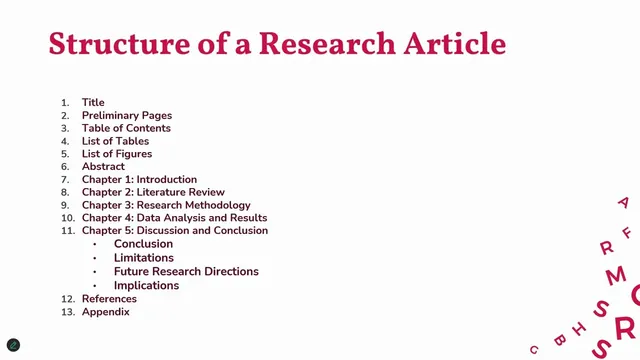
The transcript then lays out a standard research-paper structure: abstract, introduction, literature review, methodology, data analysis, results, discussion, and conclusion (with thesis versions organized as chapters). The abstract should fit within about one page and function as a precise advertisement of purpose, design, methodology, key findings, and social/practical implications. The introduction should justify the topic’s value, summarize what existing research has done, identify gaps and limitations, and lead to the problem statement. For papers, research objectives and questions can be integrated rather than listed separately.
In the literature review, each variable should be discussed individually (concept, definitions, and relevance), then relationships should be built through hypotheses supported by prior findings, contradictions, and complementarity. Theory is repeatedly singled out as the glue: it must be explicitly connected to how variables relate (e.g., using resource-based theory to link corporate social responsibility to organizational performance). Methodology should specify population, sample size, sampling technique, questionnaire distribution, data collection sources, analysis techniques, and the regression/structural model approach. The discussion should compare results to prior research while explaining why findings are significant or insignificant through the lens of the theory. The conclusion should rest on objectives, state limitations, propose future research directions, and spell out theoretical and practical implications—particularly how results advance theory.
Cornell Notes
A publishable paper depends on originality and a manuscript that makes its contribution easy to find. Replication or heavily studied topics are difficult to place in strong journals unless the study adds a clear new variable, mechanism, or context (such as a different population like top executives). Reviewers should quickly locate contributions in the introduction and implications in the discussion, supported by literature and presented in clear, readable English with short, focused sentences. Choosing the right journal requires matching the paper to journal scope and following author guidelines to avoid costly delays and rejections. The transcript also provides a section-by-section blueprint: abstract (purpose, method, findings, implications), introduction (value, gaps, problem statement), literature review (variable definitions and theory-linked hypotheses), methodology (sample and analysis details), and discussion/conclusion (theory-based interpretation, limitations, future research, and implications).
Why are replication studies and “already tested” models often a tough sell in high-quality journals?
What makes a manuscript “strong” from a reviewer’s perspective?
How should authors choose a journal to reduce the risk of rejection and wasted time?
What’s the difference between getting help from someone good at English versus someone good at research writing in a specific field?
How should theory be used in the literature review and discussion?
What should an abstract include, and why does it matter?
Review Questions
- Which kinds of “novelty” can turn a familiar topic into something publishable, and why do replication-only studies struggle?
- How do contributions and implications need to be positioned across the introduction and discussion to help reviewers evaluate significance quickly?
- What specific details must appear in methodology and analysis sections for reviewers to assess credibility (e.g., sampling, questionnaire sources, reliability/validity, and model testing)?
Key Points
- 1
Original research that advances knowledge is the priority; replication and heavily studied topics need a clear, defensible novelty to succeed in strong journals.
- 2
A strong manuscript is content-rich, logically structured, and easy to read, with contributions clearly placed in the introduction and implications clearly placed in the discussion.
- 3
Journal selection should be treated as risk management: match scope, follow author guidelines, and use journal metrics and reference patterns to target likely fits.
- 4
English quality matters, but domain knowledge matters too—use a reviewer who understands both research conventions and field-specific terminology.
- 5
Write with clarity at the sentence level: short, direct sentences with one idea each, and avoid paragraphs that become run-on sentences.
- 6
Use a consistent structure: abstract (purpose, method, findings, implications), introduction (value, gaps, problem statement), literature review (variable definitions and theory-linked hypotheses), methodology (sample and analysis details), and discussion/conclusion (theory-based interpretation, limitations, future research, implications).
- 7
Theory must be explicitly connected to how variables relate, and discussion should interpret results through that theoretical lens rather than only comparing outcomes.