How Your Brain Organizes Information
Based on Artem Kirsanov's video on YouTube. If you like this content, support the original creators by watching, liking and subscribing to their content.
Cognitive maps support generalization by organizing both physical layouts and abstract task variables into reusable structured representations.
Briefing
The brain’s ability to generalize across wildly different situations may depend on a flexible “cognitive map” that organizes both physical space and abstract task variables into a shared, reusable framework. That framework matters because it turns one-off experiences—like learning lasagna in a specific kitchen—into transferable knowledge: the same underlying procedure can be applied in a friend’s unfamiliar layout after the brain strips away irrelevant sensory details and plugs the new context into an internal model of how kitchens work.
Behavioral experiments laid the groundwork for this idea long before neuroscientists could observe the underlying neural machinery. In a classic maze study associated with Edward Tolman, rats trained in one maze were later placed in a new maze with multiple radial arms. When a previously rewarded route was blocked, rats often chose paths that pointed toward the goal direction even if those exact routes had never been directly associated with reward—consistent with the presence of an internal spatial representation rather than pure stimulus-reward association. The modern twist is that similar representational principles appear in neural activity across both spatial and non-spatial tasks.
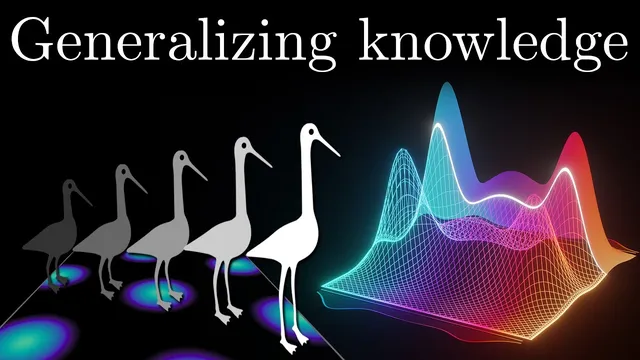
Within the hippocampal formation—especially the hippocampus and entorhinal cortex—research points to a division of labor that supports map-like computation. Place cells in the hippocampus fire when an animal occupies particular locations, but their selectivity depends on context. Grid cells in entorhinal cortex fire in stable, periodic patterns arranged on a hexagonal lattice as an animal moves, providing a kind of coordinate system. Other specialized cells—boundary cells, head direction cells, and landmark- and object-vector-like responses—add information about edges, orientation, and salient features. Crucially, this selectivity is not limited to physical space. Hippocampal neurons can become selective for a particular sound frequency in a one-dimensional “space” of auditory inputs, and entorhinal activity can show grid-like periodicity even when the “environment” is an abstract two-dimensional space defined by bird silhouette parameters.
A unifying computational theme links these diverse domains: represent the world as a graph of connected states, then perform “path integration” on that graph. In physical settings, path integration uses self-motion cues to update position; in abstract settings, the same logic can be applied using rules for how relationships compose. This graph view also clarifies why the same neural machinery could support navigation in rooms, movement in conceptual spaces, and even reasoning over structured categories like family trees.
The brain also appears to infer latent spaces—hidden variables not directly signaled by sensory cues. In a T-maze alternation task, rats must track both physical location and whether the next choice should be left or right based on the previous trial. Neurons dubbed “splitter cells” encode positions in an expanded representation that includes this inferred left/right dimension. In a virtual reality tower accumulation task, hippocampal neurons form place fields over a latent evidence axis defined by the difference in tower counts on each side.
Finally, the system seems to factor knowledge into a structural backbone and a sensory overlay. Entorhinal cortex supplies a stable structural coordinate stream (notably from medial regions with grid-like activity) alongside a sensory stream (from lateral entorhinal areas). The hippocampus then binds these into conjunctive representations, producing context-dependent remapping of place cells when sensory conditions change. The result is a map-like, factorized representation that can generalize efficiently—reusing learned structure while updating sensory context—so the same relational knowledge can guide behavior in new kitchens, new mazes, and new abstract worlds.
Cornell Notes
Cognitive maps are not just for physical navigation. They organize knowledge into structured representations that let animals generalize across contexts—like cooking lasagna in a friend’s kitchen after learning it in one’s own. Evidence from behavior and single-cell recordings points to hippocampal formation circuits that support this flexibility: entorhinal cortex provides a coordinate-like structure (grid-like periodicity) while the hippocampus encodes location and landmarks in a context-dependent way. The same representational machinery extends beyond space to abstract variables such as sound frequency, conceptual 2D spaces, and inferred latent dimensions like “left vs. right” in alternation tasks. A graph-and-latent-space framing helps unify these findings: the brain can build relational graphs and perform path integration on them, while factorizing structure from sensory input to make learning and storage more efficient.
Why do rats in the maze experiment choose routes that were never directly rewarded?
How do place cells and grid cells jointly support a map-like representation?
What evidence suggests the hippocampal-entorhinal system represents non-spatial “spaces”?
How does graph theory unify navigation in physical and abstract domains?
What is a latent space, and how do splitter cells fit in?
Why is factorization of structure and sensory input useful?
Review Questions
- How do grid cells’ relative invariance to context and place cells’ context dependence complement each other in building a cognitive map?
- In what ways can path integration be generalized from physical space to arbitrary graphs or abstract task spaces?
- Describe how latent spaces arise in the T-maze alternation task and what information splitter cells appear to encode.
Key Points
- 1
Cognitive maps support generalization by organizing both physical layouts and abstract task variables into reusable structured representations.
- 2
Behavioral evidence from maze experiments associated with Edward Tolman suggests animals can choose goal-directed paths not directly linked to reward through simple association.
- 3
Entorhinal cortex provides a coordinate-like backbone (grid-like periodicity and related signals), while the hippocampus binds coordinates to context-dependent location and landmarks.
- 4
Map-like neural coding extends beyond space: hippocampal and entorhinal activity can reflect sound frequency and abstract conceptual dimensions with grid-like structure.
- 5
A graph-and-path-integration framework unifies navigation across physical and non-physical domains by treating states as vertices and relations as edges.
- 6
Latent spaces—hidden variables inferred from sequences of observations—are crucial for tasks like alternation in T-mazes and evidence accumulation in virtual reality.
- 7
Factorizing knowledge into structural and sensory components helps the brain generalize efficiently and explains context-driven remapping of hippocampal place cells.