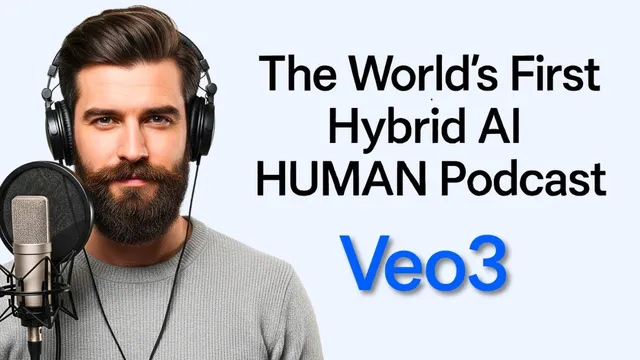
I Joined an AI Hosted Podcast with Google Veo 3
Based on All About AI's video on YouTube. If you like this content, support the original creators by watching, liking and subscribing to their content.
Gemini 2.5 Pro is favored for tasks that require feeding very large amounts of relevant information, thanks to a 1 million token context window.
Briefing
AI hosted podcasting and agent-style tooling are moving from novelty to practical workflow—driven by model choices like long-context Gemini and code-focused Claude, plus integrations such as Anthropic’s Model Context Protocol (MCP). The central takeaway is that knowledge work may soon be reshaped by systems that can pull in relevant information and take actions, but the safest preparation is immediate, hands-on experimentation with the tools already available.
For everyday tasks, Chris relies on ChatGPT for speed and a familiar interface. When work demands large amounts of relevant material—like feeding documents, data, or other context—he turns to Google’s Gemini 2.5 Pro, citing its very large context window. He frames a context window as the amount of information an LLM can keep “in attention” at once, allowing it to use PDFs, images, pasted text, and even spreadsheet-like data during a single run. Gemini 2.5 Pro’s context window is described as 1 million tokens, roughly 800,000–900,000 words, which he treats as a major advantage for complex tasks that require lots of relevant inputs.
For coding and software projects, he prefers Claude from Anthropic, especially in the context of agentic development and MCP. The appeal isn’t just the model itself, but the way Claude can connect to external tools so the system can work with real-world resources—like email or Stripe—by exposing those capabilities as callable “tools” to the model. MCP is positioned as a standard integration layer: an MCP client (such as a Claude desktop app) connects to an MCP server that represents external services. In his analogy, MCP functions like a “USB port for AI,” making it easier to plug different toolsets into an LLM without building bespoke integrations each time.
On the broader question of how agents will affect knowledge work, he calls it early to predict outcomes despite massive investment from major providers. The uncertainty comes down to practical constraints—compute cost, electricity, and other factors that could determine whether automation delivers real value at scale. Still, he encourages people not to wait for certainty: start tracking what’s happening and test the tools.
His preparation advice is direct and non-technical. People should sign up for free options like ChatGPT, download mobile apps, and use AI for concrete tasks—drafting text, critiquing work, or finding tools that fit daily workflows. He also flags a key limitation: hallucinations, meaning users shouldn’t treat every output as automatically reliable.
The conversation closes with a real-world demonstration of AI hosted podcasting. After spending a few hours assembling a setup for a short segment, Chris notes the resulting audio felt coherent and interactive, enabling Q&A-style exchanges rather than a one-way monologue. The implication is that conversational AI systems are becoming more usable and engaging, not just smarter—making them easier to adopt in everyday creative and professional settings.
Cornell Notes
The discussion centers on how to choose among LLMs and integrations for real work: use ChatGPT for quick everyday tasks, Gemini 2.5 Pro when you need massive context (up to 1 million tokens), and Claude for coding and agent-style workflows. A key concept is the “context window,” treated as the amount of information an LLM can hold in attention at once, enabling it to use large inputs like PDFs, images, and pasted data. For agentic systems, Anthropic’s Model Context Protocol (MCP) is presented as a standard way to connect an AI client to external tool servers (e.g., email or Stripe) so the model can access relevant actions and information. The practical takeaway is to start using these tools now, while remembering outputs can include hallucinations.
What does “context window” mean, and why does it change model choice?
How does MCP fit into agentic knowledge work?
Why prefer Claude for coding compared with other models?
What uncertainty surrounds agents automating knowledge work?
What practical steps should non-technical people take to prepare?
Review Questions
- How would you decide between Gemini 2.5 Pro and a faster general-purpose model based on the type of task you’re doing?
- Explain MCP using the idea of an MCP client and MCP server. What problem does MCP solve for integrating tools with an LLM?
- What are two reasons agents’ impact on knowledge work might be slower or less predictable than expected?
Key Points
- 1
Gemini 2.5 Pro is favored for tasks that require feeding very large amounts of relevant information, thanks to a 1 million token context window.
- 2
A context window can be understood as how much information an LLM can keep “in attention” at once, enabling better use of PDFs, images, and pasted data.
- 3
Claude is preferred for coding and software projects, particularly when paired with agentic tooling and MCP-based integrations.
- 4
MCP (Model Context Protocol) standardizes how AI clients connect to external tool servers, making integrations like email or Stripe more plug-and-play.
- 5
Agentic automation’s impact on knowledge work remains uncertain due to practical constraints such as compute costs and electricity usage.
- 6
Preparation should be hands-on: sign up for free AI options, test them on real tasks, and treat outputs cautiously because hallucinations are possible.
- 7
AI hosted podcast setups can become more interactive (Q&A style) rather than one-way monologues, improving usability and engagement.