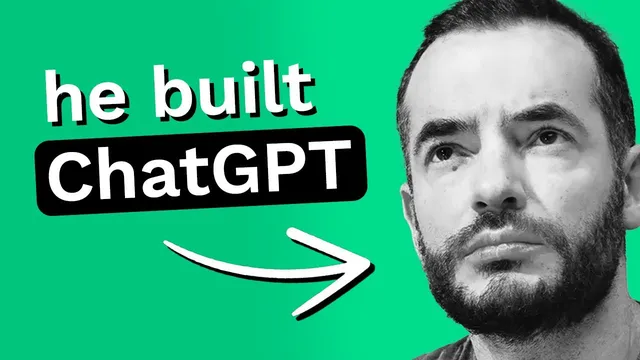
Ilya Sutskever: The Genius Behind OpenAI
Based on David Ondrej's video on YouTube. If you like this content, support the original creators by watching, liking and subscribing to their content.
Sutskever’s public profile lagged behind his technical influence, despite major contributions to deep learning and large language model foundations.
Briefing
Ilya Sutskever’s path from a self-taught coder to OpenAI’s chief scientist traces a rare mix of early obsession, elite mentorship, and timing—yet his public fame never matched his technical footprint. The central throughline is that Sutskever helped build the core machinery behind modern AI breakthroughs, including the deep learning surge and the sequence-to-sequence ideas that later fed into the Transformer architecture powering today’s large language models.
Sutskever was born in the Soviet Union around 1985 or 1986, moved to Israel at age five, and later relocated to Canada as a teenager. He taught himself to code at seven and, by 16, was already hunting for machine learning material at the Toronto Public Library. His stated life goal became building AGI, a drive that pulled him toward the University of Toronto for his bachelor’s, master’s, and PhD—credentials that, in this telling, mattered less than the access they provided to a pivotal figure: Geoffrey Hinton.
Hinton’s deep learning lab became the gravitational center of Sutskever’s early career. He reportedly knocked on Hinton’s door daily, and once admitted, arrived during an “AI winter,” when neural networks were widely dismissed as impractical. That skepticism didn’t slow the work; it hardened it. The turning point came in 2012 with the ImageNet competition, where Hinton, Sutskever, and Alex Krizhevsky created AlexNet. Training deep neural networks on GPUs helped shatter expectations and kick off what’s described as the deep learning revolution.
After joining Hinton’s DNN Research, Sutskever’s trajectory intersected with major industry shifts. Google acquired DNN Research in March 2013 and hired him as a research scientist. At Google Brain, he co-authored the famous AlphaGo paper (alongside names like Demis Hassabis and David Silver), worked on TensorFlow to make research easier, and—most importantly—developed a sequence-to-sequence learning algorithm. In the account, that algorithm became a stepping stone toward the Transformer, the architecture later used to reshape language AI.
The story then pivots from technical breakthroughs to institutional survival. Sutskever joined OpenAI after a dinner with Elon Musk, Sam Altman, and others helped crystallize the early vision. OpenAI’s nonprofit structure made fundraising difficult, and Musk’s reported $1 billion commitment enabled early hiring and progress. In 2016, OpenAI released OpenAI Gym; later came RoboSumo and Universe, followed by Dota 2 bots that outperformed professionals. But costs mounted, and OpenAI was renting compute from Google.
A rupture with Musk led to a funding crisis. Microsoft stepped in with a strategic partnership and $1 billion investment, plus Azure cloud access—relieving OpenAI from paying Google and accelerating model development. With that backing, OpenAI produced GPT-1 (2018) and GPT-2 (2019), and later GPT-3 (2020). The narrative frames the shift from open-source openness as competition-driven rather than safety-driven.
The final leap to mass adoption came when Sam Altman pushed for a user-friendly interface around GPT-3. After internal debate, OpenAI improved GPT-3 into GPT-3.5 using RLHF and launched ChatGPT with a simple UI. The result was explosive: 1 million users in five days. Despite the world’s attention landing on ChatGPT, the credit for the underlying breakthroughs remains anchored to Sutskever’s earlier work—work that, according to the transcript, has earned him major scientific recognition even if his name still isn’t widely known outside AI circles.
Cornell Notes
Ilya Sutskever’s influence on modern AI comes less from public visibility and more from foundational technical contributions and pivotal career timing. After joining Geoffrey Hinton’s deep learning lab during an “AI winter,” Sutskever helped deliver AlexNet in 2012, a breakthrough that demonstrated deep learning’s practical power using GPUs and ImageNet performance. At Google Brain, he co-authored the AlphaGo paper and developed sequence-to-sequence learning ideas that later fed into the Transformer architecture used for large language models. His OpenAI work spans GPT-1 and GPT-2, while institutional shifts—especially Microsoft’s Azure-backed investment—helped keep model development moving. ChatGPT’s rapid adoption is credited to pairing GPT-3.5 with a simple interface, turning research into a mainstream product.
Why did Sutskever’s early career hinge on Geoffrey Hinton’s lab?
What made AlexNet in 2012 a turning point for deep learning?
How does the transcript connect Sutskever’s sequence-to-sequence work to today’s Transformer-based systems?
Why did OpenAI’s funding model create existential pressure early on?
What role did Microsoft’s Azure play in OpenAI’s momentum?
What changed when ChatGPT launched, and why did adoption accelerate so fast?
Review Questions
- How did the transcript describe the relationship between AI winter skepticism and the eventual success of deep learning?
- Which milestones are used to connect Sutskever’s technical work (sequence-to-sequence, Transformer) to OpenAI’s GPT line?
- What institutional changes (nonprofit funding, Microsoft/Azure partnership) are portrayed as necessary for ChatGPT’s path to market?
Key Points
- 1
Sutskever’s public profile lagged behind his technical influence, despite major contributions to deep learning and large language model foundations.
- 2
Relentless pursuit of Geoffrey Hinton’s deep learning lab placed Sutskever in the right environment to survive an AI winter and later capitalize on ImageNet.
- 3
AlexNet’s success is attributed to deep neural networks trained on GPUs, demonstrating deep learning’s practical power in 2012.
- 4
Sequence-to-sequence learning work at Google Brain is presented as a precursor that helped lead to the Transformer architecture.
- 5
OpenAI’s early nonprofit structure made fundraising difficult, creating repeated survival pressure tied to major investor commitments.
- 6
Microsoft’s $1 billion investment plus Azure access is portrayed as a decisive fix for compute costs and a catalyst for GPT-1 and GPT-2 progress.
- 7
ChatGPT’s explosive adoption is credited to pairing GPT-3.5 with a simple, user-friendly interface rather than only pushing for incremental model improvements.