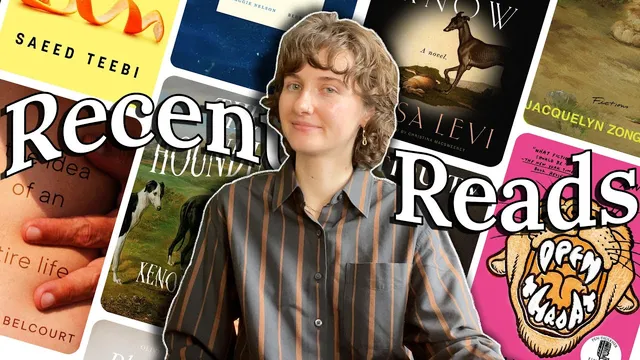
I'm obsessed with this book about a queer mountain lion + small press books | recent reads 64
Based on ShaelinWrites's video on YouTube. If you like this content, support the original creators by watching, liking and subscribing to their content.
“Open Throat” uses a punctuation-free, fragmented style to make a mountain lion’s thoughts feel instinctive, while treating queerness as non-human and “in nature.”
Briefing
A queer mountain lion narrates “Open Throat” in blunt, punctuation-free fragments—an animal voice that feels uncannily accurate even as it flirts with the question of whether hunger justifies killing. Henry Hul’s Los Angeles predator lives behind the Hollywood sign, mulling early on whether to eat a person, and the book’s fragmented form (no capitalization, no punctuation except “I”) turns thought into something like instinct. The narrator’s “English” is whimsical but not random: he overhears hikers and sometimes misunderstands, creating a lovable, unsettling intelligence. The review also highlights how the novel treats queerness as something primal and non-human—less about projecting human identity onto an animal and more about asking what queerness might mean “in nature.” In the second half, the plot shifts in a way that demands more suspension of disbelief, but the ending lands with clarity and illumination, making it a standout read of the year.
The rest of the recent-read list leans toward genre-bending small-press work, with mixed results on execution. “The Hounding” by Zenob Pervvis borrows the gothic, rumor-driven machinery of “The Virgin Suicides,” set in an 18th-century English countryside where five Mansfield sisters are rumored to be turning into dogs. The atmosphere is moody and grotesque, but the conflict often cycles through the same sightings and gossip without meaningful escalation. The rotating, mostly male perspectives are interesting on paper, yet the reviewer finds the individual narrators less distinct—and therefore less haunting—than the collective witness structure that made “The Virgin Suicides” so famous.
Alisa Levy’s “All I Know,” translated by Christina Mcweeny, is folk horror in a fableistic forest town where people who enter don’t return, while dogs do. The protagonist’s gut-burning unease and a town-wide “end of the world festival” build toward an apocalyptic question—whether she will leave—but the sustained monologue format keeps the festival and dread feeling more like background than driving urgency. The voice is charming and the meandering storytelling has its own closeness, yet the reviewer feels the structure blunts sharpness and incisiveness, leaving uncertainty about the ending.
Olivia Tapiro’s “Photoaxis,” translated by Kit Schlutoter, is described as bizarro and politically alert: a city overflowing with meat, a museum bombing, a piano player obsessed with snuff films, and a missing political organizer. The book’s mosaic structure and surreal, image-heavy sections read like flash fiction fragments, and the reviewer praises its experimental, philosophical approach to dystopia as a political reality rather than a speculative genre exercise. “Antiquity” by Hannah Johansson, translated by Kira Joff, is called a sapphic “Lolita,” following a journalist’s obsession with artist Helena and her teenage daughter Olga on a Greek island. The reviewer is especially struck by the novel’s memory-centered, vignette structure and by how it makes grooming feel “truthful” through the narrator’s self-serving obscuring—disturbing not because the book preaches, but because it shows how moral choices get romanticized in recollection.
Other picks broaden the range: “Bard Skull” by Martin Shaw is an intentionally confusing, myth-cacophony quest that can be read deeply or simply allowed to crash over the reader; “Her first Palestinian” by Saïd TV is grounded realist short fiction shaped by compression and careful word choice; Jacqueline Zong Lee Ross’s “The Longest Way to Eat a Melon” uses playful list formats to interrogate art-making under late-stage capitalism; and Maggie Nelson’s “Luettes” is a compact, mosaic lyric essay on the color blue that braids philosophy, architecture, research, and personal love.
The list ends with a more skeptical note on Nikki Gonzalez’s horror novel “Dualer,” where mood and atmosphere sometimes land but pacing, character depth, and payoff feel underwhelming. Overall, the strongest through-line is a preference for experimental form—fragmentation, mosaics, vignettes, and lyric essays—especially when it sharpens voice and theme rather than merely decorating the page.
Cornell Notes
Henry Hul’s “Open Throat” is the standout: a queer mountain lion narrates in fragmented, punctuation-free language that feels instinctive and endearing, while the story treats queerness as something non-human and “in nature.” The reviewer then tests similar genre experiments across small-press work—praising atmosphere and style in “The Hounding,” “All I Know,” and “Photoaxis,” but criticizing where plot escalation or narrative urgency doesn’t match the concept. “Antiquity” earns high marks for its vignette structure, fluid recollection, and a disturbing honesty about grooming through self-obscuring memory rather than moralizing. Across the list, mosaic and lyric forms (from Saïd TV’s realism to Maggie Nelson’s “Luettes”) are repeatedly valued for how they concentrate theme, voice, and emotional pressure.
Why does “Open Throat” feel unusually convincing as an animal narrative?
What’s the core complaint about “The Hounding” despite its strong gothic atmosphere?
How does the monologue form affect “All I Know”?
What makes “Photoaxis” feel politically different from many dystopian novels?
Why does “Antiquity” stand out as a “sapphic Lolita” without relying on overt moral instruction?
How do form and compression drive the appreciation of “Her first Palestinian” and “Luettes”?
Review Questions
- Which narrative techniques in “Open Throat” (fragmentation, punctuation rules, overheard language) most directly create the sense of an animal mind—and where does the reviewer think disbelief becomes harder later?
- Compare the role of witness structure in “The Hounding” versus “The Virgin Suicides” as described here. What does the reviewer think is missing?
- What does the reviewer suggest about how form (monologue in “All I Know,” mosaic in “Luettes,” vignettes in “Antiquity”) can either sharpen or blunt thematic urgency?
Key Points
- 1
“Open Throat” uses a punctuation-free, fragmented style to make a mountain lion’s thoughts feel instinctive, while treating queerness as non-human and “in nature.”
- 2
“The Hounding” delivers strong gothic atmosphere but underdelivers on plot escalation, with conflict largely repeating rumor rather than producing new complications.
- 3
“All I Know” builds folk-horror dread through gut-burning unease and an end-of-world festival, yet the sustained monologue format keeps the apocalypse feeling more like background than pressure.
- 4
“Photoaxis” is praised for its surreal mosaic structure and for treating dystopia as politically grounded rather than genre-speculative, with fascism and its “counterparts” in view.
- 5
“Antiquity” is valued for its memory-driven vignette structure and for portraying grooming through self-obscuring recollection rather than explicit moral lecturing.
- 6
“Bard Skull” can be approached either through deep myth research or as an intentionally confusing crash of folklore and voice, depending on how much time the reader invests.
- 7
“Dualer” is criticized for pacing and payoff: too much time before the main setting arrives, characters that don’t feel compelling, and a conclusion that doesn’t deliver strong suspense.