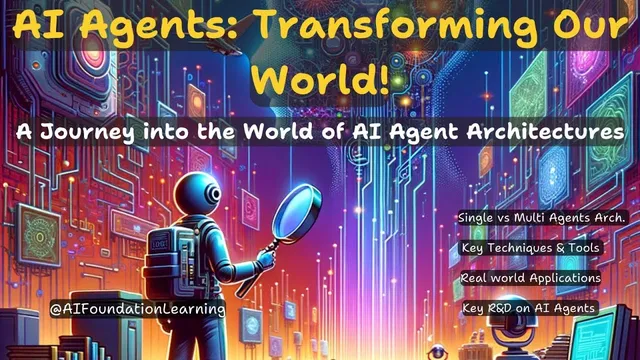
Innovations in AI Agents Architecture : Deep Dive | AI Agents Explained
Based on AI Foundation Learning's video on YouTube. If you like this content, support the original creators by watching, liking and subscribing to their content.
Single-agent architectures use one language model for end-to-end tasks, making them suitable for self-contained problems.
Briefing
AI agent architectures are moving from simple “chatbots” toward systems that can reason, plan, and use tools to complete real tasks—often by coordinating multiple specialized agents. The core takeaway is that agent design choices determine how reliably these digital workers can handle complexity: single-agent setups work best for self-contained problems, while multi-agent architectures are built for tasks that require parallel inputs, delegation, and continuous collaboration.
In single-agent architectures, one language model handles the full workflow. Two popular patterns illustrate how that single model operates. In ReAct (“reason plus act”), the agent iteratively writes down its reasoning, takes an action, observes the result, and repeats until the goal is reached. That step-by-step trace is positioned as a way to improve transparency and trust—for instance, a customer service agent can consider each step before answering. Another approach, ReaSE (with memory components), adds short-term and long-term memory to make behavior more personalized over time. In sales and customer support scenarios, memory lets agents recall past interactions, enabling tailored communication. The same idea extends to everyday assistance, like remembering grocery preferences and suggesting items when supplies run low.
When tasks become too complex for one agent, multi-agent systems distribute work across several agents. Vertical architectures use a leader-follower structure: one agent delegates tasks to specialized agents (such as scheduling or resource allocation) and then consolidates their reports. A smart home example fits this model, with a central manager coordinating lighting, temperature, and security. Horizontal architectures, by contrast, treat agents as peers that share a common environment and exchange information continuously. This suits collaborative research or product development, where different expertise must interact in real time.
For agents to be effective, three capabilities are repeatedly emphasized: reasoning, planning, and tool calling. Reasoning is the decision-making layer, such as analyzing market data for trading predictions. Planning includes task decomposition—breaking large goals into smaller subtasks—and plan selection, where the agent evaluates multiple strategies before committing. Tool calling enables agents to interact with external APIs and systems; a customer service agent might pull customer records from a CRM to craft accurate responses.
The transcript also points to emerging agent frameworks like Auto GPT and baby AGI as examples of systems that can autonomously plan and execute multi-step tasks. In terms of real-world impact, the applications span healthcare (diagnostic support and real-time monitoring), finance (trend analysis and fraud detection), and customer service/e-commerce (24/7 support and faster query resolution). Finally, major research and product organizations—Google DeepMind, IBM, Microsoft, and OpenAI—are described as pushing agent capabilities through reinforcement learning, business-oriented decision support, natural language interaction, and general-purpose reasoning, respectively. The outlook is that agents will become increasingly self-sufficient, coordinating across smart cities, scientific research, education, and other domains where real-time coordination and personalization matter.
Cornell Notes
AI agent architectures are designed to make digital workers capable of completing goals, not just answering questions. Single-agent systems rely on one language model, using patterns like ReAct (reason → act → observe) for transparency and ReaSE (memory-enhanced behavior) for personalization. Multi-agent systems split work across specialized agents, using vertical designs (leader delegates and consolidates) or horizontal designs (peer agents share information continuously). Effective agents depend on reasoning, planning (including decomposition and plan selection), and tool calling to use external APIs and data. This combination enables applications across healthcare, finance, and customer service, with major labs pushing toward more autonomous, reliable agents.
How does ReAct improve an agent’s reliability compared with a single-pass response?
What does adding memory (as in ReaSE) change about agent behavior in customer-facing tasks?
When should a system switch from single-agent to multi-agent architecture?
What’s the practical difference between vertical and horizontal multi-agent architectures?
Why are reasoning, planning, and tool calling treated as the “three core capabilities”?
How do frameworks like Auto GPT and baby AGI relate to the architecture discussion?
Review Questions
- In a ReAct-style agent, what triggers the next iteration of the loop, and how does that affect task completion?
- Describe how task decomposition and plan selection work together in an agent’s planning process.
- Give one example of a tool-calling use case and explain what external system the agent would need to access.
Key Points
- 1
Single-agent architectures use one language model for end-to-end tasks, making them suitable for self-contained problems.
- 2
ReAct structures work as an iterative loop of reasoning, acting, observing, and repeating to improve transparency and correction.
- 3
ReaSE-style memory adds short-term and long-term recall so agents can personalize responses based on prior interactions.
- 4
Multi-agent systems split complex goals across specialized agents, using either vertical (leader delegation) or horizontal (peer collaboration) designs.
- 5
Effective agents rely on reasoning, planning (decomposition and plan selection), and tool calling to use external data and APIs.
- 6
Agent frameworks such as Auto GPT and baby AGI emphasize autonomy by enabling agents to plan and execute tasks without step-by-step human control.
- 7
Real-world deployments span healthcare monitoring and diagnostics, finance trading and fraud detection, and customer service/e-commerce support.