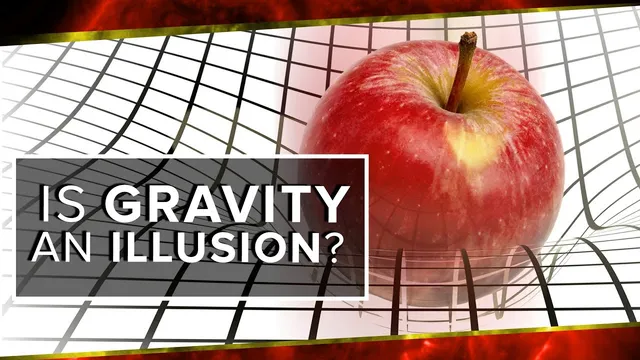
Is Gravity An Illusion?
Based on PBS Space Time's video on YouTube. If you like this content, support the original creators by watching, liking and subscribing to their content.
Newton’s laws apply cleanly only in inertial frames, which are defined by the behavior of force-free objects.
Briefing
Gravity may be “real” in the sense that it shapes motion, but Einstein’s leap was to treat it as something that could be an illusion of perspective—an idea rooted in how acceleration and free fall look identical to local observers. The core insight is the equivalence principle: inside a freely falling box, objects feel weightless in exactly the same way they would in a gravity-free region of space. If that sameness is fundamental, then what people call gravitational force could be an artifact of being in an accelerated frame, much like the apparent “backward gravity” felt in an accelerating train.
The argument starts with Newtonian mechanics and the role of reference frames. Motion is always measured relative to something, and Newton’s second law only cleanly applies in inertial frames—frames that are not accelerating relative to each other. In a uniformly accelerating train, passengers and objects all lurch backward together even though no horizontal forces act on them. Newtonian accounting explains this by adding an effective gravitational field pointing opposite the train’s acceleration. Combine that “fake” field with Earth’s real downward gravity and the net direction tilts, so pendulums and balloons align with the new effective “down.” In that sense, an accelerating car can mimic the experience of being on a different planet with a slightly stronger gravity and a tilted vertical.
Einstein asked whether the same logic could apply to Earth itself. If gravity is fictitious, then Earth’s surface would be accelerating upward relative to a standard of non-acceleration defined by free fall. A freely falling frame passes the Newtonian test for inertial behavior—force-free objects remain at rest relative to it—so long as gravity is just a coordinate effect. Locally, an observer cannot tell whether they are in intergalactic weightlessness or in free fall near Earth, because the observable physics matches.
Two complications arise in a real gravitational field because Earth is round. Objects released in a falling box don’t follow perfectly parallel paths; they drift toward each other slightly, which seems to violate the simple “no acceleration” expectation. Also, frames on an orbiting platform like the ISS are not equivalent to frames falling straight down, yet they appear to behave inertially in their own context. The resolution is that the rule about inertial frames only works cleanly in flat (Euclidean) spacetime. In curved spacetime, “straight line” and “constant speed” are geometric notions that change meaning, and inertial frames can be consistent even when they accelerate relative to one another in the everyday sense.
That geometric fix took Einstein years, culminating in general relativity: gravity becomes the manifestation of curved spacetime, not a conventional force. In that framework, orbits such as the ISS path are constant-speed “straight lines” in curved geometry, and the sensation of gravity comes from how spacetime curvature shapes motion. The episode ends by tying the idea back to everyday experience—accelerating chairs, trains, and cars—while setting up the next step: how geometry can make “straight lines” behave in ways that look like forces even when none act locally.
Cornell Notes
Einstein’s equivalence principle reframes gravity as a perspective effect tied to acceleration. In Newtonian physics, an accelerating frame mimics a gravitational field opposite the frame’s acceleration, making pendulums and balloons align with a tilted “down.” Einstein extended the idea: in a freely falling box, weightlessness is indistinguishable from being far from any gravity, so gravity could be an artifact of being in an accelerated frame. The remaining tension—Earth’s round shape and the behavior of orbiting frames—forces a deeper change: inertial-frame reasoning depends on flat spacetime. In curved spacetime, general relativity restores consistency by treating gravity as geometry rather than a conventional force.
How does an accelerating train car create an effect that looks like gravity?
What does the equivalence principle claim using the “freely falling box” thought experiment?
Why does Earth’s roundness complicate the idea that freely falling frames are simply inertial?
How do orbiting frames like the ISS fit into the inertial-frame picture?
What role does spacetime curvature play in making Einstein’s viewpoint self-consistent?
Review Questions
- In an accelerating car, what observable behavior signals the presence of an effective gravitational field, and in what direction does it point relative to the car’s acceleration?
- Why does the equivalence principle imply that observers in free fall cannot distinguish their situation from being far from gravity?
- What specific assumption about spacetime geometry must change for inertial-frame reasoning to remain consistent in general relativity?
Key Points
- 1
Newton’s laws apply cleanly only in inertial frames, which are defined by the behavior of force-free objects.
- 2
An accelerating reference frame produces an effective “fake” gravitational field opposite the acceleration, tilting the apparent direction of “down.”
- 3
Einstein’s equivalence principle extends this idea: free fall is locally indistinguishable from weightlessness in a gravity-free region.
- 4
Earth’s curvature means different parts of a freely falling box follow slightly different paths, producing relative motion even without forces.
- 5
Consistency requires abandoning the assumption of flat (Euclidean) spacetime; curved spacetime changes what “straight line” and “constant speed” mean.
- 6
General relativity replaces gravity-as-force with gravity-as-geometry, explaining orbital paths as straight lines in curved spacetime.