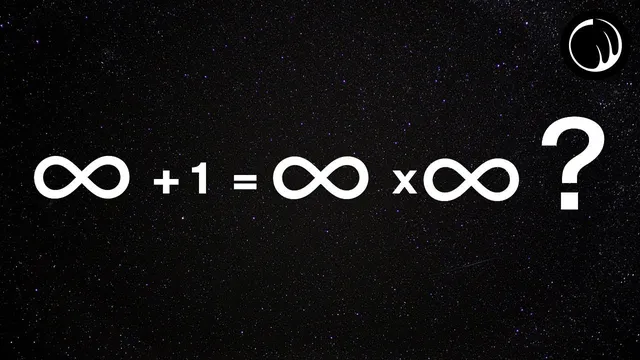
Is Infinity Real?
Based on Pursuit of Wonder's video on YouTube. If you like this content, support the original creators by watching, liking and subscribing to their content.
Infinity is treated as a concept with different cardinalities, not a single number that simply grows larger.
Briefing
Infinity isn’t a single “bigger number” but a concept that comes in different sizes—some of which can be paired with the natural numbers, and others that can’t. That distinction matters because it turns “endless” from a vague intuition into a precise mathematical question: can every element of a set be listed and matched one-to-one with 1, 2, 3, and so on? The transcript argues that even when infinities feel like they should behave differently under addition or multiplication, mathematics allows surprising equivalences among certain infinite sets.
To make that concrete, the discussion starts with the idea of countable infinity: a set is countable if its elements can be listed in principle, given infinite time. Under that definition, the natural numbers are countably infinite, and so are the integers (including negatives). The key tool is a one-to-one correspondence (bijection): even though the numbers themselves don’t “line up,” the sets can still be the same size if every element in one set matches exactly one element in the other. That’s why there are “as many” even numbers as there are whole numbers, and why the same holds for primes—each can be matched to a unique natural number.
Hilbert’s Infinite Hotel Paradox then dramatizes how countable infinities can absorb additional countable infinities without changing size. Imagine an infinite hotel with rooms numbered 1, 2, 3, … and every room occupied. A new guest arrives; the manager shifts every current guest from room n to n+1, freeing room 1. The hotel remains full, yet it has room. The paradox escalates: if countably infinite buses of new guests arrive—each bus bringing countably infinite people—the manager can still reassign guests so that every person gets a unique room. The transcript describes strategies such as moving guests from n to 2n to clear all odd-numbered rooms, or using prime numbers and exponentiation to map each guest to a unique finite room number. The takeaway is stark: for countable sets, “infinity + infinity” can still be the same size as infinity.
But Cantor’s work draws a line that Hilbert can’t cross. Cantor asks whether there exist infinities that are too large to be listed—sets that cannot be put into one-to-one correspondence with the natural numbers. While rational numbers (fractions, integers, and decimals that repeat or terminate) are countable, the real numbers include irrationals like π and √2. Cantor’s diagonal argument shows that any supposed complete list of real numbers must miss at least one number: by changing the nth digit of the nth listed number, a new number is constructed that differs from every listed entry in at least one digit. That means the real numbers between 0 and 1 form an uncountable infinity, larger than any countable infinity.
The transcript closes by wrestling with what these results mean for physical reality and human logic. If infinity can’t be fully tested or enumerated in the real world, why does mathematics produce such exact, counterintuitive conclusions? The unresolved tension is whether math reveals a real structure of the universe that exceeds intuition, or whether human reasoning forces logic into forms that don’t map neatly onto the physical world. Either way, infinity remains a boundary case—mathematically rigorous, conceptually unsettling, and still not fully understood.
Cornell Notes
Infinity is treated as a concept with multiple “sizes,” not a single endless quantity. Countable infinity—sets that can be listed and matched one-to-one with the natural numbers—behaves in counterintuitive ways, such as Hilbert’s Infinite Hotel absorbing infinitely many new guests without running out of rooms. The transcript then contrasts this with Cantor’s diagonal argument, which proves that real numbers (including irrationals like π and √2) form an uncountable infinity that cannot be fully listed or paired with the natural numbers. The result is a hierarchy: some infinities are strictly larger than others. The open question becomes what these mathematical distinctions mean for physical reality, since infinity can’t be directly tested or enumerated in the real world.
What does it mean for two infinite sets to be the “same size,” and why does that overturn everyday intuition?
How does Hilbert’s Infinite Hotel show that “infinity + 1” and even “infinity + infinity” can stay the same size?
Why does the diagonal argument imply that real numbers are “too big” to be countable?
What’s the key difference between rational and irrational numbers in terms of countability?
What does the transcript suggest about the relationship between mathematical proofs and physical reality?
Review Questions
- How does the definition of countable infinity (listable in principle) determine whether a set can be matched to the natural numbers?
- What specific mechanism in Hilbert’s Infinite Hotel allows infinitely many new guests to be assigned without room overlap?
- Why does Cantor’s diagonal argument guarantee that any purported list of real numbers must be incomplete?
Key Points
- 1
Infinity is treated as a concept with different cardinalities, not a single number that simply grows larger.
- 2
Countable sets are those whose elements can be listed in principle and matched one-to-one with the natural numbers.
- 3
Bijections let infinite sets have equal size even when everyday counting intuition says otherwise.
- 4
Hilbert’s Infinite Hotel demonstrates that adding a finite number—or even another countably infinite set—to a countably infinite set can leave cardinality unchanged.
- 5
Cantor’s diagonal argument proves that real numbers are uncountable, making their infinity strictly larger than any countable infinity.
- 6
Rational numbers are countable, but irrationals like π and √2 push the real numbers into uncountable territory.
- 7
The transcript ends by questioning how mathematical certainty about infinity relates to what can exist or be verified in physical reality.