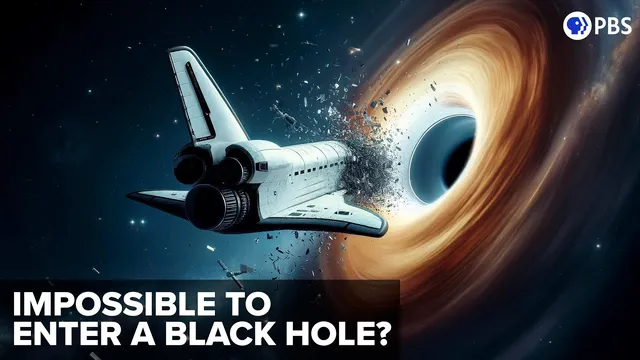
Is It IMPOSSIBLE To Cross The Event Horizon? | Black Hole Firewall Paradox
Based on PBS Space Time's video on YouTube. If you like this content, support the original creators by watching, liking and subscribing to their content.
Unitarity conflicts with the idea that black holes both destroy and later radiate quantum information, motivating the information paradox.
Briefing
Black holes may force a brutal choice between two pillars of modern physics: preserving quantum unitarity or keeping Einstein’s equivalence principle intact. The “firewall” idea—an infinitely hot barrier at the event horizon—emerges from a chain of reasoning about quantum entanglement that, if correct, would prevent anything from smoothly crossing the horizon. That matters because it turns the event horizon from a harmless boundary into a place where the laws of quantum information and the laws of gravity can’t both remain consistent.
The starting point is the black hole information paradox. If black holes evaporate via Hawking radiation while also swallowing quantum information, then the same quantum bit (qubit) would effectively be present in two places: inside the black hole and in the outgoing radiation. That would violate unitarity, the requirement that quantum evolution preserves information. Black hole complementarity tried to dodge the contradiction by arguing that no single observer could ever verify both copies. But the firewall argument sharpens the problem by focusing on entanglement rather than just cloning.
Entanglement is treated as the glue connecting the horizon to the radiation. As a black hole grows, its entropy rises, and with it the number of hidden degrees of freedom. Hawking radiation is described as coming from quantum field fluctuations near the horizon: one partner falls in while the other escapes, and the two must be entangled. Early on, the outgoing radiation is mostly entangled with the inaccessible horizon, so it carries little usable information. Later—around the Page time, roughly when about half the black hole’s mass has evaporated (near the 90% mark in time)—the entanglement pattern flips: the remaining horizon qubits become maximally entangled with the already-emitted Hawking cloud. At that point, a newly emitted Hawking qubit would need to be entangled both with the distant radiation (to preserve unitarity) and with a nearby interior partner (to maintain the smooth vacuum expected by the equivalence principle).
Quantum mechanics imposes a constraint: entanglement is monogamous. A qubit maximally entangled with one system can’t also be maximally entangled with a third. The AMPS (Ahmed Almheiri, Donald Marolf, Joseph Polchinski, and James Sully) argument claims that the entanglement requirements can’t all be satisfied simultaneously. If the horizon-to-interior entanglement is broken to save monogamy and unitarity, then the “vacuum” near the horizon is no longer empty for an infalling observer. The result is a firewall: extreme energy that would turn the would-be smooth crossing into something catastrophic.
Firewalls also undercut complementarity’s central promise. An observer could, in principle, test whether the horizon is “special” without ever entering, and then infer whether entanglement across the horizon exists. If it doesn’t, the interior effectively loses its quantum structure; if it does, monogamy and unitarity fail. Even so, physicists remain divided. Some argue equivalence principle violation is less radical than unitarity violation, while others look for ways to repair the underlying framework—such as breakdowns in quantum field theory near horizons, alternative causal descriptions, or string-theory “fuzzballs” where information never truly disappears behind a classical horizon. The upshot: the firewall paradox is less a final answer than a demand to rethink how black holes, quantum information, and spacetime fit together.
Cornell Notes
The firewall paradox reframes the black hole information problem using quantum entanglement. Hawking radiation requires entanglement between outgoing particles and their partners near the horizon, while unitarity demands that late radiation become entangled with earlier radiation after the Page time. Quantum entanglement is monogamous, so a qubit can’t be maximally entangled with both the interior partner and the distant radiation at once. To keep unitarity, the horizon–interior entanglement must be broken, which implies the infalling observer encounters a radically altered, high-energy “firewall” rather than a smooth vacuum. The result is a direct tension between preserving unitarity and maintaining Einstein’s equivalence principle at the event horizon.
What does the black hole information paradox claim goes wrong with quantum information?
Why does the Page time matter for entanglement-based arguments?
How does the AMPS argument use entanglement monogamy to force a contradiction?
What exactly is a “firewall,” and how does it resolve the entanglement problem?
Why does the firewall clash with Einstein’s equivalence principle?
What alternative directions do physicists consider if firewalls are not accepted?
Review Questions
- How do unitarity and the equivalence principle impose competing entanglement requirements on a late-time Hawking qubit?
- What role does monogamy of entanglement play in turning the information paradox into the AMPS firewall paradox?
- Why does the entanglement structure change around the Page time, and how does that enable the contradiction?
Key Points
- 1
Unitarity conflicts with the idea that black holes both destroy and later radiate quantum information, motivating the information paradox.
- 2
Entanglement patterns between the horizon and Hawking radiation evolve during evaporation, with a key transition around the Page time.
- 3
After the Page time, late Hawking quanta must be entangled with earlier radiation to preserve unitarity.
- 4
Smooth horizon physics expected from the equivalence principle requires entanglement between outgoing quanta and interior partners.
- 5
Monogamy of entanglement prevents a qubit from being maximally entangled with both the distant radiation and the interior partner simultaneously.
- 6
The firewall hypothesis breaks horizon–interior entanglement, saving unitarity but violating the equivalence principle by making the horizon locally violent.
- 7
If firewalls are rejected, the fix likely requires changing assumptions about quantum field theory near horizons or adopting new quantum-gravity mechanisms (e.g., fuzzballs).