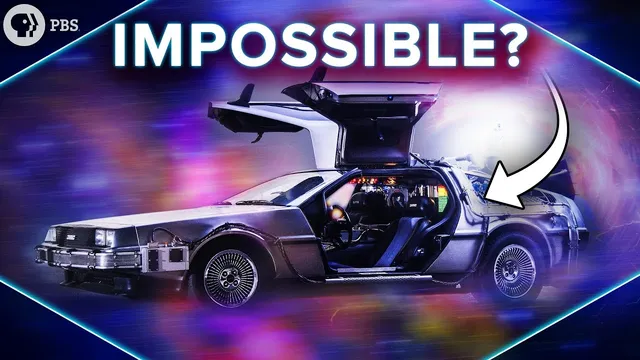
Is Time Travel Impossible?
Based on PBS Space Time's video on YouTube. If you like this content, support the original creators by watching, liking and subscribing to their content.
Time dilation from special relativity enables one-way travel into the future, but reversing time would require faster-than-light motion.
Briefing
Time travel isn’t ruled out by the core equations of relativity, but every workable route runs into a wall—either it requires exotic, likely unphysical matter, or it produces closed time-like paths only in extreme, impractical setups that still threaten causality.
Special relativity allows time dilation: a fast-moving traveler can experience less time than someone on Earth, making a one-way “future” trip possible in the sense of returning after far more years have passed. The same math also hints at a more dramatic possibility—if an object could exceed light speed, its time evolution would reverse. But faster-than-light travel is blocked for ordinary mass because reaching light speed would demand infinite energy. The only way around that within the equations is to allow “imaginary” (complex) mass, which leads to tachyons—hypothetical particles that can move only faster than light and therefore only backward in time. There’s no evidence for tachyons, and the idea remains a mathematical loophole rather than a credible physical mechanism.
General relativity offers a more geometric path: warp spacetime itself. The best-known candidate is a wormhole, a tunnel-like connection between two regions of spacetime. If one mouth of a stable wormhole is accelerated to near light speed (or placed in a deep gravitational well) and then the mouths are brought back together, the mouths can become permanently offset in time. Traversing the “future” end could, in principle, deliver someone to the “past.” Yet GR’s equations make large wormholes unstable: they collapse into black holes unless the wormhole throat is held open. Keeping it open appears to require negative energy density—often described as “negative mass” or exotic matter. The Casimir effect produces negative energy density in a limited laboratory setting, but scaling it up to the planetary or stellar magnitudes needed for a traversable wormhole remains an unsolved leap.
Other GR-based time machines also rely on special conditions. A Tipler cylinder—an infinitely long, extremely dense, rapidly rotating cylinder—can generate closed time-like curves, letting a traveler loop back to their own past. But Hawking’s results suggest that finite cylinders fail unless negative energy is introduced, effectively pushing the problem back to the same exotic-matter requirement. Gödel’s rotating universe and the interior of a Kerr (rotating) black hole also admit closed time-like curves, but they confine “time travel” to narrow, highly constrained domains.
The deeper issue is causality. Physicists don’t know a fundamental law that outright forbids time travel, yet they expect it to be impossible because backward causation invites paradoxes. Stephen Hawking’s Chronology Protection Conjecture proposes that physics will prevent time travel or allow it only in paradox-free circumstances. One route to paradox avoidance is the Novikov Self-Consistency Principle: events along a closed time-like curve must be self-consistent, so attempts to change the past simply become part of the loop. Another possibility is Everett’s many-worlds interpretation, where a “changed” past would branch into a different timeline rather than erase the traveler’s origin. Still, without a complete theory of quantum gravity, these are provisional. Even the absence of time travelers is treated as a clue—Hawking’s “time traveler cocktail party” produced no arrivals.
For now, relativity permits the mathematics of time loops, but physics seems to keep them either unstable, inaccessible, or causally constrained—leaving humanity with the only direction that reliably works: forward time, one irreversible step at a time.
Cornell Notes
Relativity’s equations allow scenarios that look like time travel, but turning them into usable machines runs into major physical barriers. Special relativity supports time dilation for fast travel (a one-way trip into the future), while reversing time would require faster-than-light motion and leads to tachyons—purely hypothetical particles with imaginary mass and no evidence. General relativity allows closed time-like curves via wormholes or rotating spacetimes, yet traversable wormholes need stability that appears to require negative energy density or exotic matter on enormous scales. Even when closed time-like curves exist in solutions like Gödel’s universe or inside Kerr black holes, they are confined to special, often impractical regions. Hawking’s chronology protection and self-consistency ideas aim to prevent paradoxes, but the final verdict depends on quantum gravity, which remains incomplete.
How does special relativity make “time travel” possible, and why is it still mostly one-way?
What is the wormhole mechanism for time travel in general relativity, and what blocks it?
Why do energy conditions matter, and why don’t they settle the question completely?
What are closed time-like curves, and why are they often tied to extreme or unrealistic setups?
How do Hawking’s chronology protection and Novikov’s self-consistency principle address paradoxes?
What role does quantum theory interpretation play in the time-travel debate?
Review Questions
- Which special-relativity effect supports a one-way “future” trip, and what additional requirement would be needed to reverse time?
- Why does stabilizing a traversable wormhole appear to require negative energy density, and what known physical effect is sometimes cited as a hint?
- What do Hawking’s chronology protection and Novikov’s self-consistency principle have in common, and how do they differ in mechanism?
Key Points
- 1
Time dilation from special relativity enables one-way travel into the future, but reversing time would require faster-than-light motion.
- 2
Faster-than-light motion is blocked for ordinary mass; the only special-relativity loophole involves tachyons with imaginary mass, for which there is no evidence.
- 3
General relativity allows time-offset wormholes in principle, but large traversable wormholes are unstable and collapse into black holes.
- 4
Keeping a wormhole throat open appears to require negative energy density (exotic matter), and scaling the Casimir effect to macroscopic needs is unresolved.
- 5
Closed time-like curves exist in several GR solutions, but they typically require extreme conditions or negative energy and are confined to special regions.
- 6
Chronology Protection and Novikov self-consistency aim to prevent paradoxes, while many-worlds offers an alternative by branching timelines.
- 7
Without quantum gravity, time travel remains neither definitively impossible nor practically achievable; the lack of observed time travelers is treated as an additional constraint.