Knowledge Management Defined
Based on APQC's video on YouTube. If you like this content, support the original creators by watching, liking and subscribing to their content.
KM focuses on actionable knowledge—what people have learned from experience—not just storing documents and organizing data.
Briefing
Knowledge management (KM) is a systemic effort to make useful knowledge—what people have learned through experience—grow, flow, and create value at the moment it’s needed. In practice, KM is less about hoarding documents and more about connecting people to the right experts and content so organizations can make faster decisions, innovate with speed, collaborate across silos, and adapt to change. That matters because knowledge is everywhere as raw information, yet the “knowledge” that drives performance is what walks out the door when employees retire, leaves, or transition—making KM a direct lever for operational efficiency and business outcomes.
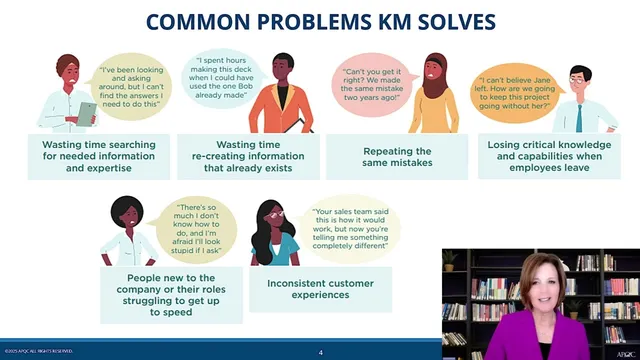
APQC frames KM as a people-centered business strategy grounded in efficiency, resiliency, and agility. It aims to reduce pain in everyday work by improving access to resources and reducing time wasted searching for answers. Research cited in the transcript links effective KM to measurable results such as lower operational costs, shorter onboarding and offboarding, reduced cycle times, and higher customer satisfaction—outcomes that ultimately affect the bottom line. Just as important, KM depends on culture: employees must feel safe sharing what they know, asking questions, and learning without fear of judgment. In that sense, KM is “not a tool” but a mindset and operating approach.
The transcript also clarifies what counts as knowledge and where it lives. Knowledge is described as information in action and a strategic asset that enables organizations to execute processes. Sources include competency maps (skills and behaviors required for roles), standard business processes, subject matter experts and “go-to” people, engineering designs, customer insights, technical solutions, regulatory and compliance knowledge, and even relationships—internal peers and external partners such as university and industry groups. A key theme is that new employees may have competencies but still lack the network of who to contact and what to use.
To make KM work, organizations must identify barriers to knowledge flow. Common gaps include insufficient knowledge supply relative to demand and missing documentation. Bottlenecks arise when only a few people hold critical knowledge or when it sits in closed systems with limited access. Risks emerge when knowledge is undocumented or trapped in small groups without central management, creating loss and accessibility problems. Islands form when knowledge is stored in disconnected systems so others can’t find it—or even know it exists.
The transcript’s formal definition of KM emphasizes creating and managing processes, approaches, and enablers so knowledge reaches the right people at the right time—enabling sharing and action to improve organizational performance. It then distinguishes what KM looks like in action: curating and providing access to the most critical knowledge (not all knowledge), enabling business-relevant collaboration and learning, and integrating people, processes, and technology. KM is also positioned as equitable access to experts and information, not as an effort to eliminate roles.
Finally, KM implementation is presented as a portfolio of approaches matched to specific business problems and the type of knowledge involved. Explicit knowledge (easy to document) can rely on self-service tools like social/search engines or portals. Less explicit, tacit knowledge requires more human interaction—facilitated workshops, communities of practice, knowledge-sharing networks, and, for the hardest cases, facilitated transfer of best practices such as interviewing experts before retirement and turning those conversations into usable documentation. Enduring lessons stress focusing on real business issues, communicating KM’s role, scaling proven practices, reducing barriers so people can participate, and continuously measuring value through qualitative and quantitative metrics.
Cornell Notes
Knowledge management (KM) is a systemic effort to help information and knowledge grow, flow, and create value by getting the right knowledge to the right people at the right time. It treats knowledge as a strategic asset—information in action—and targets the useful lessons that enable performance, not just documents and data. KM reduces operational pain (like wasted time searching) and supports business results such as lower costs, faster onboarding/offboarding, shorter cycle times, and better customer satisfaction. Effective KM depends on culture and process: employees must feel safe sharing, and organizations must remove barriers like bottlenecks, risks, and “knowledge islands.” Implementation works best as a portfolio of approaches matched to knowledge type: self-service for explicit knowledge and more human-centered methods for tacit knowledge transfer.
How does KM define “knowledge,” and why is that distinction important?
What kinds of barriers prevent knowledge from flowing inside an organization?
What is the formal APQC definition of knowledge management, and what does it require operationally?
How should organizations decide which KM approach to use?
What does KM look like in action—and what does it explicitly not look like?
Which enduring lessons are emphasized for making KM stick?
Review Questions
- How do knowledge gaps, bottlenecks, risks, and knowledge islands each affect knowledge flow differently?
- Why does the transcript treat tacit knowledge transfer as more challenging than explicit knowledge access, and what methods correspond to each?
- What metrics—qualitative and quantitative—would you choose to demonstrate KM value in onboarding or cycle-time reduction?
Key Points
- 1
KM focuses on actionable knowledge—what people have learned from experience—not just storing documents and organizing data.
- 2
Effective KM reduces workday pain by improving access to experts, past successes, and relevant lessons at the time they’re needed.
- 3
Knowledge sources include competency maps, standard processes, subject matter experts, engineering designs, customer insights, compliance knowledge, and relationships.
- 4
Barriers to knowledge flow include gaps in documentation, bottlenecks caused by limited holders or closed systems, risks from unmanaged knowledge, and islands created by disconnected repositories.
- 5
KM is a people-centered strategy and mindset that requires cultural safety for sharing, not merely a technology rollout.
- 6
Implementation works best as a portfolio: self-service tools for explicit knowledge and more human-centered practices (workshops, communities of practice, interviews) for tacit knowledge.
- 7
Sustained KM requires communicating its role, scaling proven practices, removing time/participation barriers, and measuring value with qualitative and quantitative metrics.