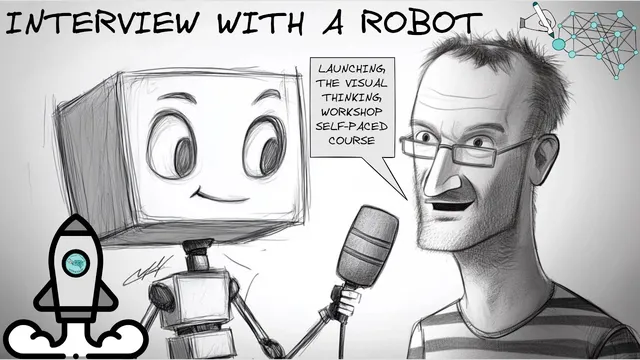
Launching the Visual Thinking Workshop Self-Paced Course
Based on Zsolt's Visual Personal Knowledge Management's video on YouTube. If you like this content, support the original creators by watching, liking and subscribing to their content.
The course turns reading “The Extended Mind” into a repeatable workflow: book-on-a-page summaries followed by permanent, linked visual notes in a PKM system.
Briefing
A self-paced Visual Thinking Workshop course is being launched as a structured path from reading a book to producing “book on a page” summaries and then turning those summaries into lasting, linked visual notes inside a knowledge management system. The core promise is not better drawing for its own sake, but a repeatable workflow that uses visuals as an external extension of thinking—so concepts become concrete, easier to remember, and easier to revisit.
The course is built around Annie Murphy Paul’s “The Extended Mind,” which the creator frames as especially relevant to spatial thinking and the way people offload cognition into tools, representations, and feedback loops. Participants move through 49 lessons and nearly 40 practical exercises, with each lesson ending in a task tied to both the reading and the visual “book on a page” method. A major deliverable is a “demo Vault” containing seven book-on-a-page examples with full literature notes, icons (nearly 7,400), article-on-a-page materials, concept-castle notes, and mindset cards, plus templating scripts—positioned as a ready-to-study reference for how the system should look and function.
What differentiates this program from other visual thinking or PKM offerings is the emphasis on visuals as first-class knowledge objects rather than decorative add-ons. The workflow treats images like text: they can be linked, referenced, deconstructed into smaller pieces, and used to build a “four-dimensional interactive” visual knowledge management system. Text remains present, but the method aims to make visuals carry the conceptual weight—turning illustrations into the ideas themselves, not just resources.
The course also targets a common learning bottleneck: people often delay creating illustrations until late in a cohort. The approach pushes learners to start immediately, using trial and error to build skill. A “seven-step concept visuals” process is highlighted as a recurring breakthrough, illustrated by a memorable example from a team session: a “too salty steak” visual built from simple icons (steak and salt shaker) paired with a short caption, used to anchor a quote and make an abstract idea stick.
Long-term retention is tied to forcing abstraction into concrete representation. The creator argues that concrete terms are remembered more reliably than abstract ones, and that forcing concept visuals compels that translation. Support is designed to help skills stick after the self-paced portion ends: learners get access to a Discord community, optional biweekly office hours in alternating time zones, and optional one-on-one coaching. A special “cohort 11” runs alongside the self-paced course, reading “The Extended Mind” together and using cohort sessions for deeper practice.
The launch package is centered on Obsidian plus Excalidraw and Excalidraw Brain as base tools, with an explicit claim that the mindset is tool-agnostic even though the setup is taught from zero. No refund policy is offered, but support is emphasized through Discord responsiveness and the structured learning materials.
Beyond the course, plans include an ongoing paid “Techno Visual PKM Community,” continued development of the Obsidian Excalidraw plugin, and future mini-workshops focused on specific visual thinking tools for workplace collaboration—expanding the approach beyond book-on-a-page outputs.
Cornell Notes
The Visual Thinking Workshop self-paced course is designed to turn reading into lasting visual knowledge. It uses Annie Murphy Paul’s “The Extended Mind” as the backbone for 49 lessons and nearly 40 hands-on exercises, culminating in “book on a page” summaries and permanent visual notes. The method treats visuals as knowledge objects—linkable, referenceable, and decomposable—so illustrations become the ideas, not just decorations. Skills are reinforced through a Discord community plus optional biweekly office hours and one-on-one coaching, and through a parallel cohort (cohort 11) that practices the same material together. The creator argues that forcing abstract concepts into concrete concept visuals improves retention and understanding by creating a feedback loop learners can revisit.
What is the course’s practical workflow from reading to a usable knowledge system?
Why does the creator claim visuals improve retention more than text alone?
What makes the approach different from typical visual thinking or PKM courses?
How does the course address the common problem of learners delaying illustration practice?
What support exists to help skills stick after finishing a self-paced course?
How does the course handle tool setup for learners who aren’t tech-savvy?
Review Questions
- What specific steps does the course require to transform a book reading into a “book on a page” and then into permanent visual notes?
- How does the “abstract-to-concrete” translation claim connect to the course’s retention and feedback-loop goals?
- Which support options (Discord, office hours, one-on-one coaching, cohort 11) are designed to reinforce learning after the self-paced portion?
Key Points
- 1
The course turns reading “The Extended Mind” into a repeatable workflow: book-on-a-page summaries followed by permanent, linked visual notes in a PKM system.
- 2
49 lessons and nearly 40 exercises drive practice, with each lesson ending in a task tied to both the reading and the visual method.
- 3
Visuals are treated as knowledge objects—linkable, referenceable, and decomposable—so illustrations represent ideas rather than acting as decorative resources.
- 4
The “seven-step concept visuals” process is used to convert abstract prompts into concrete, memorable visuals, with trial-and-error encouraged from the start.
- 5
Obsidian plus Excalidraw and Excalidraw Brain are the base tools, but the creator frames the mindset as tool-agnostic and still teaches setup from zero.
- 6
Long-term reinforcement comes through a Discord community plus optional biweekly office hours (alternating time zones) and optional one-on-one coaching.
- 7
The launch package includes a “demo Vault” with seven fully worked book-on-a-page examples, nearly 7,400 icons, literature notes, mindset cards, and templating scripts.