Leading Practices in Procurement Transformation
Based on APQC's video on YouTube. If you like this content, support the original creators by watching, liking and subscribing to their content.
Procurement transformation should build an efficient yet connected service delivery model, not just centralize procurement and add automation.
Briefing
Procurement transformation is moving beyond “centralize and automate” into a service delivery model that stays efficient while remaining connected to business units and vendors—especially through a tiered structure that matches work to the right skills. Centralization alone has not solved persistent problems like unclear roles, rework, weak customer service, and technology that fails to deliver value. The core prescription is a procurement service delivery model designed around end-to-end procure-to-pay ownership, clear service access paths, and technology used as an enabler—not a silver bullet.
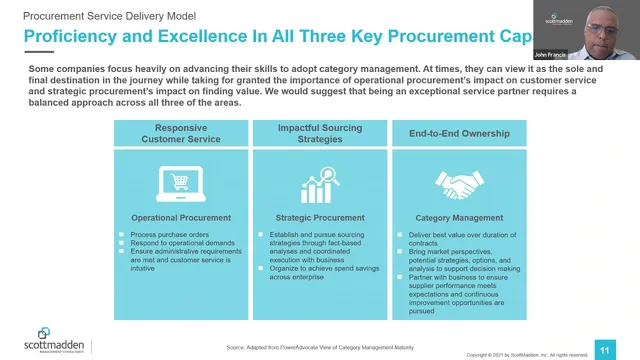
The discussion traces procurement’s evolution from mostly decentralized, transaction-heavy purchasing to strategic sourcing and category management efforts that still often lived alongside transactional work performed by the same people. That overlap created inefficiency. A newer approach pushes procurement and accounts payable toward an end-to-end purchase-to-pay process with a single owner, stronger standardization, and a deliberate split between day-to-day execution and strategic work. The model also treats customer service as a capability that must be explicitly resourced: responsiveness tends to sit in operational procurement, while category management and spend ownership require different skills and structures.
A key diagnostic theme is that procurement service delivery problems show up as symptoms across multiple dimensions. When “fires” consume attention, strategic work loses priority. When operational procurement excellence is overlooked, business units experience slow or frustrating interactions. Savings can be negotiated but fail to materialize after contract signing. Cost-cutting focus can produce diminishing returns over time. And when accounts payable feedback doesn’t improve upstream processes—such as invoice discrepancies or unclear payment terms—systems like evaluated receipt settlement stall.
To address these issues, the model proposes a tiered service delivery design. Tier 0 (“direct access”) provides self-service-style routes through portals, landing pages, templates, FAQs, and supplier onboarding tools—supported by service management rather than staff. Tier 1 (“customer service”) handles routine requests through a mix of transaction processing and support, typically using case management and ticketing so work is tracked and time-to-close is visible. Tier 2 (“special services”) escalates more complex issues and transactions, such as expediting or supplier catalog punch-outs, with workflow automation layered in. Tier 3 (“centers of expertise”) concentrates strategic and analytical judgment work—spend and market analysis, supplier performance management, continuous improvement, and category management—covering roughly 20–25% of workload.
Implementation starts with an assessment built from five inputs: site visits and interviews (to capture context and constraints), work activity assessments (to measure where work actually happens, not just org charts), performance metric assessments (directional benchmarks and sizing), internal customer satisfaction surveys (to establish a baseline and track expected short-term dips), and leading-practice adoption analysis (depth and breadth). After assessment, teams run workshops for service placement (assigning activities to tiers), harmonize policies and processes, and build a conceptual design that aligns benchmarks and workload distribution.
Execution then proceeds through work streams spanning project management, policy/process redesign, organization and staffing (including slotting or zero-based approaches), communication and change management with training plans, and technology architecture across service management, functional systems (including ERP and spend analytics), and intelligent automation. Leading practices emphasized include early and continuous stakeholder engagement, well-defined tier escalation criteria, mutually exclusive/collectively exhaustive role clarity, aggressive simplification of processes, analytics before/during/after transition, and treating technology as an enabler. The Q&A adds that ESG requirements can be disaggregated into process steps and placed across tiers and centers of expertise, and that the model can operate virtually or hybrid—using service-enabling technologies to keep staff connected. An end-to-end procure-to-pay process owner is positioned as responsible for end-to-end design, metrics, and continuous improvement, typically separated from execution responsibilities.
Cornell Notes
Procurement transformation succeeds when it replaces “centralization plus automation” with a procurement service delivery model that is efficient and connected to business units and vendors. The approach centers on end-to-end procure-to-pay ownership, explicit customer service capability, and a tiered structure that matches work to the right skills: Tier 0 direct access (portals/templates), Tier 1 customer service (case management and routine processing), Tier 2 special services (complex escalations), and Tier 3 centers of expertise (strategic and analytical judgment). Problems show up as strategic work losing to firefighting, weak operational responsiveness, savings not sticking after contracts, and poor feedback loops from accounts payable. Implementation begins with a five-part assessment—interviews, work activity mapping, performance benchmarks, customer satisfaction baselines, and leading-practice adoption—then uses workshops for service placement and process harmonization.
Why does centralization alone fail to deliver procurement transformation outcomes?
What are the three procurement capability areas that must be balanced?
What symptoms indicate procurement service delivery needs redesign?
How does the tiered service delivery model route work efficiently and “connect” stakeholders to the right help?
What does a procurement service delivery assessment need to include before designing the future model?
How should ESG obligations fit into a tiered procurement organization?
Review Questions
- Which tier should handle routine operational procurement issues, and what technology capabilities typically support that tier?
- What baseline metrics should be collected before transformation, and why is customer satisfaction measurement emphasized?
- How do unclear roles and activity without achievement show up in day-to-day procurement operations, according to the symptoms list?
Key Points
- 1
Procurement transformation should build an efficient yet connected service delivery model, not just centralize procurement and add automation.
- 2
Design end-to-end procure-to-pay ownership with a single process owner, while separating day-to-day execution from strategic work.
- 3
Balance customer service, sourcing strategy effectiveness, and end-to-end spend/category ownership to avoid business-unit dissatisfaction.
- 4
Use a tiered model: Tier 0 direct access (portals/templates), Tier 1 customer service (case management), Tier 2 special services (complex escalations), and Tier 3 centers of expertise (strategic analytics).
- 5
Diagnose service delivery problems using symptoms like firefighting-driven strategic decline, weak operational responsiveness, savings not sticking post-contract, and poor AP-to-upstream feedback loops.
- 6
Start implementation with a five-part assessment (interviews, work activity mapping, performance benchmarks, customer satisfaction baseline, and leading-practice adoption) to size and place work correctly.
- 7
Treat technology as an enabler across service management, functional systems (ERP/spend analytics), and intelligent automation—after process and roles are clarified.