Learn how to extract the Literature using AnswerThis.io
Based on Research With Fawad's video on YouTube. If you like this content, support the original creators by watching, liking and subscribing to their content.
Start the literature review by defining required sections: variable conceptualization, a theoretical framework, and hypotheses.
Briefing
A practical workflow for drafting a literature review using AnswerThis.io centers on turning research questions about key variables into structured, citable text—then synthesizing that output into a coherent conceptual framework and hypothesis set. The session’s core message is straightforward: before extracting anything, define what the literature review must contain (conceptualization, theoretical framework, and hypotheses), then use targeted prompts to pull definitions, key characteristics, importance, and prior findings for each construct.
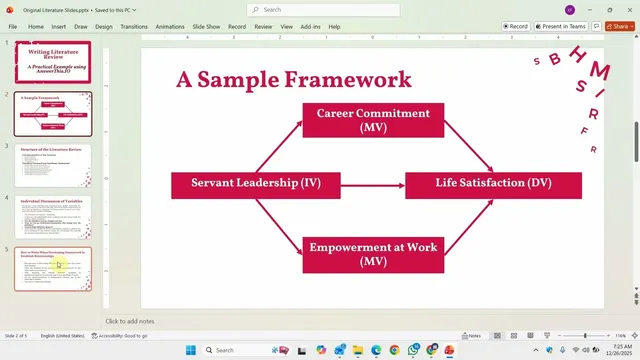
The example model uses servant leadership as the independent variable, life satisfaction as the dependent variable, and career commitment plus employment at work as mediators. The literature review is organized accordingly: first, conceptualize each variable; next, build the theoretical framework and propose hypotheses by mapping relationships among constructs (servant leadership → life satisfaction; servant leadership → career commitment; career commitment → life satisfaction; servant leadership → employment at work; and the mediating roles of both mediators). For the “individual discussion” portion, the guidance is to write about (1) how the construct is defined, (2) whether definitions differ across contexts (with an emphasis on higher education), (3) what facets or characteristics repeatedly appear across definitions, and (4) why the construct matters for organizations or the broader social field.
AnswerThis.io is then used as a prompt-driven extraction tool. For servant leadership, the workflow starts with a basic question—“What is servant leadership?”—and requests APA-formatted results that summarize core philosophy, key characteristics, and citations drawn from multiple definitions and sources. A follow-up question—“Why is servant leadership important?”—is used to generate a second set of results that can be condensed into literature-review-ready sentences. The process can also request multiple definitions (e.g., by specific authors or schools of thought such as Greenleaf, service focus, characteristics-based, and virtue-based approaches), so the writer can compare how definitions evolve and what they agree on.
After variable-by-variable synthesis, the workflow shifts to relationship-building. The next step is to ask whether existing research links servant leadership and life satisfaction, identify the mechanism of impact, and check for contradictory or inconsistent findings. If results are unanimous, the literature review can emphasize why the relationship is still worth studying; if results conflict or no direct link appears, the writer is encouraged to connect traits and characteristics of the constructs and then justify the linkage using theory.
The session highlights several theory options that can be used to explain the relationship, including Conservation of Resources theory, self-determination theory, social exchange theory, and leader-member exchange theory (with an example of using leader-member exchange theory in a study). Overall, the value proposition is not just generating text, but using AnswerThis.io to answer specific literature-review questions—definitions, importance, prior findings, contradictions, and theory fit—so the final writing remains grounded in citations and structured logic.
Cornell Notes
The session lays out a literature-review workflow that combines a clear conceptual model with prompt-based extraction from AnswerThis.io. It starts by specifying what the literature review must include: variable conceptualization, a theoretical framework, and hypotheses. Using an example model (servant leadership → life satisfaction, with career commitment and employment at work as mediators), it shows how to write individual variable discussions by comparing definitions, extracting shared characteristics, and explaining why each construct matters. AnswerThis.io is used to pull APA-style definitions, key characteristics, importance statements, and prior research findings, including whether studies agree or conflict. Finally, relationship claims are justified by identifying existing evidence and selecting an appropriate theory (e.g., Conservation of Resources, self-determination, social exchange, leader-member exchange).
What elements should a literature review include before any AI-assisted extraction begins?
How should a writer structure the literature review when there are mediators?
What prompt strategy is used to extract content for an individual variable discussion (e.g., servant leadership)?
How does the workflow handle building the relationship section between two constructs?
What role does theory play in justifying relationships in the literature review?
Review Questions
- How would you outline the mediation paths in a literature review if you had two mediators between an independent and dependent variable?
- What specific questions should be asked of AnswerThis.io to extract (a) definitions, (b) importance, and (c) prior findings for a single construct?
- When research results are contradictory or no direct relationship appears, what steps does the workflow recommend to still justify a theoretical linkage?
Key Points
- 1
Start the literature review by defining required sections: variable conceptualization, a theoretical framework, and hypotheses.
- 2
Use a mediation-aware structure that maps all relevant paths among independent, dependent, and mediator constructs.
- 3
For each variable, compare multiple definitions across contexts and extract the shared facets that repeatedly appear.
- 4
Use AnswerThis.io with targeted prompts (e.g., “What is X?” and “Why is X important?”) to generate APA-style, citation-backed material.
- 5
Check prior research for both supporting evidence and contradictory or inconsistent findings before claiming a relationship.
- 6
If direct evidence is weak or mixed, connect construct traits and justify the linkage using an appropriate theory (e.g., Conservation of Resources, self-determination, social exchange, leader-member exchange).