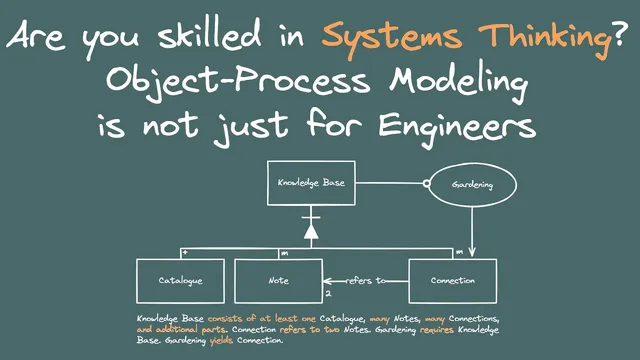
Learn Systems Thinking with Object-Process Modeling in PKM
Based on Zsolt's Visual Personal Knowledge Management's video on YouTube. If you like this content, support the original creators by watching, liking and subscribing to their content.
OPM models systems using explicit building blocks: objects (squares), processes (ellipses), and links that show how processes act on objects.
Briefing
Object-Process Methodology (OPM)—with its ISO-standard modeling tools OPD and OPL—turns messy systems thinking into a disciplined way to describe what exists, what happens, and how change propagates through states. The core payoff is clarity: objects (things) and processes (actions) are linked through explicit input/output and state changes, letting people map complex systems without hand-waving about “relationships” or “flows.” That matters both for tackling global challenges and for managing personal knowledge workflows, where the real difficulty is seeing how parts interact over time.
OPD starts with three building blocks. First come objects: nouns that “exist or might exist,” drawn as squares. Next are processes: what happens or might happen, written as verbs in present participle form ending in “-ing,” drawn as ellipses. Processes never occur in a vacuum; they act on objects, connected by lines that specify the relationship type. A key example is the instrument relation—reading requires a book—captured in OPL as “reading requires a book.”
Transformation is where OPM becomes especially practical. Processes transform objects in three ways: they can create objects, destroy or consume them, or affect them. Affecting an object means changing its state. The transcript uses reading to illustrate statefulness: a book can be unread or read, and reading changes the book’s state from unread to read. To represent transformation mechanics, OPM uses procedural links for input/output results, including participation constraints (the “plus” marker) to indicate that at least one participant is involved. In the personal knowledge context, note-making consumes fleeting notes or ideas and yields notes—an explicit accounting of what gets used up and what emerges.
The model also frames any system through complementary lenses: structure and behavior. Structure is the static question—what the system is made of and how parts relate—while behavior is the dynamic question—how the system changes over time. In a knowledge base example, structure includes components like catalogs, notes, and connections; connections link two notes, and tags specify the nature of each relationship. Behavior is represented through how processes transform stateful objects, such as generalization and specialization: consuming can change content from unknown to known, while consuming and content can be described in either direction.
Beyond the mechanics, the transcript adds a third aspect relevant to man-made systems: function—why the system exists and for whom. That “utilitarian subjective” layer is what ties modeling to purpose, not just description.
Finally, the practical takeaway lands on four “inner roles” used to model personal knowledge management: architect, librarian, gardener, and writer. The workflow is not presented as a strict sequence; instead, these personalities work in concert. Curating content aligns with the librarian, architecting the storage and backlog aligns with the architect, gardening covers organizing and connecting ideas, and authoring aligns with the writer. The transcript closes by emphasizing that OPM is a learnable modeling language rather than a foreign one, and it points viewers to an Excalidraw + Obsidian setup for diagramming, plus an older OPM tool (OPCAT) for practicing the grammar.
Cornell Notes
OPM (Object-Process Methodology) uses ISO-standard modeling tools OPD and OPL to make systems thinking concrete. It represents a system with objects (squares), processes (ellipses), and explicit links showing how processes act on objects. Processes transform objects by creating, consuming, or affecting them—especially by changing object states (e.g., a book shifts from unread to read after reading). Systems are viewed through structure (what parts exist and how they relate) and behavior (how things change over time), with an added “function” layer for man-made systems. The approach is applied to personal knowledge management through roles like librarian, architect, gardener, and writer working together.
How does OPM distinguish between objects, processes, and states?
What does it mean for a process to transform an object in OPM?
How do OPD and OPL work together in representing relationships like “reading requires a book”?
Why are “structure” and “behavior” treated as complementary system views?
What extra element matters for man-made systems that doesn’t apply the same way to natural occurrences?
How does the transcript apply the modeling concepts to personal knowledge management roles?
Review Questions
- In OPM, what visual and grammatical conventions distinguish objects from processes, and how does the model show that processes act on objects?
- Give an example of a process that creates, consumes, and/or affects an object. How would you represent the state change aspect?
- How do structure and behavior differ in OPM system descriptions, and where does “function” fit for man-made systems?
Key Points
- 1
OPM models systems using explicit building blocks: objects (squares), processes (ellipses), and links that show how processes act on objects.
- 2
Processes transform objects by creating, destroying/consuming, or affecting them; affecting means changing the object’s state.
- 3
Statefulness is essential: objects must have states so process effects can be represented as transitions (e.g., unread → read).
- 4
OPD captures structure and relationships visually, while OPL expresses the same relationships in formal sentence form (e.g., instrument relation like “reading requires a book”).
- 5
Any system can be viewed through structure (static parts and relationships) and behavior (dynamic change over time).
- 6
For man-made systems, function adds the purpose layer—why the system exists and for whom.
- 7
Personal knowledge management can be modeled as interacting roles (librarian, architect, gardener, writer) rather than a single linear workflow.