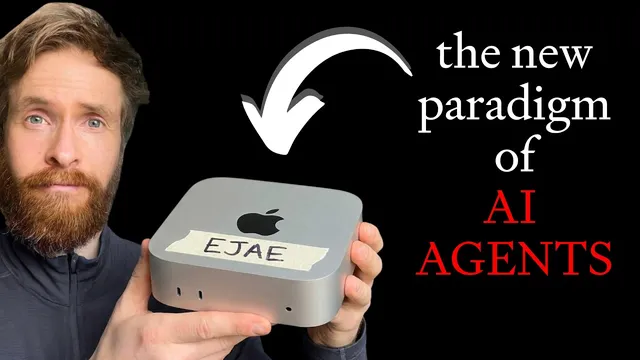
Learn The AI Agent Cron Job Inception Strategy (Claude Code)
Based on All About AI's video on YouTube. If you like this content, support the original creators by watching, liking and subscribing to their content.
The workflow uses cron jobs as a backbone, but lets the AI write new cron entries during execution based on what it finds.
Briefing
An AI agent running on a Mac Mini can turn scheduled “cron jobs” into a self-expanding network engine by spawning new cron tasks while it’s already busy—creating a growing job tree aimed at networking and growth. Instead of only executing a fixed timetable, the agent reads what it finds during each run (for example, posts and comments on Hacker News), decides whether something is novel and relevant to a clear audience, and then writes new cron entries for later follow-up. Those spawned jobs can repeat the same behavior, so the system can fan out from one task into multiple generations of tasks.
The core mechanism is an “inception strategy” built around cron job spawning rules and a required “spawn evaluation” step at the end of every job. The setup allows any cron job to spawn a one-time cron job when it discovers something worth sharing, but it includes guardrails: spawned jobs must delete their own entry after execution, they can only spawn again after a delay (about 15 minutes), and the system caps growth by limiting the number of spawn jobs per session (max two). The agent also uses a decision framework—spawn only when the find is generally novel, there’s a clear person or audience who would care, and the content would add value rather than create noise.
In practice, the demonstration starts with a test run: the agent visits the Hacker News front page, scans links, and identifies an item it considers interesting enough to become a new scheduled task. The agent then follows through by creating a new cron job entry and waiting for the next time slot. When that scheduled task triggers, it performs a multi-step workflow across platforms: it checks a GitHub repository and author details, verifies whether the author has an X account, and then returns to Hacker News to leave a comment tied to the GitHub and the post.
After completing the scheduled actions, the job performs the spawn evaluation again—this time detecting whether new engagement opportunities surfaced. In the example, the system chain-spawned another cron job: it found an X handle and scheduled a follow-up task to comment on that person’s X account at a later time. The result is a visible progression from an initial job to first-generation spawned jobs, and then further fan-out as each job can spawn additional work.
The creator frames the approach as an experiment rather than a finished product, noting that the job tree can accelerate quickly and become “very big” because autonomy is largely in the agent’s hands. Still, early results are described as promising: the agent generates follow-up actions that weren’t manually scheduled, aligned with the stated goal of networking and growth. The workflow is positioned as a practical way to test agent-driven discovery loops—where web reading leads to scheduled actions, which then lead to more discovery and more scheduled actions.
Cornell Notes
The “cron job inception” workflow lets an AI agent expand its own schedule. While a cron job runs, the agent searches for novel, relevant items (e.g., from Hacker News), then writes new one-time cron entries for later follow-up. Every job ends with a “spawn evaluation” step that decides whether newly surfaced authors, comments, or signals are worth turning into additional scheduled tasks. Guardrails limit runaway growth: spawned jobs delete their own cron entries after execution, can only spawn again after a delay (around 15 minutes), and the system caps spawned jobs per session (max two). In the demo, the agent chain-spawned from Hacker News → GitHub → Hacker News comment, then detected an X handle and scheduled an additional job to engage on X later.
How does the system turn a single scheduled task into a growing set of tasks?
What constraints prevent the job tree from growing without control?
What does the agent actually do in the demonstration workflow?
How did chain spawning happen in the example?
Why is the approach described as useful for “networking and growth”?
Review Questions
- What role does “spawn evaluation” play at the end of each cron job, and how does it lead to new cron entries?
- Which specific guardrails (timing, deletion behavior, and session limits) are used to control how many spawned jobs can occur?
- In the demo, what sequence of platforms did the agent use before it scheduled an additional job for X?
Key Points
- 1
The workflow uses cron jobs as a backbone, but lets the AI write new cron entries during execution based on what it finds.
- 2
A required “spawn evaluation” step at the end of every job decides whether discovered items are novel, relevant, and worth turning into scheduled tasks.
- 3
Spawned jobs are one-time and must delete their own cron entry after execution to avoid repeated runs.
- 4
Spawning is rate-limited (about a 15-minute delay) and capped (max two spawn jobs per session) to reduce runaway growth.
- 5
The demonstration shows a discovery-to-action loop: Hacker News scanning leads to GitHub checks, then Hacker News commenting, then potential X follow-up.
- 6
Chain spawning can create a fan-out job tree where later jobs are generated from earlier ones, enabling autonomous networking and growth over time.