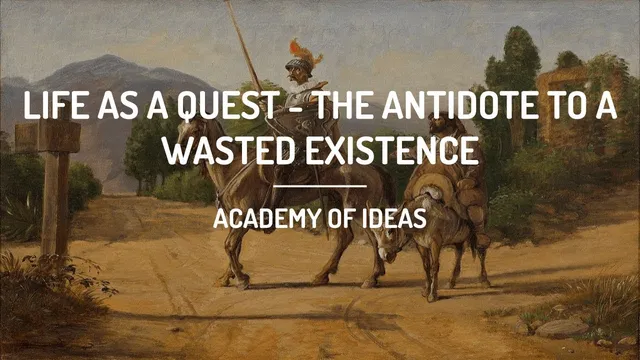
Life as a Quest - The Antidote to a Wasted Existence
Based on Academy of Ideas's video on YouTube. If you like this content, support the original creators by watching, liking and subscribing to their content.
Routine can become a prison when it turns life into a repetitive closed cycle that breeds dread and futility.
Briefing
Life becomes “wasted” when routine hardens into a closed cycle—comforting at first, then suffocating. The core remedy is to treat one’s life as a quest: a self-directed pursuit of chosen values that injects novelty, risk, and meaning into days that otherwise drift toward futility and dread. The argument draws a line from habit to imprisonment, warning that measuring life like the length of a chain leads to the question, “Is this life nothing more than this?” Yet the same recognition of confinement is framed as a turning point, because where danger grows, so does the saving power.
The proposed shift is not simply to “do more,” but to restructure existence around uncertainty on purpose. Don Quixote becomes the model: an allegory for anyone who pursues an ideal that takes hold of thinking and willing, standing out as an oddity in a world that prefers sameness. That questing requires boldness—leaving the familiar “terra firma”—and learning to manage fear of the unknown. Boldness is linked to childlike wonder: curiosity, play, and the ability to see each new day as an adventure rather than a repetition. The piece contrasts this with a deadened adulthood that numbs itself through mindless entertainment and substances in a frantic attempt to feel alive.
From there, the discussion narrows to what a quest should be. Physical travel is one route, but financial constraints, government tyranny, and family or career obligations can limit it. The alternative is to quest inward—into the unexplored realms of the mind—by organizing life around pursuits that keep it from becoming predictable. Knowledge is presented as one such quest. Nietzsche’s “Ariadne thread” is invoked as a source of purpose and joy, and the pursuit is defended as valuable in itself while also offering practical and economic benefits, including new career paths. George Washington Carver serves as a concrete example: enslaved by birth, he became a renowned agricultural scientist and inventor, driven by an intense desire to know the names, colors, and lives of stones, plants, insects, birds, and beasts.
Beauty is offered as a second major quest. It is described as a universal need, not merely a subjective preference, and the problem is not a lack of beauty but the atrophy of aesthetic perception caused by rote education and memorization. Reactivating the senses—through daily attention to nature and through engagement with human-made art—is presented as both restorative and liberating. The text also argues that questing for beauty can mean creating it: music, poetry, art, stories, philosophy, cinema, gardens, even transforming one’s body or character into a “work of art.”
All quests carry uncertainty and risk. Knowledge can bring unsettling truths and sorrow; beauty can sharpen awareness of transience and death; creation can invite envy and hostility from societies invested in stability. The closing note returns to the sea voyage of Giacomo Leopardi’s explorer: even without other benefits, the voyage keeps life dear, breaks boredom, and makes people value what they would otherwise ignore. In that framing, questing is less about achieving a perfect outcome than about escaping the closed circle that turns existence into monotony.
Cornell Notes
The central claim is that routine can become a prison: habits that once created order eventually trap people in a repetitive cycle that breeds dread and futility. The antidote is to live as a quest—structuring life around self-chosen ideals that bring novelty, uncertainty, and meaning. Boldness is essential, and it is tied to childlike wonder, curiosity, and play rather than numb adult habits. Two concrete quest paths are emphasized: pursuing knowledge (which builds purpose and can improve life materially) and pursuing beauty (which requires reactivating aesthetic senses and can also mean creating art). Questing is portrayed as risky and sometimes painful, but it keeps life from boredom and makes values feel real.
Why do routines become “imprisoning” instead of helpful, and what changes when people recognize the limits of their lives?
What does “living as a quest” require, and why is Don Quixote used as a model?
How does the text connect boldness to childhood, and what behaviors does it contrast with questing?
Why is pursuing knowledge presented as more than a hobby, and what example is used to show its power?
What makes beauty a “universal need,” and how does the text say people lose the ability to see it?
What are the risks and costs of questing for knowledge or beauty, and why does the conclusion still favor it?
Review Questions
- What mechanisms turn comforting routines into a “closed cycle,” and how does awareness of that cycle change what people do next?
- Compare the roles of boldness and childlike wonder in the argument. What behaviors are treated as alternatives to questing?
- How do knowledge and beauty quests differ in their sources of meaning and in the kinds of risks they introduce?
Key Points
- 1
Routine can become a prison when it turns life into a repetitive closed cycle that breeds dread and futility.
- 2
Living as a quest means committing to self-chosen values and ideals, not merely maintaining familiar habits.
- 3
Questing requires boldness—especially the willingness to leave the familiar and manage fear of uncertainty.
- 4
Childlike wonder, curiosity, and play are presented as psychological tools for sustaining adventurous living.
- 5
Physical travel is optional; quests can be inward, organized around knowledge or beauty rather than geography.
- 6
Pursuing knowledge is defended as both intrinsically valuable and practically life-improving, with George Washington Carver offered as evidence.
- 7
Questing for beauty involves both seeing beauty (reactivating aesthetic senses) and creating it, despite risks like sorrow, transience, and social envy.