Logseq Namespaces - How to use (or not use) them
Based on CombiningMinds's video on YouTube. If you like this content, support the original creators by watching, liking and subscribing to their content.
Namespaces in Logseq use forward slashes to create hierarchical paths and support namespace queries that generate navigable indexes.
Briefing
Namespaces in Logseq—built around the forward-slash “/” syntax—are a powerful way to create hierarchy and disambiguate similarly named notes, but they can become a maintenance burden as personal information systems evolve. The core takeaway is pragmatic: namespaces earn their keep for specific problems like “same name, different thing” and for building navigable indexes, yet they’re often harder to refactor than alternatives like page properties.
At a basic level, namespaces function like folder paths. In Logseq, “projects/Logseq Street/tutorials” creates a structured set of pages where each slash adds another layer. That hierarchy matters because it enables namespace queries that return an index of all pages under a given namespace, letting users jump across multiple levels of related content quickly. The transcript highlights this with examples such as PKM notes and Enneagram material: a namespace query can assemble a structured index for a topic (e.g., PKM) and then drill down into sub-areas like “PKM challenges.” For course-related content, namespaces also support public indexing—an updates site can pull a lesson index by querying pages under a tutorial namespace.
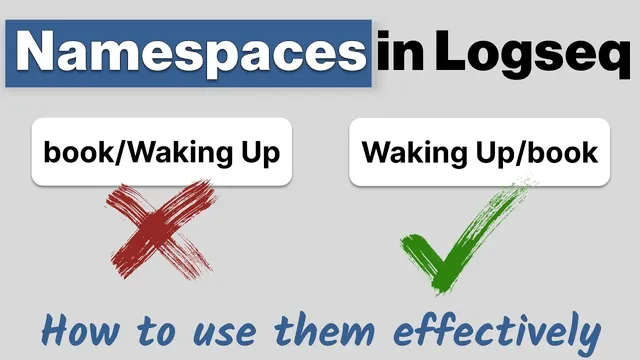
The most important use case is disambiguation. When the same label must refer to different concepts, namespaces let users “add a surname” to the name. The transcript uses “principles” as a book versus a page: “principles/book” and “principles/page” prevent links from landing on the wrong note. Similar logic applies to “waking up” (book versus other notes) and to therapy-related references where multiple people might otherwise share overlapping names. Another example is writing notes about books: instead of “write-up of Anamkara,” the system uses “Anamkara/write-ups” so searches and navigation stay fast and unambiguous.
Despite these benefits, the drawbacks loom larger in the creator’s own workflow. Renaming namespaces is described as a “hack” that becomes dangerous when the structure changes; refactoring can be difficult enough that a PowerShell attempt “lost” data. Namespaces also create compatibility issues: the forward slash is stored as “%2f” in filenames, which looks messy and less durable when syncing or using other tools—especially when paired with Obsidian. That mismatch can make long-term maintenance unpleasant.
The verdict is not “never use namespaces,” but “don’t default to them.” If an index is genuinely needed, namespaces can be justified. If the structure might change, page properties are presented as a more maintainable, bottom-up approach for generating indexes and organizing meaning without hardcoding a top-down path. The transcript’s final guidance is to avoid namespaces unless the use case is clear—like disambiguation or a stable, navigational hierarchy—and to lean on properties for flexibility as systems grow and evolve.
Cornell Notes
Namespaces in Logseq use forward slashes to create hierarchical paths and enable namespace queries that generate navigable indexes. They’re most valuable for disambiguating identical names in different contexts (e.g., “principles/book” vs “principles/page”) and for building structured topic trees like PKM or course lesson indexes. The main downside is maintenance: renaming namespaces is difficult and can be risky, and the forward slash becomes “%2f” in filenames, which can be awkward for compatibility with other systems such as Obsidian. The recommended approach is selective use—use namespaces when the structure is stable and the benefit is clear, but prefer page properties for flexible, bottom-up organization and indexing.
What problem do namespaces solve best in Logseq?
How do namespace queries improve information retrieval?
Why does the transcript argue that namespaces can be risky over time?
What compatibility issue arises when using namespaces with other tools like Obsidian?
What alternative is presented for indexing and organization when flexibility matters?
Review Questions
- When would disambiguation be a strong reason to use namespaces instead of page properties? Give one concrete example from the transcript.
- What two separate mechanisms make namespaces useful for navigation (think hierarchy and indexing).
- Why does the transcript recommend avoiding namespaces if the organization scheme might change?
Key Points
- 1
Namespaces in Logseq use forward slashes to create hierarchical paths and support namespace queries that generate navigable indexes.
- 2
The strongest justification for namespaces is disambiguation—separating notes with identical names across different contexts (e.g., book vs page).
- 3
Namespace queries can assemble multi-level topic trees (like PKM) so users can navigate broad and narrow categories quickly.
- 4
Renaming namespaces is difficult and can be risky, especially when the information architecture changes over time.
- 5
Namespaces can create cross-tool friction because “/” is encoded as “%2f” in filenames, which can look messy in systems like Obsidian.
- 6
Page properties offer a more maintainable, bottom-up way to build indexes and organization without locking into a rigid top-down path.
- 7
A selective strategy works best: use namespaces only when the benefit is clear and the structure is likely to stay stable.