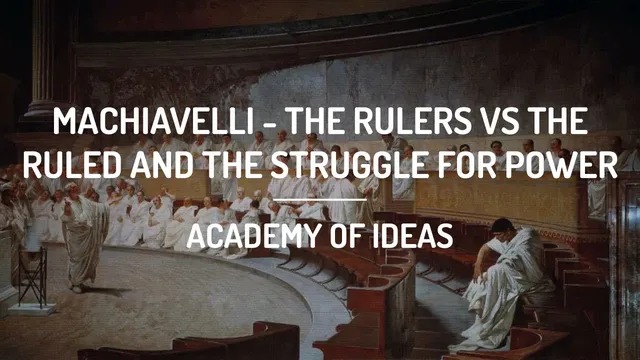
Machiavelli - The Rulers vs The Ruled and the Struggle for Power
Based on Academy of Ideas's video on YouTube. If you like this content, support the original creators by watching, liking and subscribing to their content.
Politics is portrayed as a power struggle rather than a moral project aimed at the general welfare.
Briefing
Machiavelli’s central claim is that politics is not primarily about pursuing the good society or maximizing public welfare; it is the arena where people compete—openly and covertly—for power and control over others. That shift in focus matters because it reframes political life from a moral project into a struggle with predictable incentives: rulers seek to cement and expand their power, while the rest of society is managed and constrained by that pursuit.
From that starting point, the transcript argues that people routinely confuse political reality with political ideals. Instead of treating politics as a set of abstract theories or the promises of politicians, the more accurate approach is to ask how power actually operates—how rulers behave, what tools they use, and why ordinary people tolerate their domination. Machiavelli’s answer is blunt: society is divided into two classes, rulers and the ruled, and the rulers’ primary motivation is power rather than improvement of society (even if beneficial outcomes sometimes occur as by-products).
To maintain rule, elites rely on force, fraud, deception, and the tactical redistribution of wealth they expropriate. Yet coercion alone is rarely enough to secure long-term dominance. Ruling groups also need legitimacy—myths, ideologies, religion, or political formulas that make their authority seem necessary and natural to the masses. Historically, religious justification served that role: kings sat on thrones because God willed it. When that religious framework weakened in the West, a new legitimating idea took hold: the “will of the people.” Democracy, in this telling, functions as a modern political formula that persuades citizens they are the true rulers while treating politicians as loyal servants and representatives.
The transcript then challenges the common assumption that elections eliminate power games. Voting may check some officials, but it does not remove the underlying dynamics of ambition and domination. Many positions of influence remain outside direct voting—through wealth, nepotism, or appointment—and even where elections exist, the relationship between rulers and ruled persists. The result is a persistent division: power over others tends to generate further desire for power, regardless of whether it is obtained through ballots, force, or fraud.
So what should people do with these insights? The transcript presents Machiavelli’s purpose as strategic education: understanding how elites operate can help societies avoid the traps that lead to tyranny. Freedom, it argues, does not emerge from unity preached by those in power; it tends to arise in “cracks” when ruling elites fracture internally. The most promising path is not passive hope that elites will weaken each other, but the cultivation of independent institutions of social power that counterbalance rivals and keep would-be rulers divided and competing. In that framework, liberty depends on citizens who genuinely want it and are willing to act—turning political knowledge into practical resistance rather than resignation.
Cornell Notes
Machiavelli’s view of politics centers on power, not public virtue. Politics is the realm where people compete for control over others, and rulers primarily seek to cement and expand their own authority. Elites maintain rule through force and deception, but they also require legitimacy—historical religion and, in modern times, the “will of the people” associated with democracy. Elections do not end power struggles because many forms of influence remain outside voting and power dynamics persist. Freedom is portrayed as emerging from divisions within ruling elites and from independent institutions that counterbalance competing centers of power.
Why does the transcript insist politics cannot be understood through ideals alone?
What is the defining feature of politics in Machiavelli’s framework?
How do rulers keep control over the ruled beyond coercion?
What role does religion and then democracy play in legitimizing rule?
Why doesn’t voting eliminate the ruler–ruled divide?
What is the proposed path toward freedom?
Review Questions
- How does the transcript distinguish political reality from political ideals, and why is that distinction central to Machiavelli’s approach?
- According to the framework presented, what legitimations replace religion when religious authority declines, and how does that affect citizens’ understanding of democracy?
- What mechanisms are suggested for producing freedom: internal elite division, independent institutions, or electoral checks—and how does the transcript rank their importance?
Key Points
- 1
Politics is portrayed as a power struggle rather than a moral project aimed at the general welfare.
- 2
Rulers’ primary incentive is to cement and increase their own power, even when beneficial outcomes occur incidentally.
- 3
Coercion works best when paired with legitimacy—ideologies, religion, or political formulas that make domination seem necessary.
- 4
Democracy is treated as a modern legitimating formula that can preserve the ruler–ruled structure rather than abolish it.
- 5
Elections do not eliminate power dynamics because many key positions of influence are reached through wealth, nepotism, or appointment.
- 6
Freedom is expected to grow from cracks within ruling elites and from independent institutions that create countervailing centers of power.
- 7
Passive hope that elites will divide is rejected; liberty requires active desire and action by ordinary people.