Memory Consolidation: Time Machine of the Brain
Based on Artem Kirsanov's video on YouTube. If you like this content, support the original creators by watching, liking and subscribing to their content.
Memory consolidation during sleep relies on hippocampus–cortex communication rather than passive rest.
Briefing
Sleep is doing more than restoring the body: it actively strengthens memories by running a kind of internal “time travel” inside the brain. The core mechanism centers on memory consolidation—turning newly formed experiences into stable long-term storage—and it helps explain why cramming overnight often fails while a good night’s sleep improves recall.
At the heart of this process are two structures working in tandem. The cortex acts like a warehouse or library where memories, thoughts, and language are stored. The hippocampus, buried deeper in the brain and heavily connected to the cortex, functions more like a librarian that organizes and reshapes information. During sleep, the normal daytime flow of information (cortex to hippocampus) shifts. Instead, the hippocampus becomes a primary sender, communicating with the cortex through bursts of activity.
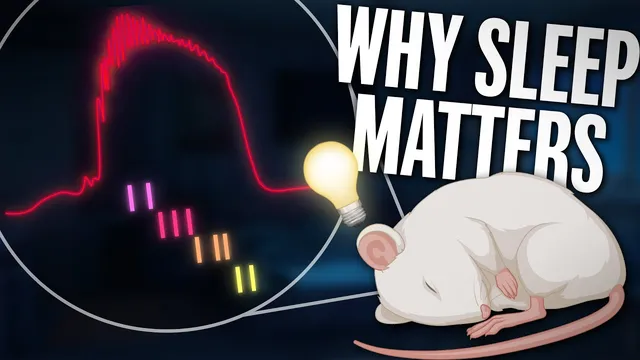
Those bursts are known as sharp wave ripples. When researchers record electrical activity from the sleeping hippocampus, they see distinct “fireworks”: overall activity rises and falls in a wave, overlaid with high-frequency oscillations. Sharp wave ripples were first suspected to support memory because they increase after animals encounter novel environments. The strongest evidence came later: when scientists artificially silence sharp wave ripples, learning slows and performance drops. That causal disruption links sharp wave ripples to the consolidation process rather than merely correlating with it.
The most revealing findings come from examining which neurons fire during these events. During the day, hippocampal place cells fire in sequences that encode an animal’s path—essentially a cognitive map of where it has been. During sleep, the same sequences reappear during sharp wave ripples, but with a crucial twist: the trajectories are replayed in reverse order and compressed into a much shorter timescale. Researchers describe this as fast reverse replay, like rewinding a mental tape.
This reverse replay appears to strengthen the synaptic connections in the cortex that represent the memory. Importantly, replay and sharp wave ripples are not limited to night. They are most frequent during slow-wave (deep) sleep, but they also show up during daytime immobility—for instance, after a mouse finds a reward in a maze and then pauses, the hippocampus replays the path to consolidate it.
Not all ripples replay the past. Some contain sequences that don’t match any prior experience; instead, they reflect the path the animal is likely to take next. In these cases, place cells fire in the forward order expected during the upcoming run. This forward replay is tied to planning and decision-making, and it differs from reverse replay in what it responds to—for example, changing reward affects reverse replay more than forward replay.
Taken together, the hippocampus behaves like a time machine with two modes: reverse replay to consolidate what happened and forward replay to simulate what might happen. While many physiological details remain unresolved, the evidence ties sharp wave ripples and replay sequences to the computational logic of how memories are stabilized—and why sleep can turn yesterday’s learning into something you can actually retrieve tomorrow.
Cornell Notes
Sleep supports memory consolidation by reactivating hippocampal activity patterns and transferring them to the cortex. The hippocampus communicates with the cortex during an “offline” brain state using sharp wave ripples—bursts of activity with characteristic wave-like and high-frequency components. During deep sleep, place-cell sequences from daytime experience reappear as fast reverse replay: the same trajectory is replayed in reverse order and on a compressed timescale, strengthening synapses that encode the memory. Sharp wave ripples also occur during daytime immobility, and not all replay is backward: forward replay can simulate near-future paths for planning. Causal experiments show that silencing sharp wave ripples slows learning, linking these events directly to consolidation.
What are sharp wave ripples, and why do they matter for memory?
How does reverse replay during sleep relate to daytime place-cell activity?
Why is the hippocampus considered a “librarian” during sleep?
Are replay events only a nighttime phenomenon?
What is forward replay, and how does it differ from reverse replay?
Review Questions
- What experimental evidence links sharp wave ripples to memory consolidation rather than mere correlation?
- Describe fast reverse replay in terms of place-cell sequence order and timescale, and explain what it is thought to do to cortical synapses.
- How do forward replay events support planning, and what key difference in sequence order distinguishes them from reverse replay?
Key Points
- 1
Memory consolidation during sleep relies on hippocampus–cortex communication rather than passive rest.
- 2
Sharp wave ripples are causal markers of consolidation: silencing them slows learning and reduces performance.
- 3
During deep sleep, hippocampal place-cell sequences from daytime are replayed as fast reverse replay—reversed order and compressed timing.
- 4
Replay strengthens synaptic connections in the cortex that encode specific experiences.
- 5
Sharp wave ripples and replay also occur during daytime immobility, such as after completing a maze run and pausing at a reward.
- 6
Not all replay is backward: forward replay simulates near-future paths in correct order and supports planning and decision-making.