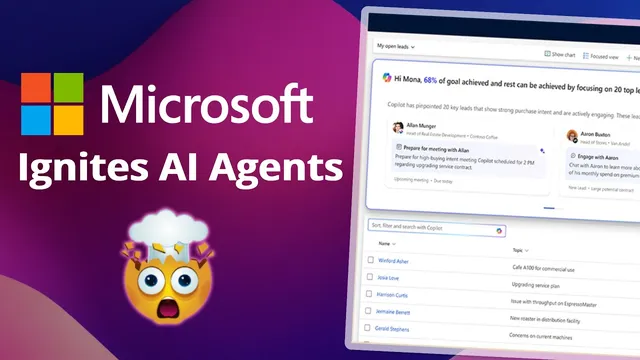
Microsoft Launches 10 NEW AI Agents
Based on Sam Witteveen's video on YouTube. If you like this content, support the original creators by watching, liking and subscribing to their content.
Microsoft is pushing autonomous agents into enterprise workflows, with a major rollout of 10 Dynamics 365 agents across sales, customer service, finance, and supply chain.
Briefing
Microsoft’s Ignite announcements push autonomous AI agents deep into enterprise software—especially Dynamics 365—by rolling out 10 new agent offerings aimed at sales, customer service, finance, and supply-chain operations. The strategic punch is less about a single “smart chatbot” and more about agents that can be triggered by business events, then take action across workflows. That shift matters because it reframes AI from a conversation tool into an operational layer that can reduce manual work, speed up decisions, and connect directly to systems enterprises already run.
A key backdrop is Microsoft’s earlier Copilot Studio updates, which emphasized integrating agents into existing workflows and moving beyond a chat-only interface. The new Dynamics 365 focus signals a hard pivot: agents should respond to triggers like orders, delays, billing cycles, customer inquiries, and case routing—not just user messages in a window. Microsoft’s enterprise integration advantage is central to the pitch. With access to cloud services and third-party connections, these agents are positioned as “plug into everything” automation rather than standalone experiments.
The 10 Dynamics 365 agents are organized around four business categories. In sales, a sales qualification agent automates lead research, prioritization, and personalized outreach drafting—targeting inbound leads rather than mass outbound spamming. A sales order agent then aims to streamline the order lifecycle, from capturing orders and confirming details to handling customer preferences and follow-ups when items are out of stock or delivery issues arise.
In supply chain, supplier communications agents manage interactions with suppliers to confirm deliveries, detect delays, mitigate disruptions, and expedite urgent shipments. The goal is to keep just-in-time operations from stalling when information is missing or timelines slip, with outputs that can be surfaced back to dashboards.
In finance, a financial reconciliation agent targets discrepancy detection in financial statements and provides actionable recommendations to reduce manual effort and improve accuracy. Account reconciliation agents extend that theme further, while time and expense agents focus on travel and expense reporting—reducing admin overhead, fraud risk, and improving timely billing.
On the customer side, a customer intent agent routes inquiries by determining whether a message is sales, marketing, or something else—solving the “who should this go to?” problem behind generic inboxes. Customer knowledge management agents update CRM knowledge articles based on customer interactions, with an implied path toward automatic transcription and CRM updates from contact-center phone systems. Case management agents handle customer service cases end-to-end, including categorization, assignment, and follow-up decisions to reduce resolution times.
Finally, scheduling operations agents aim to assign the right field resource for the job by categorizing incoming requests and matching them to the best available expertise—reducing wasted dispatches.
Taken together, the announcements highlight repeating building blocks: classification and routing, prioritization, personalization, and minimizing manual interventions. Microsoft’s approach also mirrors a broader market pattern—horizontal agent platforms versus vertical, role-specific agents—while raising the stakes for startups that have been building single-purpose agent tools. The company’s move suggests it intends to compress that startup runway by packaging many of the most common enterprise automation needs into integrated agent products.
Cornell Notes
Microsoft’s Ignite push centers on autonomous AI agents embedded in enterprise workflows, with a major rollout of 10 new agents for Dynamics 365. The emphasis is on event-driven automation—agents triggered by business events—rather than chat-only experiences. The agents span sales (qualification, order processing), supply chain (supplier communications), finance (reconciliation, time/expense), and customer operations (intent routing, knowledge management, case handling, scheduling). The practical value is reducing manual work through classification, prioritization, personalization, and system integrations that connect to cloud and third-party tools. The move also signals aggressive competition for startups building narrow agent capabilities.
What’s the strategic shift behind Microsoft’s agent announcements, and why does it matter to enterprises?
How do the sales agents aim to change day-to-day work for revenue teams?
What problem do supplier communications agents target in supply-chain operations?
Which finance agents are included, and what kinds of manual tasks do they replace?
How does the customer intent agent work conceptually, and what business bottleneck does it remove?
What’s the difference between customer knowledge management and case management agents?
Review Questions
- Which of the 10 agents rely most heavily on classification and routing, and what specific decisions do they automate?
- How does Microsoft’s emphasis on enterprise integrations change the likely deployment advantage versus standalone agent startups?
- Pick one agent from sales, supply chain, finance, and customer operations—what workflow step does it replace, and what metric would you expect to improve (speed, accuracy, cost, or resolution time)?
Key Points
- 1
Microsoft is pushing autonomous agents into enterprise workflows, with a major rollout of 10 Dynamics 365 agents across sales, customer service, finance, and supply chain.
- 2
The strategy emphasizes event-driven automation and workflow integration, not chat-only user interfaces.
- 3
Sales qualification agents automate lead research, prioritization, and personalized outreach drafting for inbound leads.
- 4
Supplier communications agents aim to prevent supply-chain disruptions by managing supplier interactions, delay detection, and expedited follow-ups.
- 5
Finance agents target reconciliation and expense workflows to reduce manual effort, improve accuracy, and support timely billing.
- 6
Customer operations agents include intent routing, CRM knowledge updates from interactions, and end-to-end case handling to reduce resolution times.
- 7
Scheduling operations agents focus on matching field resources to categorized requests to avoid wasted dispatches and improve on-site outcomes.