MPT Q1 (No Calculator) - Ontario Mathematics Proficiency Test
Based on Duddhawork's video on YouTube. If you like this content, support the original creators by watching, liking and subscribing to their content.
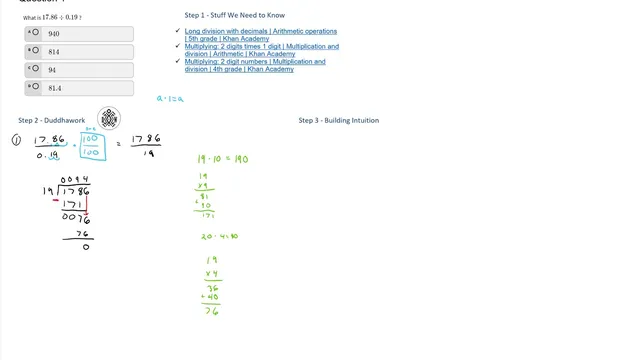
Convert decimal division into whole-number division by multiplying numerator and denominator by the same power of 10 (here, ×100).
Briefing
The core takeaway is that dividing 17.86 by 0.19 (a no-calculator Ontario Mathematics Proficiency Test question) can be solved cleanly by converting the decimals into whole numbers for long division—and then verified through an intuition-based estimate that narrows the multiple-choice options.
The method starts by removing decimal places from the divisor. Since 17.86 ÷ 0.19 is the same as 1786 ÷ 19 (multiplying numerator and denominator by 100), the problem becomes a standard long division: 1786 divided by 19. The division proceeds step-by-step: 19 doesn’t fit into 1 or 17, so zeros are placed until 19 fits into 178. From there, 19 fits 9 times into 178 (19×9 = 171), leaving 7, and bringing down the 6 to make 76. Next, 19 fits 4 times into 76 (19×4 = 76), leaving remainder 0. That means 1786 ÷ 19 = 94 exactly.
To connect back to the original decimals, the transcript shows that 17.86 ÷ 0.19 equals 1786 ÷ 19, which equals 94. The multiple-choice answer is identified as option C.
Beyond the mechanics, the solution builds intuition to reduce reliance on memorized long-division steps. The key idea is “educated guessing”: treat 0.19 as approximately 0.20. With 0.20 = 1/5, the problem becomes “how many fifths fit into 17.86?” The explanation uses a chocolate-bar analogy: dividing into five equal pieces makes each piece one-fifth. Approximating 17.86 as about 18 units, the estimate becomes 18 × 5 = 90 (because 0.19 ≈ 0.20, and dividing by 0.20 is like multiplying by 5). That estimate suggests the true answer should be near 90.
The transcript then ties the estimate to the answer choices: 94 is closer to 90 than nearby alternatives, and the rounding logic is used to argue why 94 is the most plausible option. Even if long division were forgotten, the approximation method still gives a strong path to the correct choice by eliminating options and improving odds—from 25% to 50% in the described scenario.
Overall, the solution pairs exact arithmetic (long division after scaling decimals) with a practical estimation strategy (0.19 ≈ 0.20 = 1/5) to both compute the result and understand why it lands near the expected magnitude.
Cornell Notes
Dividing 17.86 by 0.19 becomes easier by scaling both numbers to remove decimals: 17.86 ÷ 0.19 = 1786 ÷ 19. Long division of 1786 by 19 yields 94 exactly, because 19×9 = 171 leaves 7 (bringing down 6 to make 76), and 19×4 = 76 leaves remainder 0. The result matches the multiple-choice answer (C). To build intuition, the method also estimates 0.19 as 0.20, and since 0.20 = 1/5, dividing by 0.20 is like multiplying by 5. Using 17.86 ≈ 18 gives an estimate near 18×5 = 90, making 94 a reasonable choice even without full long division.
Why is 17.86 ÷ 0.19 rewritten as 1786 ÷ 19, and how does that help?
How does the long division produce 94 exactly?
What role does the subtraction step play in long division here?
How does the “educated guess” method estimate the quotient without long division?
How does the estimate help choose among multiple-choice answers?
Review Questions
- If you multiply both the dividend and divisor by the same power of 10, what stays the same about the division problem?
- In long division of 1786 by 19, what intermediate remainder leads to the next step where 19×4 is used?
- Why does approximating 0.19 as 0.20 turn the division into a multiplication by 5?
Key Points
- 1
Convert decimal division into whole-number division by multiplying numerator and denominator by the same power of 10 (here, ×100).
- 2
Use long division with careful placement of zeros when the divisor doesn’t fit into the current partial number.
- 3
After each multiplication, subtract to find the remainder that becomes the next working value after bringing down the next digit.
- 4
Verify the final quotient by checking that the last subtraction leaves remainder 0 (exact division).
- 5
Build intuition by approximating 0.19 with 0.20 and using 0.20 = 1/5 to estimate the quotient.
- 6
Use estimation to eliminate multiple-choice options even if long division steps are forgotten.