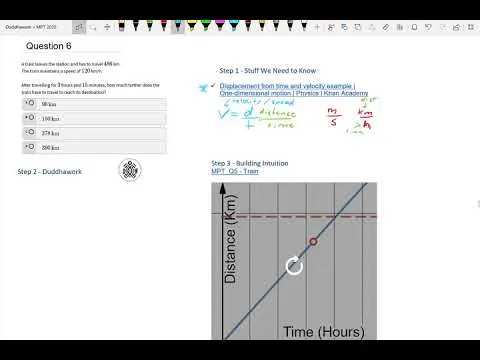
MPT Q6 - Ontario Mathematics Proficiency Test
Based on Duddhawork's video on YouTube. If you like this content, support the original creators by watching, liking and subscribing to their content.
Use d = v × t for constant speed, where distance equals speed times time.
Briefing
A train traveling at a steady 120 kilometers per hour covers a total distance of 390 kilometers after 3 hours and 15 minutes, leaving 96 kilometers still to travel to reach its destination. The key move is converting 15 minutes into a fraction of an hour, then using the distance formula d = v × t to compute how far the train has already gone.
The solution starts with the standard speed relationship: speed equals distance divided by time, so distance equals speed times time. Because the train’s speed is given in kilometers per hour, the elapsed time must also be expressed in hours. Three hours and 15 minutes becomes 3 + 15/60 hours, since 60 minutes make one hour. That fraction simplifies to 0.25, so the total time is 3.25 hours.
With t = 3.25 hours and v = 120 km/h, the distance traveled is d = 120 × 3.25. Breaking 3.25 into 3 + 0.25 makes the arithmetic straightforward: 120 × 3 = 360, and 120 × 0.25 = 30. Adding them gives 390 kilometers. A quick check confirms the same result: 120 × 3.25 equals 390.
The question then asks how much farther the train must go. The destination distance is 486 kilometers, so the remaining distance is 486 − 390. Subtracting yields 96 kilometers. The final answer matches the multiple-choice option identified as choice A.
Beyond the calculation, the approach emphasizes unit consistency and intuition-building. Since the train’s speed stays constant, the distance traveled increases linearly with time. The method suggests using a Desmos visualization to model distance versus time as a straight line with slope 120 (kilometers per hour) and an intercept of 0, then reading off the distance at t = 3.25. That graphical check aligns with the computed 390 kilometers and shows the remaining gap of 96 kilometers to the 486-kilometer destination.
In short: convert minutes to hours, multiply by 120 km/h to get the distance covered (390 km), then subtract from the total required distance (486 km) to find what’s left (96 km).
Cornell Notes
The problem uses constant-speed motion: distance equals speed times time (d = v × t). With v = 120 km/h, the time must be in hours, so 3 hours 15 minutes becomes 3 + 15/60 = 3.25 hours. Multiplying gives d = 120 × 3.25 = 390 km traveled so far. The destination is 486 km, so the remaining distance is 486 − 390 = 96 km. Building intuition is encouraged by modeling distance vs. time as a straight line with slope 120 and checking that the graph reads about 390 km at t = 3.25.
Why must 3 hours and 15 minutes be converted into hours before using d = v × t?
How is 3 hours 15 minutes rewritten as a single number of hours?
What is the fastest way to compute 120 × 3.25 without a calculator?
How is the remaining distance found once the distance traveled is known?
How does the linear distance-vs-time idea provide a sanity check?
Review Questions
- If the speed were still 120 km/h but the elapsed time were 2 hours 40 minutes, what would the time be in hours and how would you compute the distance traveled?
- Why does the unit cancellation in d = v × t depend on expressing time in the same unit as the denominator of the speed (hours for km/h)?
- Given a destination of 486 km and a computed traveled distance of 390 km, how do you set up the subtraction to find the remaining distance?
Key Points
- 1
Use d = v × t for constant speed, where distance equals speed times time.
- 2
Convert minutes to hours by dividing by 60 before multiplying by km/h.
- 3
For 3 hours 15 minutes, the time is 3 + 15/60 = 3.25 hours.
- 4
Compute distance traveled as 120 × 3.25 = 390 kilometers.
- 5
Find remaining distance by subtracting traveled distance from total destination distance: 486 − 390 = 96 km.
- 6
Check results by noting constant speed produces a linear distance-vs-time relationship.
- 7
Graphing distance vs. time (e.g., in Desmos) can confirm the arithmetic and the remaining gap.