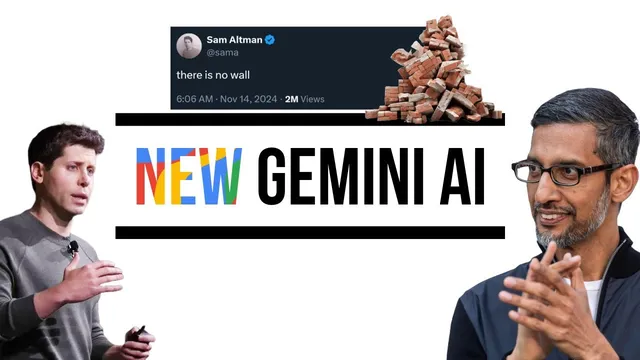
New Google Model Ranked ‘No. 1 LLM’, But There’s a Problem
Based on AI Explained's video on YouTube. If you like this content, support the original creators by watching, liking and subscribing to their content.
Gemini experimental 1114’s No. 1 human preference ranking is sensitive to style and length biases, which can be controlled and change the outcome.
Briefing
Google’s newly released Gemini experimental 1.5 (Gemini experimental 1114, dated Nov. 14) has landed at No. 1 on a human preference leaderboard—but the top ranking doesn’t settle the bigger question: whether today’s LLM progress is coming from smarter scaling or from controllable presentation factors that can mask deeper limits.
The leaderboard in question is built on blind human votes comparing two model answers over time. A key wrinkle: humans tend to prefer “flowery” language and longer responses, and those stylistic and length preferences are adjustable. When the comparison is constrained to remove style and length as variables, Gemini’s position drops to fourth place—below Claude 3.5 Sonnet for general tasks. The ranking shifts again under narrower conditions: for mathematical questions and “hard prompts,” OpenAI’s o1-preview takes the lead, while Gemini remains competitive but not dominant.
That mismatch matters because it highlights how benchmark-style wins can be sensitive to what people reward. It also exposes a communications gap. Unlike earlier Gemini launches that came with prominent benchmark scores and polished messaging, this release arrives with limited public testing access. The API reportedly had technical difficulties, preventing straightforward third-party evaluation. A workaround test using a small public “Simple Bench” sample suggests Gemini is correct on about three out of ten questions, while o1-preview and Claude perform closer to four or five out of ten. The speaker stresses this is anecdotal and that a full evaluation would require repeated runs and averaging.
Beyond the immediate ranking, the transcript ties Gemini’s uneven showing to broader industry signals: multiple reports in the last 48 hours describe diminishing returns across leading labs. Bloomberg reports OpenAI’s internally named GPT-5 (known as Orion) didn’t hit desired performance targets and may not represent the same leap GPT-4 did over earlier models. Google sources also describe disappointment with incremental gains. Meanwhile, Anthropic has reportedly reduced emphasis on Claude 3.5 Opus and released Claude 3.5 Sonnet instead.
The central takeaway is that “naive scaling” alone—more parameters, more data, more compute—may not be enough. Even Dario Amodei (via an interview referenced in the transcript) pushes back on the idea of fixed “scaling laws” as universal guarantees, calling them empirical patterns rather than laws of nature. The transcript links this to the 01-family approach: improvements increasingly rely on test-time strategies like more deliberate reasoning, “thinking time,” and related paradigms rather than only bigger training runs.
The discussion broadens into the race over what comes next: whether LLMs are plateauing on benchmarks (“eval saturation”) or whether the next gains will be less predictable and more engineering-heavy. OpenAI researchers and staff quoted here express confidence in a path to AGI—defined as replacing most economically valuable human work—while critics point to unresolved evaluation challenges like the ARC AGI benchmark. The Gemini No. 1 headline, in this telling, is less a victory lap than a snapshot of a field moving from predictable scaling to a more complicated mix of reasoning methods, evaluation limits, and product-facing behavior.
Cornell Notes
Google’s Gemini experimental 1114 hit No. 1 on a human preference leaderboard, but that result appears sensitive to what humans reward—especially longer, more “flowery” answers. When comparisons control for style and length, Gemini drops to fourth place, while o1-preview leads on math and hard prompts. Public benchmarking is limited because the Gemini API had technical issues, so the transcript relies on a small workaround test suggesting Gemini gets about 3/10 Simple Bench questions correctly versus ~4–5/10 for o1-preview and Claude. The broader implication is that LLM progress may be shifting from pure scaling to reasoning-focused paradigms (test-time compute/thinking) as labs report diminishing returns and benchmark saturation risks.
Why does Gemini’s No. 1 leaderboard position not automatically mean it’s the best model overall?
What role does the broken/limited API play in evaluating Gemini experimental 1114?
How does the transcript connect Gemini’s performance to wider industry “diminishing returns”?
What argument is made about scaling laws and why it matters?
What is the transcript’s “next phase” thesis for LLM improvement?
How does the transcript treat the AGI roadmap debate?
Review Questions
- How would controlling for response length and style change the interpretation of a human preference leaderboard?
- What evidence in the transcript is used to estimate Gemini’s performance despite the API issues, and what are the limitations of that evidence?
- Why does the transcript argue that test-time reasoning paradigms may matter more than parameter/data scaling alone?
Key Points
- 1
Gemini experimental 1114’s No. 1 human preference ranking is sensitive to style and length biases, which can be controlled and change the outcome.
- 2
When style and length are controlled for, Gemini drops to fourth place in the transcript’s description, while o1-preview leads on math and hard prompts.
- 3
Limited public access due to Gemini API technical issues shifts evaluation toward small workaround tests, which the transcript treats as anecdotal.
- 4
Multiple reports describe diminishing returns across leading labs, including OpenAI’s GPT-5 (Orion) missing internal performance targets.
- 5
Dario Amodei’s remarks frame “scaling laws” as empirical patterns rather than universal guarantees, weakening confidence in naive scaling alone.
- 6
The transcript argues that continued progress likely depends on inference-time strategies (test-time compute/thinking) exemplified by the 01 paradigm.
- 7
The AGI debate hinges on whether benchmark gains reflect real generalization, with ARC AGI cited as a key unresolved evaluation.