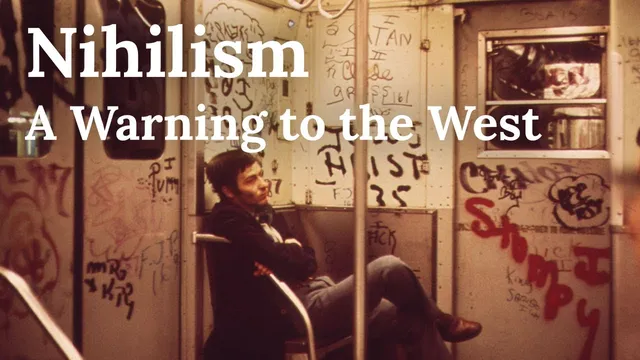
Nietzsche and Nihilism - A Warning to the West
Based on Academy of Ideas's video on YouTube. If you like this content, support the original creators by watching, liking and subscribing to their content.
Nietzsche treats modern nihilism as the downstream result of “true world” philosophies that devalue the present and promise ultimate redemption elsewhere.
Briefing
Nihilism in the modern West isn’t just a new mood—it’s the end point of a long-running “true world” tradition that trains people to distrust ordinary life. Friedrich Nietzsche warned that once Western societies exhaust the logic of their highest ideals, belief in a better realm collapses into the conviction that nothing ultimately matters. That matters because it reframes nihilism as a predictable outcome of certain moral and metaphysical habits, not merely as a personal crisis.
At the center of the argument is Nietzsche’s claim that Western worldviews have repeatedly split reality into a flawed, sensory world and a superior “true world” where redemption is finally secured. Plato’s philosophy is treated as the template: the visible world of Becoming is deceptive, while the unchanging world of Being—home of the Forms—offers truth and a route to enlightenment by turning away from the senses. Christianity then appears as “Platonism for the masses,” keeping the same basic architecture: this world is fallen and suffering follows sin, but heaven offers salvation and eternal life. In both cases, meaning comes from a journey toward an ultimate destination that makes present discomfort bearable.
Nietzsche’s sharper forecast is that the “death of God” would not end true-world thinking. Even after monotheistic belief fades, the structure survives by relocating redemption from the afterlife to this life—through human-made heavens and political projects. These post-Christian “shadows of God” include 20th-century ideologies such as fascism and socialism, described as attempts to engineer a “New Man” and build a utopia via state power. The Nazi promise of an Aryan utopia and Marx’s eschatological “end of history” are presented as secularized versions of religious arrival narratives. Carl Jung’s observation that the State takes the place of God—turning socialist dictatorships into religions—reinforces the point that political fanaticism can function like faith.
The same pattern is extended beyond politics. Environmental utopianism seeks redemption through state-managed transformation of humanity’s relationship to nature. Technocratic visions aim to use science, big data, and artificial intelligence to construct a managed paradise. Transhumanism imagines merging man with machine to transcend human limits. Spiritual movements often depict history as bending toward universal harmony. Even mainstream psychology is brought in through Michael Mahoney’s “myth of arrival,” the belief that a future turning point will end depression, anxiety, and “ill being,” delivering personal peace once life is “together.”
What unites these “true world” and “arrival” stories is pessimism about the present. Nietzsche’s critique is that the true-world concept implies this world is untruthful, inauthentic, and unfit for human needs. That rejection of earthly reality becomes a psychological crutch: people imagine another realm because they cannot endure suffering without it. When faith in the true world falters, the result is nihilism—accepting that becoming is all that exists but being unable to live with it. Nietzsche’s proposed remedy is not a new true world, but a worldview that affirms this one: a faithfulness to the earth that justifies and embraces the suffering built into life, captured in his warning to remain faithful to the earth and distrust otherworldly hopes.
Cornell Notes
Nietzsche links modern nihilism to the collapse of “true world” philosophies that devalue ordinary life. Plato’s split between deceptive Becoming and real Being becomes, in Christianity, a story of fallen earth and heavenly redemption. After God’s decline, the same structure persists in secular “shadows of God,” including political utopias, environmental and technocratic projects, transhumanist hopes, and even the psychological “myth of arrival.” These frameworks are pessimistic about the present and treat suffering as evidence that life needs an external fix. When belief in the true world breaks, people face the “repudiated world” as the only reality—leading to nihilism unless a worldview can affirm and cultivate meaning in the here and now.
What does “true world” thinking have in common across Plato, Christianity, and later secular ideologies?
Why does Nietzsche think nihilism follows from true-world philosophies rather than appearing randomly?
How do political ideologies function as “shadows of God”?
What role does psychology play in Nietzsche’s account of why people adopt true-world beliefs?
What does the “myth of arrival” add to the picture of modern nihilism?
What alternative does Nietzsche offer to nihilism, according to the transcript’s framing?
Review Questions
- How does the collapse of belief in a “true world” logically lead to nihilism in Nietzsche’s framework?
- Compare Plato’s and Christianity’s “true world” structures. What changes, and what stays the same?
- Identify at least two “shadows of God” mentioned and explain how each promises redemption while still relying on a destination-like narrative.
Key Points
- 1
Nietzsche treats modern nihilism as the downstream result of “true world” philosophies that devalue the present and promise ultimate redemption elsewhere.
- 2
Plato’s Becoming/Being split becomes a template for later Western meaning-making, including Christianity’s fallen-earth and heavenly-salvation story.
- 3
After the “death of God,” redemption narratives persist by relocating the destination into this life—often through political utopias and state-led transformation.
- 4
Secular utopian movements (political, environmental, technocratic, transhumanist, and spiritual) function like religious eschatologies by promising an arrival that ends suffering.
- 5
Nietzsche argues true-world belief is driven by psychological need: people use an imagined realm to cope with suffering they cannot otherwise endure.
- 6
When faith in the true world fails, people face the “repudiated world” as the only reality and may be unable to live with it—producing nihilism.
- 7
Nietzsche’s proposed counter is a worldview that affirms the earth and cultivates meaning in the present rather than waiting for an external salvation.