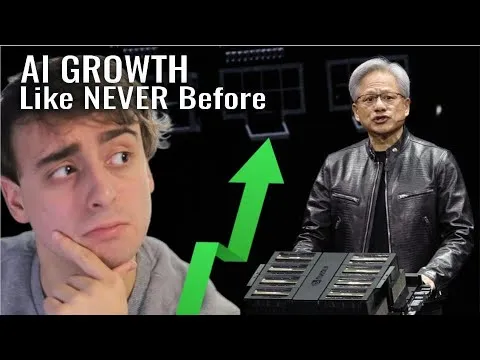
Nvidia is the Backbone for next gen A.I.
Based on MattVidPro's video on YouTube. If you like this content, support the original creators by watching, liking and subscribing to their content.
Blackwell-class GPUs are positioned as the compute backbone needed to train larger, multimodal AI models faster and at lower electricity cost.
Briefing
Nvidia’s GTC pitch boils down to a single claim: next-generation AI progress depends on ever-larger GPU “backbones,” and Blackwell-class hardware is built to make bigger, faster, and cheaper training runs possible. Jensen Huang tied the jump in compute to the next wave of model scaling—moving beyond today’s text-only systems toward multimodal models trained on text, images, and structured data—while arguing that the energy and cost profile of Blackwell will determine how quickly the industry can iterate. The payoff, in his framing, is not just better benchmarks but practical capabilities such as Sora-like video generation becoming affordable enough for broader consumer use, and enabling open-source variants that can follow.
Alongside the hardware, Nvidia pushed a software stack designed to turn raw GPU power into deployable AI services. A key element is NIM, described as a highly customizable microservice approach that packages pre-trained models with the dependencies needed to run them across multiple GPUs—explicitly including components such as CUDA, TensorRT, and LLM distribution tooling. The promise is speed to market: businesses can “plop AI in” without building and fine-tuning everything from scratch on their own data. Nvidia also leaned into Omniverse and the idea of digital twins—fully simulated product environments meant to accelerate product development before anything is built. That concept drew skepticism, especially for safety-critical domains like medical robotics, where rare real-world failures are hard to simulate. The counterpoint offered is that AI can generalize from simulation gaps, though how well that holds up in practice remains uncertain.
The broader theme across the keynote and Q&A was how quickly the industry is shifting from retrieval-based computing—streaming pre-recorded content—to generative systems that create outputs in real time. Jensen estimated that within roughly 5 to 8 years, most digital consumption could be generated on the fly, reducing the need to fetch context from servers and cutting networking and energy costs. He also addressed AGI in a way that sidesteps fear and definitions: AGI is framed as passing high-accuracy tests across major fields better than most humans, rather than a single magic threshold.
The event’s momentum extended beyond Nvidia’s core GPU story into robotics and the open-source ecosystem. Nvidia highlighted robotics simulation for humanoid robots—walking, grabbing, and other tasks—working with multiple robotics partners and even demonstrating robots on stage. Separately, the transcript shifts to open-source model releases and their tradeoffs: Grok’s open-weight release is described as extremely large (hundreds of gigabytes) and mixture-of-experts in design, making it less practical for smaller developers despite its commercial readiness. Stability AI’s Stable Video 3D is positioned as open for non-commercial use but requiring a membership for commercial use, with output quality described as decent yet not fully production-ready.
Finally, the transcript broadens to competitive pressure. OpenAI’s Sam Altman is discussed via a Lex Fridman interview, with hints of multiple releases ahead of “GPT-5” but few concrete details. Microsoft is portrayed as building an AI powerhouse with its own research and models, appointing Mustafa Suleyman to lead Microsoft AI consumer products and research. Meta is mentioned as the most consistent likely source for open releases. Taken together, the message is clear: Nvidia wants to be the infrastructure layer for AI’s next era, while the rest of the industry races to turn that compute into deployable models, real-time generation, and robotics systems.
Cornell Notes
Nvidia’s GTC keynote centers on the idea that AI’s next leap requires bigger GPU capacity, and Blackwell-class hardware is positioned as the backbone for training larger, multimodal models at lower electricity cost. Jensen Huang links compute scaling to near-term capabilities—faster training, cheaper runs, and more affordable generative applications such as Sora-like video—plus the likelihood of open-source variants. Nvidia pairs the hardware push with NIM, a microservice-style packaging approach that bundles pre-trained models with dependencies (including CUDA and TensorRT) for easier multi-GPU deployment. The keynote also argues that product development and digital experiences will increasingly rely on simulation (digital twins) and real-time generation rather than retrieval of pre-recorded content. The competitive landscape is framed as accelerating across open-source releases and major labs’ roadmaps.
Why does Nvidia frame GPU scaling as the limiting factor for “next-gen” AI?
What is NIM, and how does it change deployment for businesses?
How does the transcript connect Blackwell’s efficiency to consumer-facing generative products?
What debate surrounds Nvidia’s digital twins idea, and what counterargument is offered?
What shift is described from retrieval-based computing to generative computing?
How do open-source model releases in the transcript illustrate tradeoffs between openness and usability?
Review Questions
- What specific mechanisms does Nvidia describe for turning pre-trained models into deployable services across multiple GPUs?
- How does the transcript define AGI, and why does that definition matter for how risk is discussed?
- In what ways does the transcript suggest generative computing could reduce energy and networking costs compared with retrieval-based systems?
Key Points
- 1
Blackwell-class GPUs are positioned as the compute backbone needed to train larger, multimodal AI models faster and at lower electricity cost.
- 2
NIM is presented as a microservice packaging approach that bundles pre-trained models with dependencies (including CUDA and TensorRT) to simplify multi-GPU deployment.
- 3
Lower training costs are linked to faster iteration and the prospect of more affordable generative applications, including Sora-like capabilities.
- 4
Digital twins (digital simulation of products) are pitched as a product-development accelerant, but safety-critical domains like medical robotics raise concerns about rare real-world failures.
- 5
The transcript frames a shift from retrieval-based content streaming to real-time generation, with Jensen estimating a 5–8 year runway for most digital consumption to become generative.
- 6
Robotics is treated as a parallel frontier, with Nvidia emphasizing humanoid robot simulation and multiple partner collaborations.
- 7
Open-source model releases are portrayed as balancing openness with practicality, where model size and licensing terms can determine real-world usability.