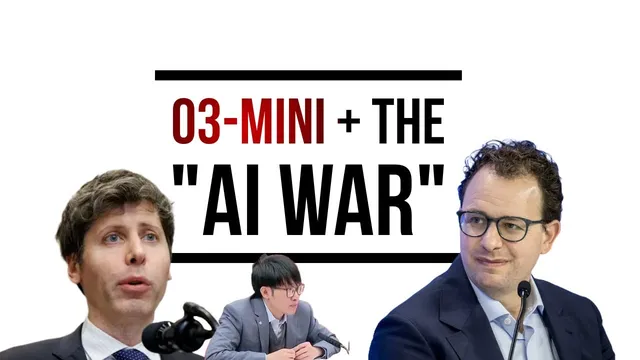
o3-mini and the “AI War”
Based on AI Explained's video on YouTube. If you like this content, support the original creators by watching, liking and subscribing to their content.
o3-mini is available to free ChatGPT users via the “reason” option, but it does not support vision or image inputs.
Briefing
o3-mini is positioned as a “cost-effective reasoning” model that can feel conversationally smarter than earlier releases, but its real-world value hinges on what tasks it’s used for—especially coding and math—while its safety posture signals a tightening grip on what the public will see next. For free ChatGPT users, selecting “reason” unlocks o3-mini, but the model can’t process images, and the pricing gap versus DeepSeek R1 is large enough that o3-mini would need to be roughly twice as capable to justify the cost for API users.
On benchmarks, o3-mini’s strongest case comes from math and tool-using performance. In Frontier Math, a notoriously difficult benchmark, o3-mini’s “high reasoning effort” results look modest at first glance, but the first-attempt success rate with Python tools jumps to over 32%—a figure that the transcript treats as a major tell about how much performance improves when the model can actually use tools. It also posts 28% on a mid-tier set of challenging problems (tier three), including a nontrivial equation-counting task where the correct answer is 3.8 trillion. Beyond math, o3-mini shows comparable science performance to 01 on a hard GPQA benchmark, and it’s described as beating DeepSeek R1 and 01 on “encoding” tasks even at medium settings.
Yet the transcript also highlights a sharp mismatch between broad intelligence and specific competence. In a simple public “agency” style scenario—where a friend might help with CPR—o3-mini is portrayed as failing most of the time, getting only 1 correct answer out of 10. DeepSeek R1 and Claude 3.5 Sonnet outperform it on those public questions, and o3-mini’s weakness extends to a new “research engineer pull request” automation benchmark: it scores 0%, while 01 reaches 12%. OpenAI attributes the poor result to instruction-following and confusion around tool formatting.
The most consequential “bad news” is policy, not performance. OpenAI’s system card commits to not publicly deploying models that score above certain risk thresholds, and o3-mini is described as the first model to reach “medium risk” on model autonomy—meaning it can take more independent actions. The transcript frames this as a warning that future frontier models may become unavailable to the public if they cross “high” risk levels, with concerns spanning hacking, persuasion, and guidance related to chemical/biological/radiological/nuclear weapons.
Finally, the transcript situates o3-mini inside an accelerating AI “arms race” narrative—complete with CEO quotes about capability spending, chip supply, and unipolar competition. It argues that this race rhetoric can create safety “perfect storm” conditions, even as capabilities progress appears to be speeding up despite earlier restraint claims. In short: o3-mini looks strong where reasoning meets tools, uneven where autonomy and instruction discipline matter, and increasingly constrained by safety gating that could reshape what users can access next.
Cornell Notes
o3-mini is a reasoning-focused model that performs best on coding and math, especially when paired with tools like Python. In Frontier Math, its first-attempt success rate with Python tools exceeds 32% on high reasoning effort, and it also posts 28% on a tier-three subset. It matches or beats earlier models on some science and encoding tasks, but it struggles on other “agency” and tool-integration benchmarks, including a pull-request automation test where it scores 0% versus 01’s 12%. The biggest implication may be policy: OpenAI’s system card commits to withholding models that exceed risk thresholds, with o3-mini reaching “medium risk” on model autonomy—suggesting future frontier releases could be gated from the public.
Why does o3-mini’s Frontier Math performance look better once tools are involved?
How do the cost numbers compare between o3-mini and DeepSeek R1 for API users?
What does the transcript suggest about o3-mini’s weaknesses in autonomy and instruction-following?
What policy change is described as the most important “bad news” for future access?
How does the transcript connect AI competition rhetoric to safety risk?
Review Questions
- Which benchmark result is cited as the strongest evidence of o3-mini’s tool-using reasoning advantage, and what tool is involved?
- What are two distinct areas where o3-mini underperforms in the transcript (one about agency/autonomy and one about research-engineer task replication)?
- How does the transcript describe OpenAI’s risk-threshold policy, and what does “medium risk on model autonomy” imply for future releases?
Key Points
- 1
o3-mini is available to free ChatGPT users via the “reason” option, but it does not support vision or image inputs.
- 2
o3-mini’s strongest performance claim is tied to tool use: in Frontier Math, Python tool prompting yields over 32% first-attempt solves on high reasoning effort.
- 3
Despite strong math and science results, o3-mini shows notable weaknesses on agency-style public questions and on a pull-request automation benchmark (0% vs 01’s 12%).
- 4
API cost comparisons favor DeepSeek R1 substantially on input pricing, making o3-mini’s “cost-effective reasoning” claim dependent on being about twice as capable.
- 5
OpenAI’s system card introduces access constraints: models that exceed risk thresholds may not be publicly deployed, with o3-mini reaching “medium risk” on model autonomy.
- 6
The transcript frames AI competition as accelerating capability progress while increasing the chance of safety failures due to race pressures and adversarial incentives.