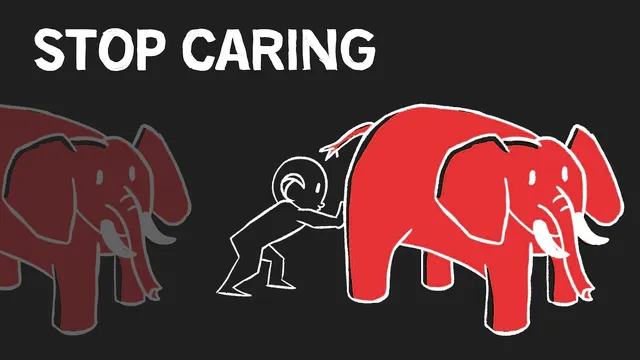
Once You Stop Caring, Results Come | The Law of Reverse Effect
Based on Einzelgänger's video on YouTube. If you like this content, support the original creators by watching, liking and subscribing to their content.
The “Law of Reverse Effect” claims that conscious, outcome-focused striving can reduce the chance of success by increasing pressure and narrowing attention.
Briefing
Success often slips away when people try hardest to force it. The core claim—framed through the “Law of Reverse Effect” (also called the law of reversed effort)—is that conscious, outcome-focused striving can undermine the very performance it aims to secure. When pressure rises, attention narrows to proving oneself, controlling thoughts, or managing future consequences; that mental grip then disrupts execution, creativity, and emotional stability.
The transcript opens with a writer’s creative slump that breaks only after she stops chasing inspiration. Searching for topics, scouring books and the internet, and panicking about “writer’s block” produces nothing—until she relaxes and lets the need to be productive drop. While walking in a forest without trying to generate ideas, an answer arrives spontaneously. The paradox is explicit: the more she tries to make results happen, the less she can produce; only when she stops caring does writing return. That pattern is tied to a quote attributed to Aldous Huxley: “The harder we try with the conscious will to do something, the less we shall succeed.”
A second illustration comes from ancient China. A merchant seeks a sage’s approval by boasting about wealth and achievements, but the sage remains unimpressed and points to Lao Tzu’s warnings about outshining others, boasting, and diminishing one’s own light through self-promotion. The merchant’s eagerness to impress becomes the sabotage: he cannot let accomplishments speak at the right moment, and his need for validation undermines the very impression he wants to create. The lesson extends beyond etiquette into psychology—boasting can signal insecurity, and insecurity can distort behavior.
The transcript then connects the law to mental health and performance under pressure. Professor David Clark’s “Mental Control Paradox” is used to argue that attempts to suppress unwanted thoughts or control emotional states often backfire. The more someone tries to stop negative thinking, the more negative thinking persists—mirroring the “pink elephant” style insight that resisting a thought can keep it active. Similar dynamics appear in creativity: forcing inspiration, outlining ideas, or “pushing and pulling” can block organic growth. Julia Cameron’s view is cited that creativity is closer to surrender than control, with mystery and surprise at its core.
Taoist stories reinforce the same mechanism in sports and skill. A nervous archer who performs perfectly in practice fails in competition when prizes and outcomes become the focus. The transcript argues that caring about results creates tension, pulls attention into the future and past, and turns a task into an emergency. Taoist “wu wei” (effortless action) is presented as a remedy: optimal performance—often described as “the zone”—emerges when striving less allows attention to stay on the present task. The result is not obsession with winning, but responsive action shaped by what’s actually happening.
Across these examples, the through-line is consistent: caring too much about outcomes builds a mental firewall of predictions and rumination that blocks responsive performance. Letting go creates space for the environment, the body, and the mind to coordinate in real time—so results arrive as a byproduct of action rather than a target of constant control.
Cornell Notes
The transcript argues that outcome-focused striving can sabotage performance through the “Law of Reverse Effect”: the harder people try with conscious will, the less they succeed. A writer regains creativity only after dropping pressure to produce, and a merchant fails to impress a sage because his need for approval distorts his behavior. Psychological research is used to support a related idea, the “Mental Control Paradox,” where attempts to suppress thoughts or control emotions often intensify them. Taoist “wu wei” and “in the zone” performance are presented as practical alternatives: attention stays on the present task, not future results, enabling more effective action and better outcomes.
What does the “Law of Reverse Effect” claim about effort and results?
Why does the writer’s creativity return only after she stops caring?
How does the merchant-sage story illustrate the same principle?
What is the “Mental Control Paradox,” and how does it relate to thought suppression?
How do Taoist ideas like wu wei connect to performance in sports and skill?
What does “results come through action” mean in this framework?
Review Questions
- How does the transcript explain the difference between productive effort and counterproductive striving?
- In what ways do thought suppression attempts intensify the very thoughts they aim to eliminate, according to the “Mental Control Paradox”?
- What changes in attention and emotion are described as happening when someone cares too much about winning (e.g., the archer story), and how does wu wei counter that?
Key Points
- 1
The “Law of Reverse Effect” claims that conscious, outcome-focused striving can reduce the chance of success by increasing pressure and narrowing attention.
- 2
Creativity is portrayed as returning when the need to produce is dropped, not when inspiration is forced.
- 3
Boasting and constant self-presentation are framed as signals of insecurity that can undermine the impression someone wants to make.
- 4
Attempts to suppress unwanted thoughts or control emotions can backfire, reinforcing the unwanted content (“what you resist persists”).
- 5
For performance, caring about results is described as creating tension and pulling attention into future and past rumination.
- 6
Taoist “wu wei” and “in the zone” performance emphasize present-moment responsiveness rather than striving for a specific outcome.
- 7
Results are presented as emerging from action and responsiveness, not from repeated mental fixation on winning or producing.