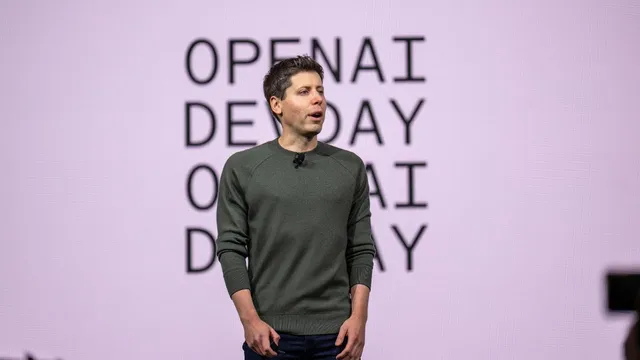
OpenAI DevDay: Opening Keynote
Based on OpenAI's video on YouTube. If you like this content, support the original creators by watching, liking and subscribing to their content.
GPT-4 Turbo raises context to 128,000 tokens and improves long-context accuracy, enabling longer documents and multi-step workflows.
Briefing
OpenAI’s DevDay keynote centers on a major shift from “chat” toward practical, agent-like AI—powered by a new GPT-4 Turbo model, new multimodal tools, and two developer platforms (GPTs and the Assistants API) designed to make complex workflows easier to build and safer to deploy.
Altman opened by recapping rapid product momentum: ChatGPT moved from a research preview to mainstream use; GPT-4 arrived as the company’s most capable model; and recent releases added voice and vision so ChatGPT can see, hear, and speak. DALL-E 3 expanded image generation, while ChatGPT Enterprise brought enterprise-grade security, privacy, higher-speed GPT-4 access, and longer context windows. Usage figures—2 million developers on the API, 92% of Fortune 500 companies using OpenAI products, and about 100 million weekly active users—were framed as evidence of real-world utility, reinforced by user stories showing confidence-building, tutoring-like explanations, accessibility benefits, and daily-life assistance.
The keynote then moved to the headline developer announcement: GPT-4 Turbo. The model’s biggest technical leap is a major context expansion to 128,000 tokens—described as roughly 300 pages—paired with improved accuracy over long inputs. Developers also get more control through JSON Mode (guaranteed valid JSON for API responses), better function calling (including the ability to call multiple functions at once), and reproducible outputs via a seed parameter. Retrieval arrives as a platform feature so apps can pull knowledge from external documents or databases, while the knowledge cutoff for GPT-4 Turbo is updated to April 2023. Multimodal capabilities are pushed into the API as well: DALL-E 3, vision-enabled GPT-4 Turbo, and a new text-to-speech model with six preset voices. OpenAI also announced Whisper V3 for speech recognition, with improved multilingual performance.
Customization and scaling follow. Fine-tuning expands from earlier GPT-3.5 work to the 16K version, and active fine-tuning users can apply for experimental GPT-4 fine-tuning access. A new “Custom Models” program offers deeper, company-specific training and RL post-training—positioned as expensive and limited at first. Rate limits for established GPT-4 customers are doubled, and developers can request further quota changes in API settings. Legal risk is addressed with “Copyright shield,” which covers certain copyright infringement claims for both ChatGPT Enterprise and the API—paired with a clear warning not to train on API or Enterprise data.
Pricing is the other major lever. GPT-4 Turbo is pitched as “considerably cheaper” than GPT-4: 3x lower cost for prompt tokens and 2x lower for completion tokens, with specific rates of 1¢ per 1,000 prompt tokens and 3¢ per 1,000 completion tokens. OpenAI also plans speed improvements and reduced costs for GPT-3.5 Turbo 16K.
Finally, the keynote reframes the developer roadmap around agent-like behavior. ChatGPT is updated to use GPT-4 Turbo with the latest knowledge cutoff and capabilities, and the model picker is removed to reduce friction. OpenAI introduces GPTs—tailored ChatGPT versions built with instructions, expanded knowledge, and actions—plus a GPT store launching later this month with revenue sharing for top builders. For developers building inside apps, the Assistants API goes to beta with persistent threads, built-in retrieval, Code Interpreter, and improved function calling. Demos showed assistants that manage state, parse uploaded documents, run code to compute travel costs, and use voice via Whisper and text-to-speech. The overall message: better tools lead to more capable automation, and OpenAI is moving toward agents through gradual, iterative deployment with safety as an ongoing constraint.
Cornell Notes
The keynote argues that OpenAI is moving from conversational AI toward agent-like systems by combining a new GPT-4 Turbo model with developer platforms that support long context, structured outputs, retrieval, and multimodal interaction. GPT-4 Turbo adds 128,000-token context, JSON Mode for valid JSON responses, improved (and more controllable) function calling, reproducible outputs via a seed, and a knowledge cutoff updated to April 2023. The API also gains retrieval, DALL-E 3, vision, text-to-speech, and Whisper V3, alongside customization options like fine-tuning and “Custom Models.” On the product side, GPTs let users build tailored ChatGPT versions with instructions, knowledge, and actions, while the Assistants API (beta) provides persistent threads, retrieval, and Code Interpreter to build assistive agents inside apps. This matters because it lowers the engineering burden for complex workflows while aiming to keep safety and control central.
What are the most important technical upgrades in GPT-4 Turbo, and why do they matter to developers building real apps?
How does OpenAI plan to improve “world knowledge” and reduce the problem of outdated training data?
What new multimodal capabilities are entering the API, and what are concrete examples of use?
What does “more control” mean beyond JSON Mode—how do reproducibility and logging fit in?
How do GPTs and the Assistants API differ, and what problem does each solve for builders?
What safety and legal guardrails were emphasized alongside these new capabilities?
Review Questions
- Which GPT-4 Turbo features directly improve integration reliability (e.g., structured outputs and determinism), and what are their specific mechanisms?
- How do retrieval and the updated knowledge cutoff work together to keep answers accurate over time?
- What capabilities does the Assistants API add that would otherwise require significant engineering (state management, retrieval, and code execution)?
Key Points
- 1
GPT-4 Turbo raises context to 128,000 tokens and improves long-context accuracy, enabling longer documents and multi-step workflows.
- 2
JSON Mode and enhanced function calling aim to make API outputs more dependable and easier to wire into applications.
- 3
Reproducible outputs via a seed parameter (beta) give developers a way to reduce variability across runs.
- 4
Retrieval is added at the platform level, and GPT-4 Turbo’s knowledge cutoff is updated to April 2023 to reduce staleness.
- 5
New API multimodality includes DALL-E 3, vision input/output, and text-to-speech with six preset voices, plus Whisper V3 for speech recognition.
- 6
OpenAI’s pricing shifts GPT-4 Turbo to 1¢ per 1,000 prompt tokens and 3¢ per 1,000 completion tokens, positioning it as 2x–3x cheaper than GPT-4 depending on token type.
- 7
GPTs and the Assistants API are positioned as the first steps toward agent-like systems, with persistent threads, retrieval, and Code Interpreter to lower the engineering burden for assistive apps.