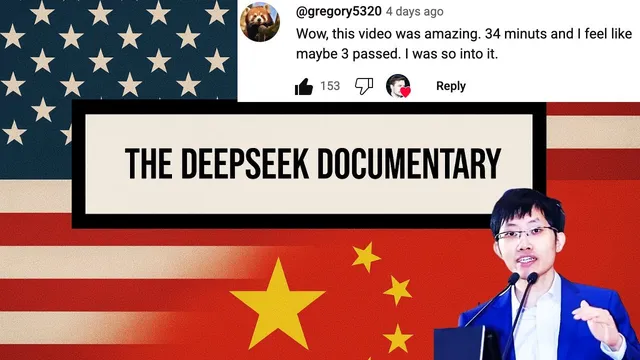
"OpenAI is Not God” - The DeepSeek Documentary on Liang Wenfeng, R1 and What's Next
Based on AI Explained's video on YouTube. If you like this content, support the original creators by watching, liking and subscribing to their content.
DeepSeek R1’s impact came from combining visible reasoning-style outputs with strong performance and unusually low cost, making the model’s “thinking” part of the public debate.
Briefing
DeepSeek R1 detonated a long-simmering AI power struggle by delivering “reasoning” that looks like it thinks before it answers—at a price and openness that made Western labs scramble to explain why their lead wasn’t as secure as markets assumed. The shock wasn’t just that a Chinese model could compete with frontier systems; it was that R1’s chain-of-thought style output, plus the availability of the model and methods, turned a technical advantage into a public spectacle. Within weeks, the debate shifted from raw capability to cost, transparency, and whether the West’s “closed” approach is becoming a liability.
That outcome traces back to Liang Wenfeng’s unusual path into AI. Before DeepSeek, Liang built a hedge fund, Highflyer, using machine learning to find patterns in micro- and nanocond movements in financial markets—an approach that helped him amass billions by his mid-30s. The earlier AI work also left scars: his trading system and fund became risk-tolerant and overextended, prompting public damage control and tighter investment limits. DeepSeek, launched as a research body in April 2023, grew out of that same drive—except now the target was general intelligence rather than market prediction.
DeepSeek’s technical momentum came from efficiency-first design rather than brute-force scaling alone. The transcript highlights a sequence of innovations: a mixture-of-experts style activation strategy where certain “experts” are always engaged to keep general capability while specializing the rest; DeepSeek Math, a smaller model matching GPT-4–level math performance; and GRPO (group relative policy optimization), a reinforcement-learning method that avoids heavy critic models by generating answer groups in parallel and reinforcing the relative winners. Later, DeepSeek V2 is described as using multi-head latent attention to reduce the number of weights needed for comparable performance. The message is consistent: DeepSeek’s breakthroughs are framed as ways to extract more intelligence per unit of compute.
Compute constraints then become part of the plot. Liang’s lab reportedly secured 10,000 Nvidia A100 GPUs for Highflyer, but U.S. export controls tightened access to advanced chips. The transcript describes a broader “smuggling” narrative—chips moving through Singapore and Malaysia—suggesting that the AI race is increasingly about logistics as much as algorithms. That pressure helps explain why DeepSeek’s efficiency matters so much: without access to the largest compute stacks, better training methods and architectural tricks become the path to parity.
R1’s virality also sparked competing narratives. Western leaders questioned whether DeepSeek’s low training cost and open methods translate into sustainable progress, pointing to DeepSeek’s large infrastructure spending and the likelihood that costs will rise as models push toward AGI-like capabilities. There’s also a security and policy backlash: OpenAI and others argued that DeepSeek could be state-influenced and that freely available models create privacy and safety risks. Meanwhile, DeepSeek’s openness is portrayed as selective—R1 is MIT-licensed, but sensitive topics can still be constrained.
Beyond DeepSeek itself, the transcript argues the larger story is automation: reasoning is being operationalized through techniques like “think out loud” reinforcement, and the next frontier may involve infinite context and even replacing the transformer architecture. The central question becomes whether DeepSeek can keep compounding its efficiency and reasoning gains fast enough to reach AGI first—and whether it will share that path openly before the world catches up.
Cornell Notes
DeepSeek R1 became a global flashpoint because it combined visible “thinking” (chain-of-thought style outputs), strong benchmark performance, and unusually low cost—while also publishing enough research to let others study and adapt the approach. The transcript traces R1’s rise to Liang Wenfeng’s shift from AI-driven finance (Highflyer) into long-term research, then to a set of efficiency-focused training and architecture innovations: mixture-of-experts activation, DeepSeek Math, and GRPO (group relative policy optimization) for reinforcement learning without heavy critic models. It also links DeepSeek’s constraints to U.S. export controls on advanced chips, making compute access and logistics part of the competitive landscape. The stakes extend beyond one model: Western labs, regulators, and investors are now debating whether open, efficient reasoning systems can scale toward AGI faster than closed, compute-heavy approaches.
Why did DeepSeek R1’s “chain-of-thought” style output matter as much as its benchmark scores?
What efficiency techniques does the transcript credit for DeepSeek’s ability to compete without frontier-scale resources?
How did DeepSeek’s earlier work in finance (Highflyer) shape its approach to AI research?
Why do export controls and chip access show up as a central driver of the AI race?
What competing narratives emerged after R1—especially around cost, openness, and security?
How does the transcript connect R1 to the next phase of AI—toward AGI?
Review Questions
- Which specific training method in the transcript is used to replace memory-heavy critics, and how does it decide which model outputs to reinforce?
- How does the transcript explain why DeepSeek’s mixture-of-experts design avoids the usual downside of needing all experts to contribute to every response?
- What are the transcript’s main reasons Western labs and lawmakers raised concerns about DeepSeek R1 after its release?
Key Points
- 1
DeepSeek R1’s impact came from combining visible reasoning-style outputs with strong performance and unusually low cost, making the model’s “thinking” part of the public debate.
- 2
Liang Wenfeng’s path runs from AI-driven finance (Highflyer) into long-term AI research, with DeepSeek framed as an efficiency-first attempt to reach general intelligence.
- 3
DeepSeek’s technical approach emphasizes extracting more capability per compute unit through mixture-of-experts activation, GRPO reinforcement learning, and multi-head latent attention.
- 4
U.S. export controls on advanced chips are portrayed as a major constraint that shifts competition toward logistics and training efficiency rather than pure scaling.
- 5
After R1’s release, arguments split between cost/trajectory skepticism from Western labs and security/policy concerns about open availability and potential state influence.
- 6
The transcript places DeepSeek’s next milestones in reasoning optimization, infinite context, and possible architectural changes beyond transformers.
- 7
The broader takeaway is that reasoning is increasingly being automated and optimized, raising the stakes for who can scale these methods fastest toward AGI.