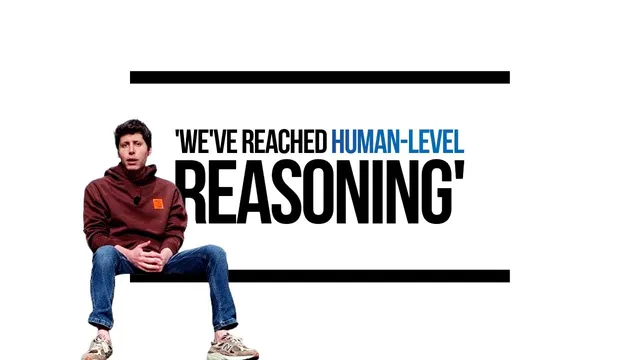
OpenAI: ‘We Just Reached Human-level Reasoning’.
Based on AI Explained's video on YouTube. If you like this content, support the original creators by watching, liking and subscribing to their content.
OpenAI’s “levels” ladder is meant to replace the overloaded AGI term, with 01 positioned as a level-two reasoner rather than an all-purpose AGI.
Briefing
OpenAI’s DevDay claim that its new 01 model family reaches “human-level problem solving” is being treated as a potential milestone—yet the real debate is less about whether 01 can reason, and more about what counts as “human-level” and how quickly the gap to more autonomous systems will close.
At the center of the discussion is Sam Altman’s “levels” framework, introduced partly to sidestep the overloaded term AGI. In that scheme, chatbots sit at level one, reasoners at level two, agents at level three, innovators at level four, and organizations at level five. Altman’s headline assertion is that 01 clearly lands at level two: it doesn’t just produce the first plausible output, but works through difficult tasks. He also argues that the next steps are likely to arrive fast—forecasting steep progress over the next two years and claiming that by this time next year the improvement from 01 to the next model could be as large as the jump from GPT-4 Turbo to 01.
Support for the reasoning claim comes from multiple outside assessments, though much of it is anecdotal. Researchers in quantum physics, molecular biology, and mathematics are cited as seeing more coherent, plateau-breaking responses from 01. One mathematics professor describes a proof generated with GPT-1 mini after “43 seconds of thought” as both correct and more elegant than a human proof, presented as evidence that the boundary of what language models can do is shifting.
Still, benchmarks complicate the “human-level” label. A new benchmark called SCoRe (described as scoring 7.7% for 01 preview) is used to argue that 01 is not yet performing at the top end of research-grade reasoning. The benchmark is framed as unusually demanding: models must generate code that solves scientific subproblems tied to methods used in Nobel Prize–winning work, then correctly compose solutions across 338 subproblems to answer the main questions. The takeaway is that 01’s strengths may be real, but they don’t yet map cleanly onto the hardest “research problem” standard.
The transcript then pivots to a sharper challenge: is it easier to find a reasoning test that 01 passes while an educated adult fails, or the reverse? The analysis suggests the former may be easier than the latter—implying that “human-level” could be overstated if it’s measured against narrow tasks rather than broad competence.
Beyond capability, the discussion links reasoning to autonomy and incentives. Financial Times reporting is cited about a push toward agentic systems that interact with the world like humans do, with 2025 framed as a mainstream inflection point—though trust issues remain, especially without near-perfect accuracy for high-stakes actions like payments. The transcript also raises governance and business pressure: OpenAI’s charter language around defining AGI as a highly autonomous system that outperforms humans at most economically valuable work could create incentives to delay that designation. That matters because the charter’s AGI threshold affects licensing and commercial terms with Microsoft.
Finally, the transcript broadens the lens to tools and timelines. It highlights Google’s NotebookLM (powered by Gemini 1.5 Pro) for turning PDFs, audio, and YouTube URLs into podcast-style summaries, and it ends with a DevDay quote about AI systems potentially automating parts of OpenAI research—an idea tied to preparedness frameworks that emphasize risk levels and autonomous research as a critical threshold. The overall message: 01 may represent a genuine reasoning step forward, but the magnitude, measurement, and downstream consequences—especially for agents—are still contested.
Cornell Notes
OpenAI’s DevDay messaging places its 01 model family at “level two” in a new capability ladder: it’s framed as a reasoner that works through problems rather than outputting the first plausible response. Altman links that to rapid improvement, predicting steep progress over the next two years and a potentially large jump by this time next year. Outside reactions from researchers in physics, biology, and mathematics are cited as signs that 01 is breaking prior limits in coherence and problem-solving. Benchmarks like SCoRe complicate the “human-level” label by showing 01 preview still struggles on research-style tasks requiring code generation and composition across many subproblems. The practical question becomes what “human-level reasoning” means and how quickly reasoning turns into reliable, agentic action.
What is OpenAI’s “levels” framework, and where does 01 fit?
Why do critics focus on benchmarks like SCoRe instead of broad “human-level” claims?
What kinds of external reactions are cited as evidence of improved reasoning?
How does the discussion connect reasoning to agents and mainstream adoption?
What governance and incentive issues are raised around the AGI definition?
Review Questions
- How does the levels framework change the way “AGI” is discussed, and why does that matter for interpreting claims about 01?
- What makes SCoRe different from typical benchmarks, and how does that affect conclusions about “human-level” reasoning?
- What technical and governance bottlenecks must be solved for reasoning capabilities to translate into trustworthy agentic systems?
Key Points
- 1
OpenAI’s “levels” ladder is meant to replace the overloaded AGI term, with 01 positioned as a level-two reasoner rather than an all-purpose AGI.
- 2
Altman’s core claim is that 01 reasons through difficult problems instead of producing the first plausible output, and he predicts rapid improvement over the next two years.
- 3
External reactions from researchers in physics, biology, and mathematics are used as supporting evidence, but they are largely anecdotal rather than benchmark-based.
- 4
Benchmarks like SCoRe highlight that 01 preview still struggles on research-style tasks requiring code generation and correct composition across hundreds of subproblems.
- 5
The transcript raises a measurement challenge: it may be easier to find tasks where 01 succeeds and humans fail than the reverse, complicating “human-level” interpretations.
- 6
Agentic systems (level three) are framed as the next mainstream step, but reliability—especially self-correction—is presented as the gating factor for real-world trust.
- 7
OpenAI’s charter-based AGI threshold is portrayed as potentially shaping incentives, since it affects when certain commercial terms with Microsoft apply.