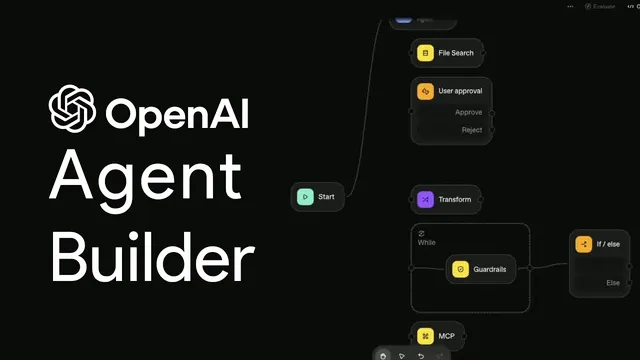
OpenAI's Agent Builder
Based on Sam Witteveen's video on YouTube. If you like this content, support the original creators by watching, liking and subscribing to their content.
Agent Builder uses a workflow of guardrails → structured classification → conditional routing to specialized nodes or agents.
Briefing
OpenAI’s Agent Builder turns agent design into a node-and-guardrail workflow: prompts, classification, conditional routing, and tool use are assembled visually, then deployed as a working agent. The practical payoff is speed—templates and drag-and-drop nodes let builders go from idea to an agent that can decide what to do next—while the key tradeoff is flexibility, since many capabilities are tied to OpenAI’s Agent Kit components.
Agent Builder’s templates show how multi-step agents are structured. Workflows resemble visual automation tools (think drag-and-drop nodes with configurable settings), but the logic is explicitly agentic: a guardrails stage can block unsafe requests, followed by a classification step that outputs structured JSON (for example, an enum like Q&A vs fact finding). Conditional edges then route the request to different downstream nodes. Tool-enabled nodes add control over outputs and enable retrieval or external actions, such as web search or code execution.
A second template example uses a prompt rewriter to make user questions more specific to a knowledge base, then classifies the rewritten query into categories like Q&A or fact finding. That classification is returned as JSON, including an “operating procedure” field, which drives an if/else split. Depending on the result, the workflow either answers from an internal Q&A path, performs fact-finding with tools, or asks for more details when the request doesn’t fit the expected buckets.
To build something hands-on, the workflow creator starts with a guardrails node and adds a query classifier that must return structured output. In the walkthrough, a “Westworld” theme park travel agent is built using a jailbreak guardrail (with a confidence threshold and model settings) and a classifier that labels user intent as Westworld, other, or non-travel. The conditional routing then selects one of three specialized agents:
- For Westworld queries, the agent uses a “file search” tool configured as a vector store built from a “Westworld travel” markdown guide. A system prompt instructs it to answer using only that information, avoid false details, and sell the experience convincingly. - For “other” travel topics (e.g., Shogun World or other Delos parks), the agent politely declines and directs users to other representatives. - For non-travel requests, it similarly refuses and points users to Delos customer support.
Testing shows the classifier correctly routes a request like “create me a sample itinerary… with pricing” to the Westworld agent, which retrieves pricing and itinerary details from the uploaded document. When the user asks about Disneyland, the workflow routes to the rejection path and returns a refusal consistent with the agent’s scope.
Once validated, the agent can be published and deployed either through a chat interface option or by exporting code via an Agents SDK. The builder highlights a likely ecosystem impact: Agent Builder lowers the barrier to creating agents, potentially pressuring automation platforms like n8n. The main concern is lock-in—an open, framework-agnostic version that exports to multiple agent systems (e.g., LangGraph or Pydantic AI) would broaden adoption. The workflow also supports wiring in external systems via MCPs, hinting at more extensibility beyond file search and built-in guardrails.
Cornell Notes
Agent Builder organizes AI agents as visual workflows: guardrails first, then structured classification, then conditional routing to specialized sub-agents. Templates demonstrate patterns like rewriting prompts, returning JSON enums (e.g., Q&A vs fact finding), and using tools such as web search or code execution depending on the classification. In the hands-on build, a Westworld travel agent uses a jailbreak guardrail and a classifier that labels requests as Westworld, other, or non-travel. If the request is Westworld, a file-search vector store built from a Westworld markdown guide powers grounded answers with pricing and itinerary details; if it’s Disneyland or another non-scope topic, the agent declines and redirects users. This matters because it shows how to combine safety, routing logic, and retrieval into a deployable agent quickly—while raising questions about framework lock-in.
How does Agent Builder decide which part of an agent should run next?
What role do guardrails play in the workflow?
Why does the Westworld agent rely on a vector store built from a markdown guide?
How does the classifier improve reliability for out-of-scope requests?
What tools and integrations can be wired into Agent Builder workflows?
Review Questions
- How does structured JSON output (enums) enable conditional routing in Agent Builder workflows?
- What combination of components (guardrails, classifier, vector store, specialized agents) is used to keep the Westworld travel agent from answering Disneyland questions?
- What tradeoffs does the walkthrough suggest when exporting or deploying agents via the Agents SDK compared with using other agent frameworks?
Key Points
- 1
Agent Builder uses a workflow of guardrails → structured classification → conditional routing to specialized nodes or agents.
- 2
Classification outputs are returned as JSON with enum fields, making routing deterministic and easier to control.
- 3
Guardrails can block jailbreak attempts early, preventing downstream tool use and reducing unsafe behavior.
- 4
File search can be configured as a vector store from uploaded documents, enabling grounded answers that match a specific knowledge base.
- 5
A practical pattern is to create separate sub-agents for in-scope vs out-of-scope topics and route requests based on the classifier’s enum.
- 6
Agents can be published and deployed via a chat interface option or exported through an Agents SDK for code-based integration.
- 7
The main downside raised is potential lock-in to OpenAI’s Agent Kit and SDK rather than framework-agnostic portability.