Ordinary Differential Equations 16 | Periodic Solutions and Fixed Points
Based on The Bright Side of Mathematics's video on YouTube. If you like this content, support the original creators by watching, liking and subscribing to their content.
Fixed points are exactly the states where the vector field vanishes (V(X)=0), so the solution remains constant for all time.
Briefing
A dynamical system’s “special” long-term behaviors—fixed points and periodic solutions—show up directly in the phase portrait, and for a pendulum-like example they can be found systematically using a conserved quantity. Fixed points occur at states where the vector field vanishes, letting a trajectory remain constant for all time. Periodic solutions repeat after some time period, producing closed orbits that the phase portrait records as loops.
For a general first-order system of ordinary differential equations written as Ẋ = V(X), the phase portrait is built from the orbits of solutions: each orbit is the set of points in the state space D that the solution visits, without showing the time parameter. Under the usual assumption that V is locally Lipschitz, the initial value problem has a unique maximal solution for any starting point X0 at time 0. Because trajectories cannot cross in such systems, the solution’s orbit is either injective (the trajectory never revisits a state), or it is a fixed point, or it is periodic. Injective solutions are the “generic” case and may fail to exist for all time; only the fixed-point and periodic behaviors force global solutions defined for every real time.
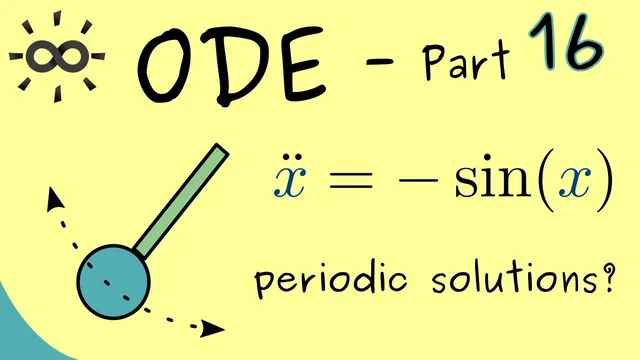
The transcript then turns to a concrete mechanics model: a pendulum described by the second-order equation x¨ = −sin(x). Converting it to a first-order system by setting X1 = x and X2 = ẋ yields Ẋ1 = X2 and Ẋ2 = −sin(X1), so the vector field in R^2 becomes V(X1, X2) = (X2, −sin(X1)). To find orbits without solving the differential equation explicitly, a “contour-line” trick is introduced: look for a function F(X1, X2) that stays constant along solutions. If F(α(t)) is constant for every time t, then d/dt F(α(t)) = 0. Using the chain rule and the fact that α̇(t) = V(α(t)), this reduces to requiring that the gradient of F is perpendicular to the vector field V everywhere along trajectories—equivalently, ∇F · V = 0.
A suitable choice is given by F(X1, X2) = 1/2·X2^2 + cos(X1) (up to an additive constant/sign convention consistent with the perpendicularity condition). With this conserved quantity, the phase portrait becomes the set of level curves (contour lines) of F: each orbit lies on one contour. Fixed points occur where the vector field is zero, which here means X2 = 0 and sin(X1) = 0, so X1 = kπ for integers k. The contour picture then distinguishes behaviors: closed periodic orbits correspond to the pendulum swinging around a stable equilibrium (the “normal” motion), while fixed points near the top of the potential correspond to the pendulum balanced upside down—still solutions, but highly unstable. Finally, injective solutions correspond to trajectories with energy high enough that the pendulum effectively keeps moving in one direction without settling into the closed swing-around pattern.
The key takeaway is that fixed points and periodic solutions are not just abstract definitions: in the pendulum system they emerge as specific level sets and equilibrium states of a conserved function, setting up the next step—analyzing stability via linearization near fixed points.
Cornell Notes
For systems of ODEs written as Ẋ = V(X), the phase portrait is made of orbits: the set of state-space points visited by solutions. With V locally Lipschitz, each initial value problem has a unique maximal solution, and trajectories cannot cross; an orbit is therefore either injective (no revisits), a fixed point (V(X)=0 so the solution stays constant for all time), or periodic (the state repeats after some period, giving a closed orbit). In the pendulum example x¨ = −sin(x), converting to first order gives Ẋ1 = X2 and Ẋ2 = −sin(X1). A conserved quantity F(X1, X2) can be chosen so that F stays constant along solutions, making orbits coincide with contour lines of F. Fixed points then appear where ∇F (and equivalently V) vanishes: X2 = 0 and X1 = kπ, revealing both stable swinging motion and unstable upside-down equilibria.
Why does a fixed point correspond to a global solution, and how is it identified from the vector field?
What does “injective orbit” mean here, and why do periodic solutions and fixed points break injectivity?
How does the contour-line trick work to find orbits without solving the ODE directly?
For the pendulum system Ẋ1 = X2 and Ẋ2 = −sin(X1), what are the fixed points and how are they found?
How do periodic solutions relate to the pendulum’s physical behavior in the contour picture?
Review Questions
- In a locally Lipschitz system Ẋ = V(X), what three types of orbits can occur for a maximal solution, and what property of the orbit distinguishes each type?
- How does the condition ∇F · V = 0 guarantee that F(α(t)) remains constant along solutions α(t)?
- For the pendulum x¨ = −sin(x), why do fixed points occur at x = kπ with ẋ = 0?
Key Points
- 1
Fixed points are exactly the states where the vector field vanishes (V(X)=0), so the solution remains constant for all time.
- 2
Periodic solutions produce closed orbits because the state repeats after some period T: α(t+T)=α(t) for all t.
- 3
With V locally Lipschitz, uniqueness and non-crossing imply an orbit is either injective, a fixed point, or periodic.
- 4
In the pendulum example x¨ = −sin(x), converting to first order yields Ẋ1 = X2 and Ẋ2 = −sin(X1).
- 5
A conserved quantity F can be constructed so that ∇F · V = 0, making orbits coincide with contour lines of F.
- 6
Fixed points for the pendulum satisfy X2=0 and X1=kπ, giving equilibria at multiples of π.
- 7
Stability differs between equilibria: stable fixed points correspond to nearby closed periodic motion, while the upside-down equilibrium is unstable despite being a valid fixed point.