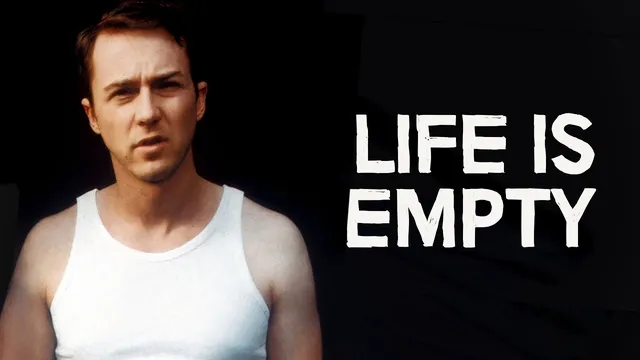
Our Great Depression is Our Lives | The Philosophy of Fight Club
Based on Einzelgänger's video on YouTube. If you like this content, support the original creators by watching, liking and subscribing to their content.
The transcript frames consumer culture as an existential “Great Depression,” producing nihilism disguised as lifestyle and consumption.
Briefing
Fight Club’s core punchline is that modern consumer life functions like a personal Great Depression: it drains meaning, replaces purpose with shopping and status, and leaves people trapped in “nihilists with credit cards.” The Narrator—an exhausted corporate drone obsessed with designer furniture and catalog fantasies—doesn’t lack money so much as direction. Tyler Durden’s entry reframes that emptiness as a cultural fraud: society sells the dream of becoming rich, famous, and self-defining, while most people end up obediently grinding through jobs they hate to buy things they don’t need.
The argument then widens beyond the novel’s plot to describe a broader shift in Western life. Earlier mass struggles—world wars, the Holocaust’s aftermath, even the Crusades—created shared missions that made suffering feel purposeful. Viktor Frankl’s survival is used as a model for how meaning can be found even in extreme conditions, while the Crusades illustrate how collective religious goals can turn life into a quest with a prize. Against that backdrop, consumer culture looks like a counterfeit mission: happiness becomes “consumerist happiness,” generated by purchases and amplified by celebrity feeds, endless channels, and self-optimization trends.
Tyler’s critique targets not just individual shopping habits but the corporate feudal order that now shapes everyday desire. The transcript contrasts the old symbols of power—governments, space programs—with today’s corporate giants like Starbucks, IBM, KFC, and newer tech-and-commerce empires such as Facebook, Tesla, and Amazon. In this system, “rich” becomes the new holiness, while public attention shifts toward influencer fame, curated bodies, and viral spectacle. The result is a generation primed for narcissism and complacency, reinforced by survey claims that large numbers of young adults prioritize fame and wealth.
Philosophically, Tyler Durden’s worldview is tied to Friedrich Nietzsche’s “Last Man.” The Last Man seeks comfort and security, avoids risk, and settles into spiritual tiredness—filled with short-term distractions and minor upgrades rather than any Great War or transformative purpose. The Narrator is presented as a near-perfect example: routine, consumption, and apathy disguised as normal life. Nietzsche’s counter-image, the Übermensch, is offered as the cure: someone who breaks from imposed values, creates meaning independently, and affirms life through creativity and self-authorship.
Fight Club’s rebellion is portrayed as a radical attempt to escape the consumerist “Matrix,” even when it becomes violent. Tyler’s nonconformity—rejecting polite small talk, dismissing luxury, living in a “dump,” mocking advertising—signals a rejection of the herd. The movement escalates into Project Mayhem, described as a sabotage campaign aimed at wiping out debt and resetting society with a “clean slate.” The transcript frames this as a Nietzschean insistence that freedom often requires losing everything first.
A final example centers on Raymond K. Hessel, a convenience store worker coerced into pursuing a long-lost dream of becoming a veterinarian. The transcript treats this as a grim but purposeful “paradigm shift”: when choice feels impossible, action becomes suddenly available. The closing idea is Nietzsche’s line that having a “why” makes almost any “how” bearable—meaning, not comfort, is what keeps people alive.
Cornell Notes
Fight Club is presented as a philosophy of escape from a “Great Depression” of everyday life—an emptiness produced by consumer culture. The Narrator’s insomnia and obsession with designer goods symbolize a society that sells meaning as consumption, while most people remain trapped in low-purpose work and status-chasing. Tyler Durden’s rebellion is linked to Nietzsche’s “Last Man” (comfort-seeking, risk-avoiding nihilism) and the “Übermensch” (self-created values and life-affirming action). The transcript argues that breaking the cycle may require radical self-transformation, including rejecting authority and even old moral comfort. It ends with the idea that a compelling “why” can make hardship bearable and unlock action when people feel they have no choice.
How does the transcript redefine “Great Depression” in personal terms?
Why are historical struggles like World War II, the Holocaust, and the Crusades used as comparison points?
What does “Ikea nesting instinct” signify in the Narrator’s behavior?
How do Nietzsche’s “Last Man” and “Übermensch” map onto Fight Club’s characters and message?
What role does rebellion play, and why does the transcript tolerate its darker turn?
How is Raymond K. Hessel’s story used to argue for “paradigm shift” as a cure?
Review Questions
- What specific behaviors in the Narrator’s life are used to symbolize consumerist nihilism, and how does Tyler reinterpret them?
- How does the transcript use Nietzsche’s “Last Man” to explain why comfort and routine can still produce spiritual emptiness?
- What does the Raymond K. Hessel example suggest about the relationship between meaning, choice, and risk?
Key Points
- 1
The transcript frames consumer culture as an existential “Great Depression,” producing nihilism disguised as lifestyle and consumption.
- 2
The Narrator’s catalog-driven identity quest is treated as evidence that society sells meaning through purchases while delivering obedience and misery.
- 3
Historical examples like Viktor Frankl’s survival and the Crusades are used to show how shared missions can make suffering purposeful.
- 4
Tyler Durden’s critique is linked to Nietzsche’s “Last Man” (comfort-seeking complacency) and the “Übermensch” (self-created values and life-affirming action).
- 5
Escaping consumerism requires rejecting authority, refusing herd conformity, and undergoing radical self-transformation—sometimes through extreme measures.
- 6
The transcript argues that a sudden “paradigm shift” can unlock action when people feel trapped, illustrated by Raymond K. Hessel’s coerced return to a lost dream.