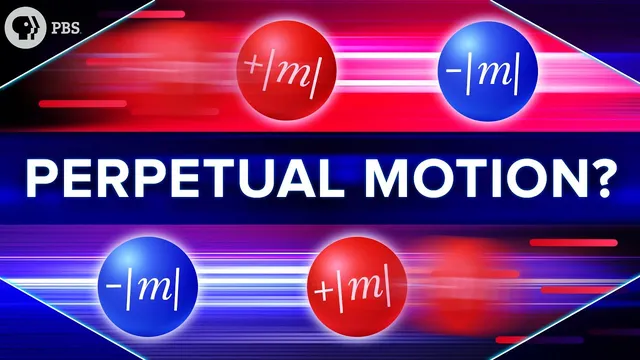
Perpetual Motion From Negative Mass?
Based on PBS Space Time's video on YouTube. If you like this content, support the original creators by watching, liking and subscribing to their content.
Negative mass becomes most problematic when it’s treated as having negative inertial mass, because that flips the sign of acceleration under applied forces.
Briefing
Negative mass keeps showing up in science fiction and some serious cosmology ideas, but the real sticking point isn’t whether spacetime can curve the “wrong” way—it’s whether mass can behave consistently when it resists acceleration and exchanges energy. The central takeaway is that the most pathological predictions (infinite acceleration, unbounded positive/negative energies, and unstable vacuum behavior) arise when negative mass is treated as having a negative inertial mass, not merely a negative gravitational effect.
In Newtonian physics, mass plays two roles: inertial mass resists acceleration (through F = ma) and gravitational mass both generates and responds to gravity. When inertial mass and passive gravitational mass match, objects fall with the same acceleration regardless of their composition—an equivalence Galileo highlighted and general relativity later elevated into the equivalence principle. That principle says there’s no experiment that distinguishes weight from acceleration in empty space, forcing passive gravitational mass and inertial mass to be identical.
With that Newtonian framework, negative mass leads to a seemingly simple rule set: like signs attract and opposite signs repel in gravity, mirroring how quantum field theory flips behavior depending on field “spin.” But the moment inertial mass is allowed to be negative, Newton’s second law effectively flips the response to applied forces. The result is the notorious runaway scenario: two negative masses can accelerate in a way that drives them apart, while a positive mass can both attract and be repelled by a negative mass at the same time. In the idealized two-body case, a positive and a negative mass placed together chase each other across space with ever-growing speeds.
At first glance, that looks like a direct violation of conservation laws. The resolution offered in the Newtonian picture is that the positive mass gains positive momentum and energy while the negative mass carries negative momentum and negative energy—so total momentum and energy can remain “conserved.” The problem is that the energies are unbounded: they can run to plus and minus infinity. General relativity also imposes energy conditions meant to prevent such bottomless negative-energy wells, and the prospect of infinite negative energy threatens the stability of the vacuum itself.
General relativity changes the story’s mechanics but not the core tension. In GR, free-fall motion follows geodesics determined by spacetime geometry, and the equations don’t explicitly include inertial or passive gravitational mass. A rubber-sheet analogy suggests positive active gravitational mass curves spacetime so trajectories bend toward it, while negative active gravitational mass curves it the other way so trajectories bend away. Yet the runaway energy pathology still traces back to assumptions about how negative inertial mass would work—especially the idea that applying forces to exotic matter flips the sign of acceleration and also flips kinetic and potential energy. That combination is described as incoherent and potentially incompatible with both quantum field theory and general relativity.
The episode ends without a definitive verdict: some researchers argue negative mass is impossible, others argue it can exist but with different sign-behavior rules. Either way, the physics remains unresolved—so the challenge is framed as a thought experiment. If positive mass both attracts and is repelled by negative mass, the task is to design a perpetual motion machine that extracts continuous power from a pair of infinitely accelerating positive/negative masses, with an extra-credit question about maximum power under extreme density assumptions (neutron-star-like).
Cornell Notes
Negative mass is often treated as a way to curve spacetime in unusual directions, but the most dangerous consequences show up when negative mass is assumed to have negative inertial mass. In Newtonian terms, that flips how objects respond to applied forces, producing runaway behavior: a positive mass and a negative mass can accelerate forever while exchanging energy with no bound. The Newtonian “fix” keeps conservation laws formally intact by assigning negative energy to the negative-mass object—but the energies become unbounded, which clashes with general relativity’s energy conditions and threatens vacuum stability. General relativity’s geodesic picture can reproduce attraction/repulsion patterns from spacetime curvature, yet the core pathology still points back to the assumptions about inertial behavior and energy sign. The episode concludes that the status of negative mass is unresolved, with competing sign conventions and no consensus.
Why does Newtonian gravity predict attraction for like-signed masses and repulsion for opposite-signed masses?
What goes wrong in the Newtonian runaway scenario involving positive and negative masses?
How does general relativity’s equivalence principle constrain the relationship between inertial and gravitational mass?
Why does the rubber-sheet analogy suggest negative gravitational mass repels everything?
What does the episode identify as the likely source of “nonsense” in negative-mass physics?
Review Questions
- In Newtonian mechanics, how do inertial mass and passive gravitational mass need to relate for the equivalence principle to hold?
- Explain how conservation of momentum/energy can remain formally true in the positive/negative mass runaway case while still producing an unacceptable physical outcome.
- What specific assumption about negative mass does the episode single out as most likely responsible for conflicts with general relativity and quantum field theory?
Key Points
- 1
Negative mass becomes most problematic when it’s treated as having negative inertial mass, because that flips the sign of acceleration under applied forces.
- 2
Newtonian gravity predicts like-signed masses attract and opposite-signed masses repel, but adding negative inertial mass produces runaway acceleration.
- 3
The runaway scenario can preserve formal conservation laws by assigning negative momentum/energy to the negative-mass object, yet it leads to unbounded energies (plus and minus infinity).
- 4
General relativity’s equivalence principle ties inertial mass to passive gravitational mass, so any consistent theory must respect that link.
- 5
General relativity’s geodesic motion can reproduce attraction/repulsion from spacetime curvature, but the energy-pathology still points back to assumptions about inertial behavior and energy sign.
- 6
Infinite negative-energy wells violate general relativity’s energy conditions and threaten vacuum stability.
- 7
The field lacks consensus: some argue negative mass is impossible, while others allow it with different sign-behavior rules, leaving the physics unresolved.